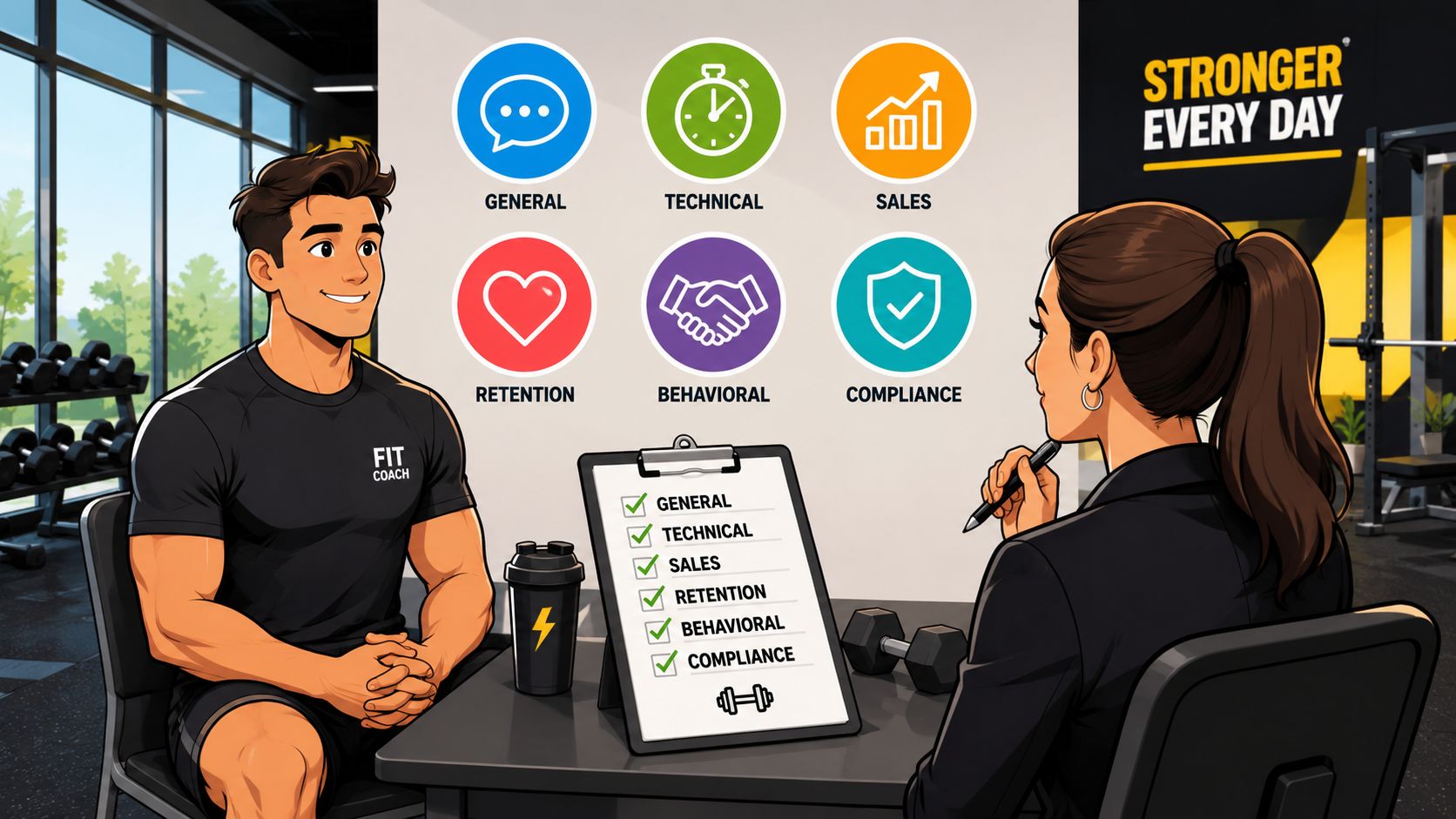
Hire a coach, not just a rep counter. The right hire changes how members feel when they walk in, how long they stay, and how often they tell friends your place is different. The wrong hire creates tension on the floor, confuses programming, and turns simple member issues into retention problems.
Most gym owners know this already because they've lived both versions. A candidate can have the right certification stack, look sharp in branded apparel, and still miss the job entirely. Coaching is part training, part communication, part judgment. Interviewing for it like you're hiring a generic staff member is a mistake.
The best interview questions for coach candidates don't just test knowledge. They reveal priorities, maturity, boundaries, and whether someone can build trust under pressure. I want to know how a coach thinks when progress stalls, when a member pushes back, when safety and ego collide, and when the right answer is to refer out.
This guide is the hiring system I'd want on the table before any interview started. You'll get the question, why it matters, what a strong answer sounds like, follow-up probes that expose weak spots, and a simple scorecard you can use with your team. The goal isn't to hire the most polished talker. It's to hire the coach who will strengthen your culture, protect your members, and help your business grow.
1. Tell me about your coaching philosophy and how you've developed it over time
A coach who can't explain their philosophy usually coaches on instinct alone. That doesn't mean they're bad, but it often means their decisions change with mood, trends, or whoever trained beside them last month. You want someone who can connect methods to values.

One of the sharpest filters comes from education-based athletics. The National Federation of High Schools recommends asking candidates to rate how important winning is on a 1 to 10 scale. In that framework, a 10 can signal a results-first mindset, while a 1 to 5 often points to teachable moments, leadership, and integrity as priorities, as outlined in the NFHS coach interview guidance. In a gym, that translates cleanly. Is this coach trying to build people, or only chase visible short-term outcomes?
What a strong answer sounds like
A strong candidate usually describes an evolution. Maybe they started performance-first, then learned that adherence, recovery, and confidence matter just as much as programming quality. Maybe they used to coach everyone hard, then realized the best program is the one a member can repeat safely and consistently.
Look for language around progression, safety, communication, and member ownership. I also want to hear how they define success when the whiteboard, scale, or leaderboard doesn't tell the full story.
Practical rule: If a candidate talks about philosophy only in terms of intensity, discipline, and results, keep digging. Good coaches know behavior change is part of the job.
Follow-up probes that reveal the truth
Use these after the first answer:
- Ask for a pivot point: “What experience changed your philosophy the most?”
- Test values under stress: “Tell me about a time your philosophy was challenged by a difficult client result.”
- Check alignment: “How would your approach fit a gym that values retention, coaching consistency, and member confidence?”
A weak answer sounds borrowed. A strong answer sounds lived-in. The best coaches can explain not just what they do, but why they stopped doing things that didn't serve members.
2. Describe a situation where a member wasn't seeing results despite following your programming. How did you handle it?
You find out whether the coach solves problems or protects their ego. When a member isn't progressing, the lazy answer is to blame compliance. The better answer is to investigate the full picture.

The strongest candidates walk through a process. They review attendance, exercise execution, recovery, stress, and expectations. They ask questions before they prescribe fixes. In real gyms, “not seeing results” can mean poor sleep, inconsistent effort, technique leaks, medication changes, unrealistic timelines, or a goal that was never defined clearly in the first place.
What good problem-solving looks like
A useful answer usually includes three moves. First, the coach validates the member's frustration. Second, they gather evidence instead of guessing. Third, they adjust the plan with the member, not to the member.
For example, a member says strength has stalled for weeks. A smart coach reviews training logs, watches bar path, asks about stress and sleep, and notices the member is grinding through fatigue from work travel. Instead of forcing another hard cycle, they simplify volume, reinforce technique, and reset the goal around consistency for the next block.
Red flags and better follow-ups
If the candidate says, “I just motivate them harder,” that's not enough. If they talk as if every stalled result is a discipline issue, that's a warning sign. Coaching requires curiosity.
Try these probes:
- Push for diagnostics: “What data or observations did you review first?”
- Check collaboration: “How did you involve the member in the solution?”
- Test humility: “Did you consult anyone else, such as a therapist, physician, or nutrition professional?”
When coaches stay curious, frustrated members usually stay engaged. When coaches get defensive, members start shopping for another gym.
The answer should show calm, structure, and ownership. Not panic, blame, or generic positivity.
3. How do you stay current with fitness trends, research, and coaching education?
Fitness changes fast, but not every new idea deserves floor time. I'm not hiring someone just because they consume content. I'm hiring someone who can separate useful education from noise and then apply it responsibly.
A good answer includes specific habits. Courses completed. Mentors they learn from. Books or journals they revisit. Workshops they've taken and how those changed practice. If they say they “stay current on Instagram,” keep the conversation going until you know whether that means education or entertainment.
The broader coaching market is projected to reach $5.8 billion in 2026, and content creation remains the dominant AI use case for coaches, even though it offers the least strategic benefit, according to the State of AI in Coaching 2026 projection. That matters in hiring because many candidates are spending time polishing posts instead of sharpening judgment.
What I want to hear
I like candidates who can say, “I tested this idea in a limited way, saw where it fit, and kept what worked.” That's different from chasing every trend. A strong coach learns continuously but filters aggressively.
One useful prompt is to ask what they changed their mind about recently. That question often reveals whether they're reflective or just collecting credentials. For more perspective on structured professional growth, this piece on continuing education for personal trainers is worth reviewing alongside your hiring process.
Follow-up questions worth asking
- Check specificity: “What did you learn recently that changed how you coach?”
- Test source quality: “How do you decide whether a trend is credible enough to use?”
- Look for application: “Give me an example of education you paid for and how it improved member experience.”
A coach who invests in learning should be able to show the trail from education to better coaching decisions. If they can't, it may just be consumption without mastery.
4. How do you handle a member who disagrees with your coaching approach or feedback?
Disagreement isn't the problem. How a coach handles it is the problem, or the opportunity. Members challenge cues, question exercise choices, resist regressions, and bring in advice from social media every week. You need a coach who can stay composed without becoming passive.
The wrong answer sounds combative or overly rigid. “I remind them I'm the coach” is a poor answer. So is “I just let them do what they want.” One kills trust. The other kills standards.
What a strong answer includes
A strong coach listens first. Then they separate preference from safety. If a member prefers trap bar deadlifts over straight bar work, that may be negotiable. If a member wants to ignore pain signals or skip essential regressions, that's different.
I like hearing a response such as: “I ask what they're feeling, explain my reasoning in plain language, and offer options that preserve the training goal.” That shows confidence without ego. It also protects the relationship.
On the floor, authority works best when members feel respected. Coaches who explain well don't need to dominate the conversation.
The interview angle many owners miss
Youth coaching has moved strongly toward communication and inclusivity. SkillShark identifies handling difficult parents as a top interview topic because relationship management directly affects team harmony, as discussed in their coach interview question roundup. In gyms, members may not be parents on the sideline, but the dynamic is similar. Expectations, emotion, and communication shape the environment as much as technical coaching does.
Ask follow-ups that force the candidate to show their actual method:
- Clarify the tension: “Tell me about a time a member rejected your feedback in the moment.”
- Test boundaries: “When do you hold the line, and when do you adapt?”
- Measure communication: “How do you explain a correction without sounding condescending?”
The best answer balances empathy, clarity, and standards. That's the combination that keeps relationships intact when the easy version would be either argument or retreat.
5. What metrics or assessments do you use to measure member progress beyond the scale?
If a coach can only talk about pounds lost, they'll struggle to retain members through normal fluctuations. Clients need proof of progress in more than one language. Strength, endurance, movement quality, confidence, consistency, and day-to-day function all matter.
This question also shows whether the coach can make progress visible. That's a business skill as much as a training skill. Members stay longer when they can see a path, not just a hope.
What solid answers usually include
A strong candidate mentions a mix of objective and subjective markers. That might include lift performance, movement video review, conditioning benchmarks, energy levels, recovery notes, or lifestyle consistency. The exact tools matter less than whether the coach uses them consistently and can explain why each one matters.
I also want to know how they communicate those results. A great coach doesn't dump data on a member. They translate it into encouragement and next steps.
- Objective markers: Strength progressions, work capacity tests, range-of-motion notes, training consistency.
- Subjective markers: Energy, sleep, confidence, pain changes, daily function.
- Communication method: Review cadence, notes, dashboards, or progress conversations.
A hiring shortcut that works
Ask the candidate to describe their last intake and their last progress review. If those two stories don't connect, they may not have a real assessment system.
Candidates preparing for high-stakes interviews often perform better when they use structured response frameworks and practice with calibrated feedback. One example is the R-STAR-L approach covered in this interview coaching discussion. That same principle applies here. The best answers are specific, reflective, and aligned with your gym's priorities, not generic.
If you want another lens on measurement and member experience, this article shares actionable insights for coaching growth. Use it as a complement, not a replacement, for your own scorecard.
6. How do you approach nutrition coaching, and what's your philosophy on the coach's role in member nutrition?
This question tells you whether the coach understands both impact and limits. Nutrition matters too much to ignore and carries too much risk to fake. A coach who overreaches can create legal, ethical, and trust problems fast.
The strongest candidates are clear about scope. They can provide general education, habit support, and accountability. They also know when the member needs a registered dietitian or another qualified professional.
What good boundaries sound like
Listen for phrases like “within my scope,” “general guidance,” and “refer out when needed.” Those are signs of maturity, not weakness. A coach doesn't become more valuable by pretending to be a clinician.
A practical answer might sound like this: they help a member build regular meal structure, hydration habits, and food awareness through simple tracking. If the member presents a medical condition, disordered eating concerns, or complex therapeutic needs, they refer out and coordinate where appropriate.
Follow-up probes that expose weak spots
Use direct questions here:
- Scope check: “What nutrition topics are you comfortable coaching directly?”
- Referral judgment: “When would you stop and involve another professional?”
- Method check: “How do you keep the conversation supportive instead of judgmental?”
There's also a newer issue many interview guides ignore. Safety literacy. Existing hiring content often underplays injury prevention frameworks for specific populations. One example raised in discussion around coach interviews is that candidates are often weak at naming evidence-based injury prevention approaches, especially for adolescent females, even though preventable knee injury risk is a real concern in youth sport settings, as highlighted in this discussion on coach interview preparation. In gym hiring, that's a reminder to ask nutrition and recovery questions with the same seriousness you bring to programming.
For a deeper read on service boundaries and offer design, review personal nutrition coaching. If you're building hybrid support, PlateBird on finding your digital coach can also spark ideas.
7. Describe your experience with different member populations (age groups, abilities, special populations). How do you adapt your approach?
Versatility matters. Most gyms don't serve one perfect avatar all day. They serve beginners, former athletes, busy parents, older adults, cautious returners, and people carrying old injuries or zero confidence. A coach who can only thrive with one type of client becomes a bottleneck.
This question isn't about collecting every specialty under the sun. It's about whether the candidate adapts with respect and competence. Coaching a strong, confident adult in a semi-private setting is different from coaching a deconditioned older adult who's nervous around equipment.
What I want to hear from candidates
A strong answer gives examples. Not just “I can work with anyone.” I want to hear how they adjust exercise selection, cueing, pacing, and expectations. They should talk about simplifying without patronizing, progressing without rushing, and listening without losing structure.
Good candidates also mention what they haven't done much of yet, followed by how they'd stay safe and learn before taking on more. That honesty is useful. False confidence is not.
Follow-up questions that sharpen the picture
- Population-specific adaptation: “How would you coach the same movement differently for a teen athlete, an older adult, and a postpartum member?”
- Communication check: “How do you change your language for someone who's intimidated?”
- Boundary check: “What population would you want more mentoring with before leading solo?”
If your business is refining service lines or target audiences, this article on examples of niches can help you decide what kind of coach you need before you start interviewing.
A polished generalist can still be the right hire. But only if they know how to adapt on purpose, not by accident.
8. How do you build and maintain relationships with gym members over time? What's your strategy for member retention?
This is the money question. Great coaching that doesn't translate into retention is incomplete. Members stay because they feel progress, belonging, and trust. A coach influences all three every shift.
The candidates who impress me here usually think beyond sessions. They talk about follow-up messages, milestone recognition, attendance awareness, and adjusting expectations during hard seasons of life. They understand that retention isn't a front-desk problem alone.
What good retention thinking sounds like
A strong coach has a system, even if it's simple. They notice when attendance drops. They check in after a rough week. They celebrate non-scale wins. They remember details. They make members feel coached, not processed.
I also want to hear how they respond when someone starts to drift. Do they panic and push a hard sell, or do they reopen the relationship with curiosity? The latter keeps people around longer.
“Member retention starts long before a cancellation request. It starts when a coach notices a change in behavior and responds early.”
Ready-to-use interview scorecard
Use a simple 1 to 5 rating for each category after every interview:
- Values alignment: Member-centered, safe, teachable, culturally aligned
- Communication skill: Clear, respectful, adaptable, calm under friction
- Problem-solving: Investigative, accountable, practical
- Scope and judgment: Knows limits, refers appropriately, protects members
- Retention mindset: Builds relationships, notices behavior changes, follows through
- Coaching presence: Credible, organized, confident without ego
After scoring, ask one final question: “Would I trust this person alone on the floor with my best long-term members?” That answer is usually clearer than any resume line.
Coach Interview: 8-Question Comparison
| Interview Question | Implementation complexity | Resource requirements | Expected outcomes | Ideal use cases | Key advantages |
|---|---|---|---|---|---|
| Tell me about your coaching philosophy and how you've developed it over time. | Low, open-ended conversational question | Minimal, interview time, attentive listening | Insight into values, long-term approach, cultural fit | Hiring for culture alignment, senior coach roles | Reveals self-awareness, commitment to development |
| Describe a situation where a member wasn't seeing results despite following your programming. How did you handle it? | Moderate, requires behavioral probing and specifics | Moderate, time for follow-ups; may request examples or evidence | Assess troubleshooting, accountability, adaptability | Hiring coaches who handle plateaus and retention issues | Demonstrates problem-solving, member-centered adjustments |
| How do you stay current with fitness trends, research, and coaching education? | Low–Moderate, direct question with follow-ups | Minimal–Moderate, verify certifications or professional activities | Gauge ongoing education, evidence-based practice | Roles needing up-to-date methodologies or specialty skills | Identifies lifelong learners and adherence to best practices |
| How do you handle a member who disagrees with your coaching approach or feedback? | Moderate, scenario-based, tests communication style | Minimal, interview time, possible role-play | Evaluate emotional intelligence, conflict resolution | Frontline coaches, high-touch member relationships | Shows communication skills, boundary-setting, diplomacy |
| What metrics or assessments do you use to measure member progress beyond the scale? | High, requires technical detail and examples | Moderate–High, may involve tools, data systems, certifications | Understands multi-dimensional progress tracking and retention tools | Performance programs, member retention strategies, data-driven gyms | Demonstrates data-driven coaching and ability to motivate non-scale wins |
| How do you approach nutrition coaching, and what's your philosophy on the coach's role in member nutrition? | Moderate, explores scope-of-practice and referrals | Moderate, verify knowledge, referral network, possible certifications | Clarifies safe nutrition guidance and referral behavior | Holistic coaching roles, members needing nutrition support | Ensures ethical practice and integrated fitness-nutrition approach |
| Describe your experience with different member populations (age groups, abilities, special populations). How do you adapt your approach? | High, needs specific examples and credentials | Moderate–High, may require proof of certifications or case studies | Assess adaptability, inclusivity, and safety competence | Gyms serving seniors, prenatal/postpartum, rehab, youth, adaptive athletes | Expands service capacity and reduces safety risk for special populations |
| How do you build and maintain relationships with gym members over time? What's your strategy for member retention? | Moderate–High, explores systems and habits | Moderate, communication tools, time investment, community programs | Predicts retention impact and community engagement | Roles tied to retention, membership growth, community building | Directly supports member lifetime value and long-term engagement |
Your Next Hire & A Spotless Gym
Armed with these interview questions for coach candidates, you're in a much stronger position to hire someone who improves both member results and the day-to-day feel of your gym. The best hires don't just run sessions well. They communicate clearly, protect standards, adapt to real people, and reinforce the kind of culture members want to stay part of.
That's why I like using a full hiring toolkit instead of a loose conversation. Ask the question. Listen for real examples. Use follow-up probes to test whether the answer holds up. Then score the candidate against the behaviors your business needs. If you want another perspective on building better interview systems, this framework for hiring success is a useful companion read.
A great coach also understands something many owners treat as secondary. Facility standards are part of coaching standards. Members don't separate the quality of instruction from the quality of the environment. If your floor is chaotic, your benches are smeared, and your cardio consoles look neglected, people feel it immediately.
That's where your operations need to back up your hiring. Keep sanitizing wipes or disinfectant wipes visible and easy to grab. Put a gym wipe dispenser where members naturally finish sets, not tucked into a forgotten corner. If you run a busy club, having commercial disinfecting wipes from Wipes.com close to high-touch areas makes cleanup far more consistent than relying on good intentions.
A few practical cleaning rules matter more than people think. EPA-registered gym wipes need to stay wet on the surface for the stated dwell time, which typically ranges from 2 to 4 minutes, according to these gym equipment sanitation best practices. If the surface dries too quickly, staff and members may think they disinfected properly when they didn't.
Frequency matters too. Cleaning gym equipment after every single use significantly reduces microbes and helps prevent buildup issues such as MRSA on surfaces, based on this equipment cleaning guidance for fitness clubs. That's a simple standard worth reinforcing during onboarding for every new coach you hire.
Product choice matters as well. Avoid alcohol-based solutions, bleach, ammonia, and abrasive chemicals on many machines because they can discolor materials, crack plastics, and corrode electronic parts. Using presaturated disinfectant wipes on a microfiber cloth is a better approach for protecting equipment, as described in this gym equipment cleaning overview from Simple Green.
In practice, I'd stock a mix of fitness wipes for member use, gym equipment cleaning wipes for staff rounds, and a few specialty options like yoga mat wipes where they make sense. If you buy in volume, bulk gym wipes can make the process easier to standardize across shifts.
Hire carefully. Coach deliberately. Clean professionally. When all three line up, your gym feels better, runs better, and keeps good people longer.
Leave a Reply