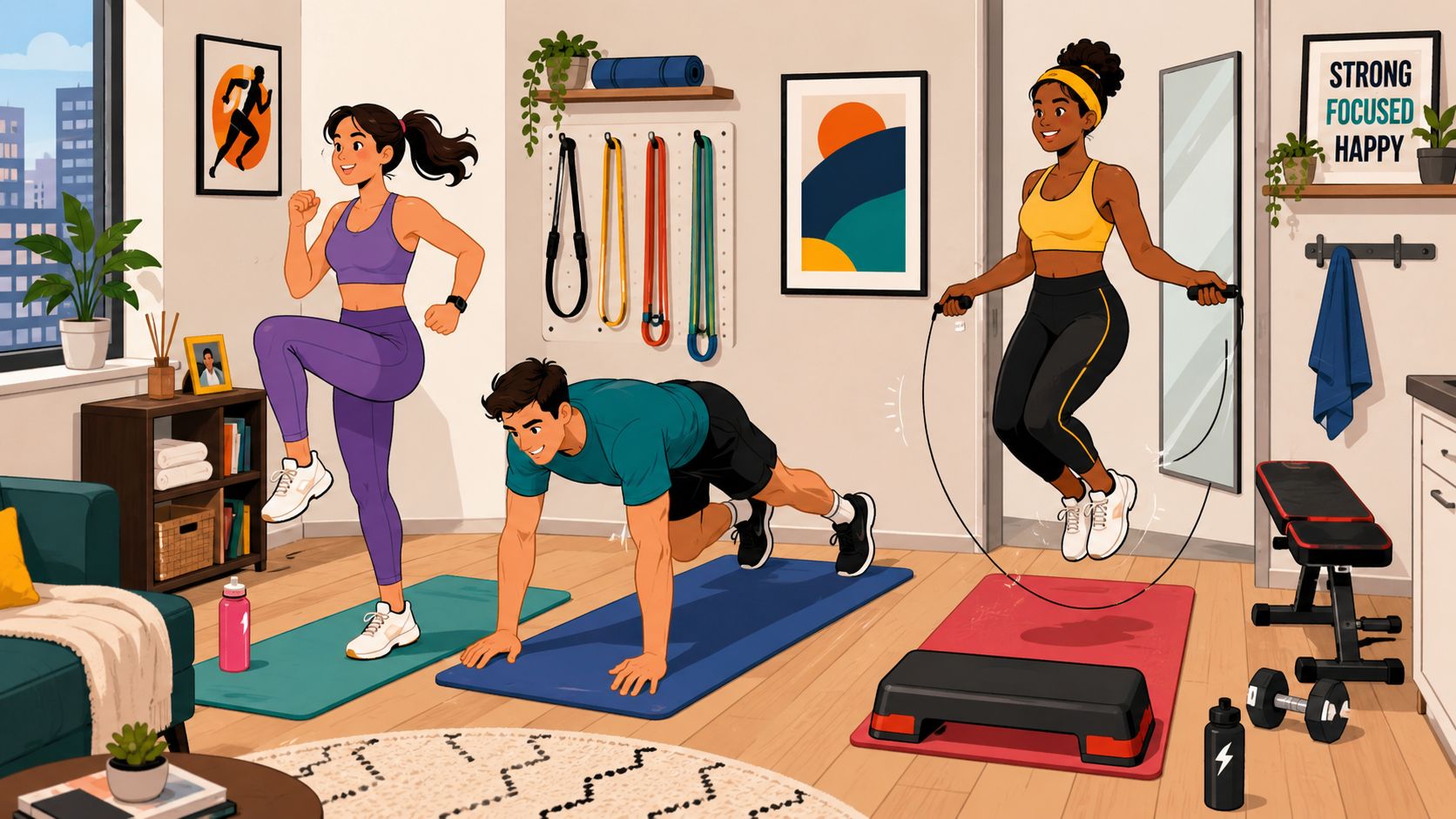
Got a small studio, a crowded training floor, or an underused corner near the front desk? That space can either become dead square footage or a reliable cardio revenue engine. Members don't care how much room you have. They care whether they can get an effective workout, get it done fast, and feel like your facility fits real life.
That's why cardio exercises for small spaces deserve more strategic attention than most operators give them. Public health guidance still calls for meaningful weekly aerobic volume. The Mayo Clinic says adults should aim for at least 150 minutes of moderate aerobic activity or 75 minutes of vigorous aerobic activity per week, and notes that 300 minutes can provide greater health benefits, which makes compact formats commercially useful because they help members accumulate that weekly dose without needing a large training footprint or outdoor route (Mayo Clinic aerobic activity guidance).
For gym owners, that's the opening. You're not just filling a class slot. You're packaging convenience, consistency, and adherence into something members will pay for and keep using. If you're redesigning a tight facility, it helps to plan with Room Sketch 3D before you commit equipment dollars or class capacity.
1. Jump Rope
Jump rope still works because it solves two problems at once. It delivers recognizable cardio, and it gives members a skill they can improve week after week. That second part matters more than many operators realize. People stay longer when they can feel progression.
Boxing gyms have understood this for years. A rope, a timer, and a small marked station can create a conditioning lane that feels intentional instead of improvised. In a compact studio, that's a strong operational win because you can rotate users quickly without tying up a machine.
How to make it work on your floor
The common mistake is throwing a few ropes in a bin and assuming members know what to do. Most don't. Beginners slap the floor, jump too high, and burn out fast. The result isn't just poor exercise quality. It's frustration.
Use adjustable ropes. Teach members to keep the movement tight, land softly, and stay relaxed through the shoulders. If your facility has neighbors above or below, add rubber flooring or mats to cut sound and reduce complaints.
Jump rope works best when you coach rhythm before speed.
A few practical ways to turn jump rope into a member-retention tool:
- Create beginner lanes: Mark short stations for single bounces, boxer step practice, and rope-free timing drills.
- Run challenge boards: Track streaks, rounds completed, or consistency, not just advanced tricks.
- Bundle it into onboarding: Give new members a short rope-conditioning session so the exercise feels accessible.
- Protect the experience: Wipe ropes and shared mats down between users so the station always feels clean and ready.
Jump rope isn't ideal for everyone. Some members hate impact, some have poor timing, and some will never enjoy it. That's fine. It's best used as a high-value option, not your only compact cardio solution.
2. High-Intensity Interval Training With Bodyweight Circuits
If I had one format to monetize in a small footprint, bodyweight HIIT would be near the top of the list. It's flexible, coachable, and easy to repackage into classes, semi-private sessions, or digital add-ons.
There's also real support for the format beyond convenience. A peer-reviewed study on inactive adults used an 11-minute bodyweight training session built from five exercises, including burpees and high knees, and the authors concluded that this simple model can enhance cardiorespiratory fitness without specialized equipment (peer-reviewed bodyweight cardio study). For an operator, that matters because short sessions are easier to sell to busy members than long, complicated programming.
A packed floor is exactly where this format shines.

Programming that members actually stick with
The best small-space HIIT classes use a narrow exercise menu and excellent coaching. Think high knees, mountain climbers, jumping jacks, burpees, and fast feet. The worst ones try to impress people with novelty and end up creating confusion, traffic jams, and sloppy reps.
That's why I'd rather see a clean, repeatable circuit than a “creative” class with too many transitions. If you're building a branded offering, a simple cardio boot camp format is easier to scale than a complicated choreography-heavy session.
Practical rule: Every high-impact move should have a live low-impact substitute ready before class starts.
Use visual timers. Coach modifications in real time. Split members by intensity lane if your room allows it. Then market the class around efficiency and coaching quality, not punishment.
For operators serving sports teams or performance-minded clients, there's room to position HIIT alongside broader conditioning concepts like endurance training for football coaches. Just don't oversell HIIT as the answer for everyone. Some members love the pace. Others need lower-impact consistency to stay engaged.
3. Running or Walking on a Treadmill
Treadmills aren't trendy, but they still close sales. Prospects understand them instantly, members trust them, and staff can prescribe them without a long teaching curve. In a small gym, that clarity has value.
A treadmill also gives you something bodyweight cardio can't always offer. Precision. Speed, incline, duration, and visible feedback make the session feel measurable. For members who want structure, especially beginners returning to exercise, that can be the difference between casual use and habit formation.
Why the treadmill still earns its footprint
What works is simple. Put quality units where staff can monitor them, make the screens easy to read, and offer short orientation sessions so nervous users don't avoid the machine. Hotel gyms, corporate wellness facilities, and traditional commercial clubs all lean on treadmills for exactly that reason. They're familiar and low-friction.
What doesn't work is stuffing too many units into a tight line with poor airflow and no service plan. Broken treadmills don't just create maintenance tickets. They create visible disappointment on your cardio floor.
If you're comparing placement and investment across machine types, this guide to the best gym machines is a useful starting point. And if you need marketing language for treadmill programs, it helps to understand how runners think about improving your running with a treadmill.
A few smart revenue plays:
- Launch beginner plans: Couch-to-running style programs are approachable and easy to sell.
- Use orientation as retention: A short treadmill tutorial builds confidence early.
- Offer interval templates: Members often need structure more than motivation.
- Keep cleaning visible: Handles, rails, and screens should be wiped after each use so members trust the space.
Treadmills do have trade-offs. They need maintenance, electricity, and more capital than open-floor cardio. But when you want a dependable, familiar cardio anchor in limited space, they still perform.
4. Stationary Cycling
Stationary cycling is one of the easiest compact cardio formats to turn into a premium experience. It's low-impact, scalable, and naturally suited to community building. That combination is why bike-based programming remains attractive in both full-service clubs and small studios.
For members, the appeal is simple. They can push hard without the same joint stress they may feel from repetitive jumping. For owners, the appeal is even simpler. Bikes support both self-guided use and instructor-led classes, which gives you multiple revenue paths from the same footprint.

Turn bikes into a branded product
Cycling becomes profitable when it has identity. A room full of bikes is just equipment. A named class series with strong instructors, clear scheduling, and recognizable music style becomes a product members talk about.
That's why operators who do this well focus on experience design. They build a rhythm around commute hours, lunch breaks, and evening energy. They also make bike setup part of the service, because discomfort kills repeat attendance fast.
Members will forgive hard work. They won't forgive a bad bike fit.
A few ways to improve the commercial side of cycling:
- Offer fit sessions: Saddle and handlebar setup should never be guesswork.
- Build signature formats: Recovery rides, interval rides, and rhythm rides attract different member types.
- Use instructor personality: The coach often sells the class more than the bike does.
- Protect hygiene standards: Seats and handlebars need quick, visible wipe-downs after every ride.
Cycling isn't the best fit if your clientele strongly prefers free movement or strength-led formats. But if you want compact cardio exercises for small spaces that support premium group programming, bikes are hard to ignore.
5. Rowing Machine Workouts
Rowers are excellent when you coach them well, and a waste of floor space when you don't. That's the blunt version.
Members who learn proper rowing technique often love the combination of rhythm, effort, and full-body engagement. Members who never get that instruction usually pull with the arms, rush the slide, and decide the machine feels awkward. The difference is coaching, not equipment.
Technique is the business model
Many gyms miss the opportunity. They buy a rower, place it near the wall, and assume it will self-market. It won't. Rowing needs onboarding.
CrossFit boxes often succeed here because they normalize coaching and repeated exposure. Traditional gyms can borrow that lesson without copying the whole model. Offer a short technique primer, post simple visual cues nearby, and use rowing in structured small-group sessions instead of leaving it entirely unsupervised.
Good rowing programming can include:
- Short interval blocks: Great for members who want intensity without impact.
- Mixed-modality circuits: Pair rowing with strength work for efficient sessions.
- Progress tracking: Distance, split feel, and consistency all create stickiness.
- Leaderboards with context: Celebrate improvement, not just top performers.
What works financially is using rowers as part of a coached product. What doesn't work is relying on them as passive cardio inventory. They're too technical for that in most gyms.
Clean the handle, seat, and rail regularly, especially when multiple members rotate through circuits. Rowers don't have as many obvious touchpoints as bikes or treadmills, which makes it easy for teams to under-clean them if you don't build the habit into class reset.
6. Stair Climbing
Stair climbers attract a specific kind of member. They want work. Not novelty, not choreography, not a long learning curve. Just a machine that gets the heart rate up and makes the legs earn it.
That clarity is useful from a sales standpoint. When a prospect asks for cardio that feels productive, stair climbing often lands immediately. It also gives your gym a stronger lower-body conditioning option without requiring a large class space.
Strong positioning, but not for everyone
The best use case is straightforward. Put stair climbers where members can step on safely, see themselves in a mirror if possible, and get quick coaching on posture. Encourage light hand support for balance instead of leaning heavily on the rails.
The trade-off is that stair machines can feel intimidating. Some beginners avoid them because the movement looks demanding. Others overuse the rails and turn the session into a balancing act rather than real work. Staff intervention helps a lot here.
A few operational wins:
- Pair them with lower-body programs: Members connect the machine to a clear goal.
- Use short finishers: Stair intervals work well after strength sessions.
- Coach posture early: Upright mechanics improve both safety and session quality.
- Keep rails and controls clean: These are high-contact surfaces and members notice.
Stair climbing won't suit every demographic. If your base skews older, brand-new, or highly impact-sensitive, you may need more approachable cardio at the front of the journey. But for members who want hard, efficient conditioning in limited space, this format earns loyalty.
7. Elliptical Machine Training
Ellipticals rarely create social media buzz, but they solve a retention problem that many owners underestimate. They give deconditioned, older, and joint-sensitive members a place to succeed without feeling punished.
That's commercially important. A member who can train comfortably is far more likely to stay engaged than one who feels every cardio option is too jarring. In mixed-population facilities, ellipticals help widen your usable market.
Quiet performer, strong retention tool
The best elliptical setup feels unintimidating. Clear access, straightforward controls, and a short explanation of resistance or stride options are usually enough. These machines work especially well in clubs that serve general fitness populations rather than only performance-focused members.
What doesn't work is leaving ellipticals as “the machine people use when they don't know what to do.” That framing makes the session feel second-rate. Instead, package elliptical training as intentional low-impact endurance work.
You can strengthen the offer with:
- Endurance challenges: Longer steady sessions fit the machine well.
- Recovery-day programming: Members appreciate guidance on easier but useful cardio.
- Rehab-friendly positioning: Joint-conscious members need to know this option exists.
- Entertainment support: Screens or audio help with longer sessions.
A clean elliptical area also matters more than some operators think. Handles and consoles collect sweat quickly, and if the machine feels sticky or neglected, members interpret that as a sign that lower-intensity users aren't a priority. That's a retention leak you can prevent.
8. Kickboxing and Dance Cardio
If your goal is energy, personality, and community in a compact room, kickboxing and dance cardio deserve serious consideration. These formats turn cardio into an event. That gives you a marketing advantage because “fun” sells to a different segment than “intense.”
The strongest commercial upside here is emotional connection. Members don't just finish sweaty. They leave feeling expressive, social, and capable. That creates referrals.

Keep the room controlled, not chaotic
These classes work best when the instructor can manage spacing and skill variation. That matters even more in a smaller studio. Punches, knees, lateral steps, and choreographed movement need boundaries so the room feels dynamic without becoming messy.
There's also a useful trend line in compact cardio programming. The British Heart Foundation's home aerobic guidance highlights short sessions and apartment-friendly movement patterns such as marching, lateral steps, kicks, and torso rotations, which aligns well with no-jumping and all-standing class options that many beginners now prefer (British Heart Foundation home aerobic ideas). That's good news for operators because quieter formats widen your audience.
If you're refining your class mix, this overview of different types of workout classes can help position kickboxing or dance cardio within a broader schedule.
A great instructor can make a small room feel premium. A weak instructor can make the same room feel cramped.
To make these classes profitable:
- Hire for presence, not just certification: Energy management matters.
- Offer beginner versions: Many prospects want the vibe but fear the pace.
- Use memorable class names: Packaging drives trial.
- Sanitize any shared pads or props fast: Clean transitions protect the member experience.
These formats aren't ideal if your brand is heavily performance-science driven and your clientele dislikes choreography or rhythm. But for community-focused retention and strong word-of-mouth, they're powerful.
Small-Space Cardio: 8-Item Comparison
| Cardio Option | Implementation Complexity | Resource Requirements | Expected Outcomes | Ideal Use Cases | Key Advantages |
|---|---|---|---|---|---|
| Jump Rope | Low, simple setup, basic technique training | Minimal, rope, small floor/ceiling clearance, optional mat; low cost | High-intensity cardio; quick calorie burn (~12–16 kcal/min); improved coordination and bone density | Home workouts, small studios, HIIT warm-ups, budget gyms | Extremely portable and cheap; excellent for HIIT; rapid cardiovascular gains |
| HIIT (Bodyweight Circuits) | Low–Medium, program design and skilled instruction needed | Minimal, bodyweight only, timers, small space; instructor recommended | Maximal short-session calorie burn with strong EPOC; improves aerobic and anaerobic capacity | Time‑pressed members, group classes, corporate wellness, boutique studios | Time-efficient; no equipment cost; highly scalable; strong perceived value |
| Treadmill (Running/Walking) | Medium, requires electrical and maintenance planning | High, purchase cost, electricity, footprint (~3×6 ft), ongoing service | Versatile steady-state and interval training; measurable metrics (speed, distance, HR); accessible to all levels | Core gym amenity, runner training, hotel/corporate gyms, structured programs | Data-driven feedback; broad demographic appeal; reliable steady cardio option |
| Stationary Cycling (Spin) | Medium, class programming and certified instructors advised | Moderate, bikes (4×2 ft each), studio space, maintenance | Low-impact high-cardio; builds lower-body endurance and power; strong retention through classes | Group spin classes, premium memberships, community-focused studios | Low joint impact; strong community and premium pricing potential; adjustable resistance |
| Rowing Machine | Medium, technique instruction improves safety and results | Moderate, commercial erg (~2×7 ft), moderate cost and upkeep | Full-body low-impact cardiovascular and strength benefits; high calorie efficiency; measurable metrics | CrossFit, performance training, full‑body cardio programs, challenge events | Engages majority of muscles; excellent metrics for progress; efficient full-body conditioning |
| Stair Climbing (Stepmill) | Medium, safe programming and form coaching recommended | High, stepmill cost, dedicated footprint (~3×4 ft), maintenance | Very high metabolic demand; strong lower-body toning; significant calorie burn | Lower-body toning programs, boutique metabolic classes, members targeting glutes/quads | Efficient lower-body conditioning; high perceived difficulty and accomplishment; strong ROI |
| Elliptical Machine | Medium, equipment acquisition and floor planning required | High, machines, floor space, maintenance, electricity | Low-impact steady-state cardio suitable for long durations; moderate calorie burn; upper/lower engagement | Rehabilitation, older adults, beginners, hotel fitness centers | Joint-friendly; accessible to diverse populations; comfortable for extended workouts |
| Kickboxing & Dance Cardio | Medium–High, needs energetic, certified instructors and class management | Low–Moderate, open studio space, audio system, optional pads/gloves, music licensing | High-energy full-body cardio; improved coordination and stress relief; social engagement | Group fitness, boutique studios, community-building programs | Highly engaging and fun; strong retention via instructor personality; premium class pricing |
Programming for Profit and Post-Workout Hygiene
The operators who win with cardio exercises for small spaces don't just add a few workouts and hope for the best. They build a system. That means matching each format to a clear member type, scheduling it at the right times, coaching it properly, and making the space feel organized from the moment someone walks in.
A balanced weekly schedule usually performs better than a one-note cardio lineup. High-intensity bodyweight classes bring urgency and strong energy. Low-impact options like cycling and elliptical training give beginners and recovery-focused members a reason to stay engaged. Skill-based formats like jump rope and rowing create progression, which is one of the strongest retention levers any gym has.
There's also a practical programming benchmark worth using when you build compact classes. Small-space circuits can be structured in the 10 to 30 minute range using bodyweight moves such as jumping jacks, mountain climbers, high knees, skaters, burpees, and invisible jump rope, and some coaching guidance suggests they can be done with as little as one meter of clear floor space and repeated across the week. That same guidance notes that chest-strap monitoring is the most effective way to verify intensity, while the conversation test and pulse counting can help when wearables aren't available (small-space cardio programming guidance).
Don't ignore the apartment-friendly and beginner-friendly segment either. Low-impact small-space cardio can be compressed into roughly 3×3 ft using patterns like high knee marches, modified jumping jacks, side-to-side steps, and squat-and-punch drills, with stepping substitutions helping keep heart rate increased while reducing impact for beginners, older adults, or members coming back from injury (low-impact small-space cardio guidance). That's not just exercise advice. It's market expansion.
Cleanliness is part of the product, especially in compact cardio zones where members share surfaces quickly.
Post-workout hygiene needs just as much discipline as your programming. Build wipe-down expectations into staff scripts, signage, and class reset procedures. Make it automatic after treadmills, bikes, rowers, stair machines, mats, ropes, and shared touchpoints. In smaller facilities, sanitation is more visible because members are physically closer to one another and to the equipment.
For high-traffic studios, keep sanitation stations obvious and easy to reach. Stock them generously, train staff to reset fast, and audit the floor regularly so nothing feels neglected during busy blocks. We recommend keeping stations supplied with Wipes.com Disinfectant Wipes so members and staff can quickly sanitize handles, seats, mats, rails, and other contact points without slowing down the flow of the workout.
When your programming is tight and your hygiene is consistent, limited space stops being a constraint. It becomes part of your competitive advantage.
Leave a Reply