If you're running a gym, studio, or performance facility, you've probably felt this tension already. Your coaches are good, your members are solid, and the local teams in your area are always looking for an edge, but the energy inside the building still feels fragmented. Staff stay in their lanes. Athletes train hard without really connecting. Member experience varies depending on who's on shift.
That disconnect shows up fast. Front desk teams hand off weakly to coaches. Coaches default to the same cliques of athletes. Team sessions feel like group workouts instead of actual culture-building experiences. And when that happens, you lose two things at once: internal cohesion and an easy revenue opportunity.
Sports team building exercises fix both problems when you run them well. They create structured moments for communication, trust, and coordination under pressure, which is why strong coaches often use low-stakes challenges, mixed-group drills, and cooperative tasks instead of relying on speeches alone. Practical coaching guidance also emphasizes mixing groups outside normal positional habits so athletes build broader chemistry, not just comfort with their usual circle. Broader team-building research cited in coaching guidance reports that 63% of leaders observed improved team communication and 61% noted better collaboration after these kinds of activities, which is useful context if you're packaging them as a service for schools, clubs, or local organizations through sports team building guidance for coaches.
The upside for gym operators is simple. You can use these sessions to tighten up your own staff culture, then package the same formats for local teams as premium events. If you also want inspiration from the event side of the market, it helps to discover team building events and see how structured experiences are sold.
1. Relay Races and Circuit Competitions
Relay races work because they remove overthinking. Put athletes into mixed teams, send them through sprints, rower intervals, medicine ball throws, sled pushes, and bodyweight stations, and people start talking, encouraging, and adjusting on the fly.
That's why I like this format for both staff development and external bookings. Your coaches learn how to run high-energy group flow under pressure, and local teams get a session that feels competitive without becoming a full scrimmage.

How to Run It So It Actually Builds Chemistry
The biggest mistake is stacking teams by ability or by existing friend groups. That kills the point. Mix captains with quiet athletes, veterans with newcomers, and stronger athletes with less experienced ones.
Use stations that reward different strengths. One leg might favor speed, another coordination, another pacing, and another communication. A high school soccer team, for example, can move through cone shuttles, SkiErg work, planks with ball passes, and target throws. A staff version might swap in bike calories, sandbag carries, and front-desk-to-floor handoff challenges.
Practical rule: Don't let one superstar carry the whole relay. Build stations that force transitions, communication, and role-sharing.
A few details make this more sellable:
- Balanced heats: Seed teams so the finish stays close and people stay engaged.
- Clear demos: Teach movement standards first, especially if outside teams aren't familiar with your equipment.
- Visible scoring: Whiteboards keep energy high and make the session feel event-worthy.
- Brandable setup: Cones, lane markers, and team colors make the package look more premium. Custom gear like promotional rally cones can help with presentation.
What Works and What Doesn't
Short rounds work. Endless circuits don't. Teams remember fast rotation, loud encouragement, and a tight finish. They don't remember station six of a bloated 90-minute grind.
Keep hygiene simple and visible too. Put sanitizing wipes at each station and assign one athlete per team to wipe shared handles or benches during transitions. That keeps the flow clean without slowing momentum.
2. Team Fitness Challenges with Shared Goals
It is midseason, attendance is slipping, and the coaching staff can feel standards getting loose. A shared-goal challenge gives the group a reason to show up for each other, not just for their own numbers.
This format works best when a team needs consistency over several weeks. Set one combined target that matches the sport and the current problem. Total training sessions completed, total recovery check-ins, total mobility minutes, or a team strength benchmark all work when the score reflects habits that carry into competition.

Build the Challenge Around the Team's Identity
The best challenges feel specific. A football team in summer usually responds to a strength and conditioning board with clear weekly standards. A swim club often buys into a dryland consistency challenge because the work supports performance without competing with pool volume. Staff teams can use the same format to improve session prep, recovery habits, and attendance before a high-volume sales month.
Public tracking matters. Put the scoreboard where athletes and staff will see it often. Locker-room charts, lobby leaderboards, and team chat updates keep the challenge alive between sessions and cut down on the usual drop-off after week one. If you want more formats to adapt, these fitness challenge ideas for groups are a good starting point.
Short checkpoints keep people engaged. Weekly wins beat a distant finish line every time.
I also like to package these challenges in a format similar to small group training programs for gyms. That gives you a clean way to price the offer, cap headcount, assign coach touchpoints, and show value beyond floor access.
The Revenue Angle
This format earns its keep because it helps your team internally and sells well externally. For staff, it improves accountability, communication, and daily standards. For local schools and clubs, it becomes a multi-week service with a clear beginning, visible progress, and an easy renewal conversation at the end.
Sell it as a package, not a challenge board on the wall. Include kickoff testing, weekly score reviews, coach communication, and a final recap with next-step recommendations. That structure gives parents, athletic directors, and club coaches something concrete to buy.
There is a trade-off. Multi-week challenges take more admin than a single event. You need someone to own scoring, follow-up, and schedule control or the experience starts to feel sloppy. A simple tracking system helps. The Strive Workout Log guide is useful for setting up shared records, check-ins, and progress notes without overcomplicating the process.
One more operational point. Keep hygiene visible at tracking stations, clipboards, tablets, and shared equipment during longer challenges. It protects the experience and signals that your gym runs organized programs, not loose contests.
3. Fitness Mentorship Pairings and Skill Development
Not every sports team building exercise needs noise and competition. Some of the best ones happen in pairs.
Mentorship pairings work when you've got a mix of maturity levels, skill levels, or confidence levels inside one team. A senior athlete helps a younger player with form, preparation, and routine. In a gym business, the same setup works with lead coaches and newer hires.
Where Mentorship Pays Off
This format is strongest when the team struggles with consistency, not effort. Athletes may work hard but still miss details like warm-up quality, recovery habits, communication with coaches, or professional conduct in the facility.
Good pairings aren't random. Match by personality, communication style, and usefulness. A veteran point guard mentoring a freshman guard makes sense. A calm senior defender mentoring an impulsive winger can make even more sense. In staff development, pairing a polished group coach with a technically strong but less confident trainer often produces better growth than matching by popularity.
A useful support piece is a shared training record. Something as simple as goals, movement cues, and weekly check-ins can keep the relationship from drifting. Tools and guidance from a Strive Workout Log guide can help teams structure that process.
Keep It Structured or It Fades
Mentorship fails when coaches announce it once and never revisit it. It works when you give the pairs a clear rhythm:
- Set one focus area: Don't ask a pair to improve everything at once.
- Meet on a schedule: Before practice, after lifts, or after class works best.
- Use observation plus action: Talk briefly, then drill the skill.
- Review in public: Coaches should check progress often enough that the pairing stays real.
If you run small-group coaching already, you can blend that model directly into team mentorship. This small group training article gives a useful framework for structure and supervision.
A mentor's job isn't to be a second coach. It's to make good habits stick between coaching moments.
Include equipment care in the process. Have mentors show newer athletes how to reset stations, wipe benches, store bands, and leave the space ready for the next group. That small discipline builds a more professional culture fast.
4. Team Sports Leagues and Cross-Training Competitions
Friday at 6 p.m., your coaches have finished the last session, your front desk team is still answering texts, and the varsity soccer staff you want to win as a client walks in for a trial event. Instead of another conditioning circuit, you run a short handball league with mixed teams, simple rules, and a clear scorecard. Within minutes, you can see who communicates, who adjusts, and who keeps the group steady when the game gets messy.
That is why cross-training leagues work so well. They build chemistry inside your own gym team, and they give you a package local sports programs will pay for.
The change of sport matters. Basketball players in volleyball or baseball players in dodgeball lose the comfort of their normal pecking order. Staff members do the same thing in an in-house futsal or floor hockey block. The sport changes, but the habits carry over. You still see leadership, frustration tolerance, effort after mistakes, and whether people help each other or shut down.
Why It Works Better Than Another Standard Team Workout
Primary sport training usually reinforces existing roles. Cross-training exposes the gaps between those roles.
A captain who dominates every drill may struggle when the setting changes. A quieter athlete may become the best organizer on the floor. In a gym business, that information is useful beyond culture. It helps managers spot future leads, decide who can run events, and identify staff members who need coaching on communication before they are put in front of paying groups.
It is also an easy offer to sell. Schools, club teams, and adult rec programs are often looking for team bonding that feels active, organized, and different from practice. If you already run private events or want ideas for formatting team-based sessions, these group exercise formats for private team sessions can help.
How to Run It Without Creating Chaos
Keep the design tight. Loose events feel fun for ten minutes, then turn into dead time and side conversations.
Use a simple format:
- Pick low-skill, low-impact games: Handball, futsal, dodgeball, kickball, and volleyball usually work well.
- Set a short event window: Forty-five to sixty minutes keeps energy high.
- Mix the teams on purpose: Blend starters, reserves, staff roles, or departments.
- Score one or two behaviors: Communication, support, and reset speed are easier to track than everything at once.
- Finish with a quick debrief: Ask what helped the team adapt and where communication broke down.
I have found that random teams work better than friend-group teams if the goal is development. If the goal is client retention or a booster-club experience, let captains draft teams and keep the atmosphere lighter. The right choice depends on whether you are training behavior or selling an event people want to book again.
Common Mistakes
Overcoaching ruins the point. Let the game reveal patterns before a coach jumps in with corrections.
The other mistake is treating the session like open play. A cross-training competition still needs clear boundaries, rotation rules, and a staff member who controls tempo. Without that structure, stronger personalities take over, quieter athletes disappear, and the takeaway gets muddy.
Handle equipment flow well, too. Shared balls, mats, pinnies, and benches need to be reset quickly between rounds. Put cleaning supplies and trash access near the play area so staff and athletes can wipe down shared gear and keep the event moving. That protects the space, keeps the session professional, and matters if you plan to sell this format to outside teams regularly.
5. Synchronized Group Training Classes
If your teams are too segmented by hierarchy, synchronized training classes reset the room.
A private spin class, yoga session, or coach-led HIIT block works because everyone follows the same cues at the same time. Captains don't get special treatment. New athletes can't hide. Your coaches also get a direct look at how the group responds to rhythm, instruction, and collective pacing.

Use the Instructor to Flatten the Hierarchy
Many facilities miss the point. They run a generic class instead of a team session. Brief the instructor ahead of time. Ask for partner cues, synchronized starts, group holds, and moments where athletes have to move together.
That structure builds non-verbal awareness fast. Teams start noticing pacing, breathing, timing, and effort in a more unified way than they do in open-gym lifting. If you want class structures to adapt for teams, these group exercise ideas can help.
A private cycling class is a great example. The room gets dark, the music gets loud, and status fades. What matters is whether the group can stay together through the effort.
Best Use Cases
This format works especially well for:
- Teams with social cliques: Shared rhythm breaks up subgroups.
- Staff teams with role tension: Everyone becomes a participant, not a title.
- Recovery weeks: Yoga, mobility, or lower-impact formats still build cohesion.
- Premium bookings: Private classes feel polished and easy to sell.
A strong evidence point sits behind the general practice. A 2024 meta-analysis found a moderate overall effect size of 0.65 on cohesion, with a 95% confidence interval of 0.40 to 0.91, and concluded that team-building interventions improve cohesion in sports teams, with stronger gains in task cohesion than social cohesion according to this sports team-building meta-analysis.
Set sanitizing stations at the entrance and exit, especially for bikes, mats, and dumbbells. Teams are more likely to respect cleanup when the expectation is part of the class flow.
6. Outdoor Adventure and Obstacle Courses
Take teams out of the building and you remove their usual coping patterns.
Outdoor sessions change behavior fast. Athletes can't rely on the same corners, the same routines, or the same pecking order. On a ropes course, trail challenge, kayak session, or obstacle run, people show you how they handle uncertainty.
Why the Outdoors Reveals More Than the Gym
A player who looks locked in during structured practice may hesitate on a balance element or group navigation task. Another athlete who stays quiet in training may become the most reliable leader once the setting gets unfamiliar.
That's why outdoor adventure works so well as a reset. It strips away normal context and forces practical cooperation. For staff, it can be even more revealing. You'll spot who prepares well, who keeps morale up, and who helps the team adapt when plans change.
Field lesson: If you want trust to deepen, give the group one shared problem they can't solve alone.
How to Package It Without Creating Chaos
Sell outdoor sessions as managed experiences, not random outings. Partner with outfitters who understand group flow and liability. Keep travel reasonable, build in hydration stops, and choose challenges that match the team's current training load.
A few smart guardrails make a big difference:
- Schedule off-peak: Bye weeks and off-season windows reduce resistance.
- Brief expectations early: Clothing, food, timing, and weather policy should be clear.
- Capture content carefully: Candids are better than overproduced footage.
- Pack sanitation supplies: Portable sanitizer and wipes matter before meals and after shared equipment use.
Outdoor events can become strong premium offerings for clubs, schools, and corporate wellness groups that want something more memorable than another circuit on the turf.
7. Cross-Discipline Skill Workshops
This is one of the most underrated sports team building exercises because it builds respect, not just energy.
In a cross-discipline workshop, athletes teach each other what their role requires, or they borrow skills from another sport entirely. Receivers learn how quarterbacks read coverage. Basketball players try a wrestling-based control session. Hockey players do a balance-focused dance workshop. Defenders and attackers swap roles in a drill block.
Respect Grows Faster When People Feel the Difficulty
Athletes often underestimate what teammates do until they try it themselves. The moment a striker has to defend space or a guard has to absorb contact in a wrestling drill, the team's internal conversation changes.
That matters for staff too. A sales employee shadowing onboarding, or a coach teaching the front desk what setup really takes, can soften friction fast. Shared vulnerability builds better collaboration than another meeting ever will.
Use a chalk-talk opening, then move quickly to practice. Keep the skill narrow and useful. One concept per workshop is plenty.
Good Workshops Feel Tight, Not Academic
The best sessions are short, active, and slightly uncomfortable. Long lectures lose the room. Sharp teaching wins.
A strong setup looks like this:
- Start with context: Explain why the borrowed skill matters.
- Pick communicators, not just stars: Great players aren't always great teachers.
- Use fast reps: Keep athletes moving and learning by doing.
- Debrief briefly: Ask what they noticed, not what they enjoyed.
Teams get smarter when players understand each other's jobs, not just their own.
Because these workshops often involve mats, handheld tools, or demo equipment, build cleanup into the end of every segment. Wipe surfaces, reset stations, and make the room ready for the next use. That small operational detail also signals professionalism if you sell the workshop externally.
8. Internal Pro Day and Skill-Based Competitions
A good Pro Day gives athletes something many team sessions don't. Individual spotlight inside a team format.
This works especially well when morale is flat or when a team needs objective competition without a full game environment. Build a menu of speed, power, agility, and sport-specific skill tests. Then package the whole thing like an event, with music, stations, rankings, and a visible leaderboard.
Make the Event Feel Bigger Than Testing
The difference between a boring assessment day and a strong team-building event is atmosphere. A coach or emcee should keep energy up. Teammates should rotate between competing and supporting. Video clips, lane calls, and positional champions all help.
For a football group, that might mean sprint times, jumps, shuttle work, and throw accuracy. For basketball, use sprint-and-finish sequences, lane agility, vertical testing, and shooting under fatigue. For your own staff, a “Pro Day” can be more playful but still structured. Demo quality, coaching cue clarity, member greeting speed, and setup efficiency can all become scored events.
Strong Pro Days Create Content and Sell Future Sessions
This format is highly marketable because it gives teams takeaways. They leave with clips, rankings, and a sense of progress. It's also one of the easiest services to repeat seasonally.
A few rules keep it sharp:
- Mix event types: Don't let one physical trait dominate the whole day.
- Show scores live: Visibility keeps spectators involved.
- Reward categories: Overall winners are fine, but positional or role-based recognition matters too.
- Clean as you rotate: Bars, balls, jump mats, and timing gear should be wiped before and after use.
If you offer it to outside teams, present it as a branded package with media, recap notes, and coach feedback. That turns one event into a relationship.
8-Way Team-Building Exercise Comparison
| Activity | Implementation complexity | Resource requirements | Expected outcomes | Ideal use cases | Key advantages |
|---|---|---|---|---|---|
| Relay Races and Circuit Competitions | Moderate planning for stations and safety | Gym space, varied equipment, supervisors; 30–60 min | Measurable results, high energy, equipment familiarity | Team practices, short events, promotional content | Authentic HIIT exposure, camaraderie, social-media friendly |
| Team Fitness Challenges with Shared Goals | Low–moderate, requires ongoing management | Tracking tools/dashboards, coach communication; multi-week | Sustained engagement, accountability, improved conditioning | Off-season conditioning, culture-building, long-term goals | Long-term motivation, inclusive participation, measurable progress |
| Fitness Mentorship Pairings and Skill Development | Low setup, ongoing coordination and oversight | Time from veteran players, scheduled sessions, tracking | Improved skills, leadership growth, stronger cohesion | Preseason development, rookie integration, depth building | Personalized coaching, leadership pathways, trust-building |
| Team Sports Leagues and Cross-Training Competitions | Moderate: league scheduling and facility coordination | Alternative facilities, basic equipment, short-season time | Increased adaptability, social bonds, active recovery | Off-days, morale-boosting, recreational competition | Low-pressure fun, diverse movement patterns, team bonding |
| Synchronized Group Training Classes | Low: arrange instructor and suitable time | Instructor, studio space or private booking; 30–60 min | Shared challenge, improved coordination, morale lift | Monthly team events, non-hierarchical bonding, recovery days | Equalizing experience, group timing, endorphin-driven morale |
| Outdoor Adventure and Obstacle Courses | High: logistics, weather planning, liability management | Transportation, outfitter fees, full/half-day commitment | Deep bonding, leadership emergence, memorable experiences | Team retreats, leadership development, off-season resets | Authentic trust-building, nature-based wellness, standout content |
| Cross-Discipline Skill Workshops | Moderate: curriculum design and facilitator selection | Player or guest coaches, practice space, 1–3 hour sessions | Broader tactical IQ, respect for roles, better communication | Tactical learning, position swaps, targeted clinics | Peer-led teaching, strategic insight, breaks routine |
| Internal 'Pro Day' and Skill-Based Competitions | High: precise measurement, scoring systems, staffing | Timing/measurement gear, staff, single-day event | Objective metrics, motivation, talent recognition | Preseason benchmarking, scouting, performance validation | Data-driven evaluation, publicity potential, celebrates excellence |
From Drills to Dominance Your Team Building Playbook
A coach calls on Tuesday with a familiar problem. The team needs better communication, better buy-in, and a session that feels organized enough to justify the budget. A good gym can solve all three.
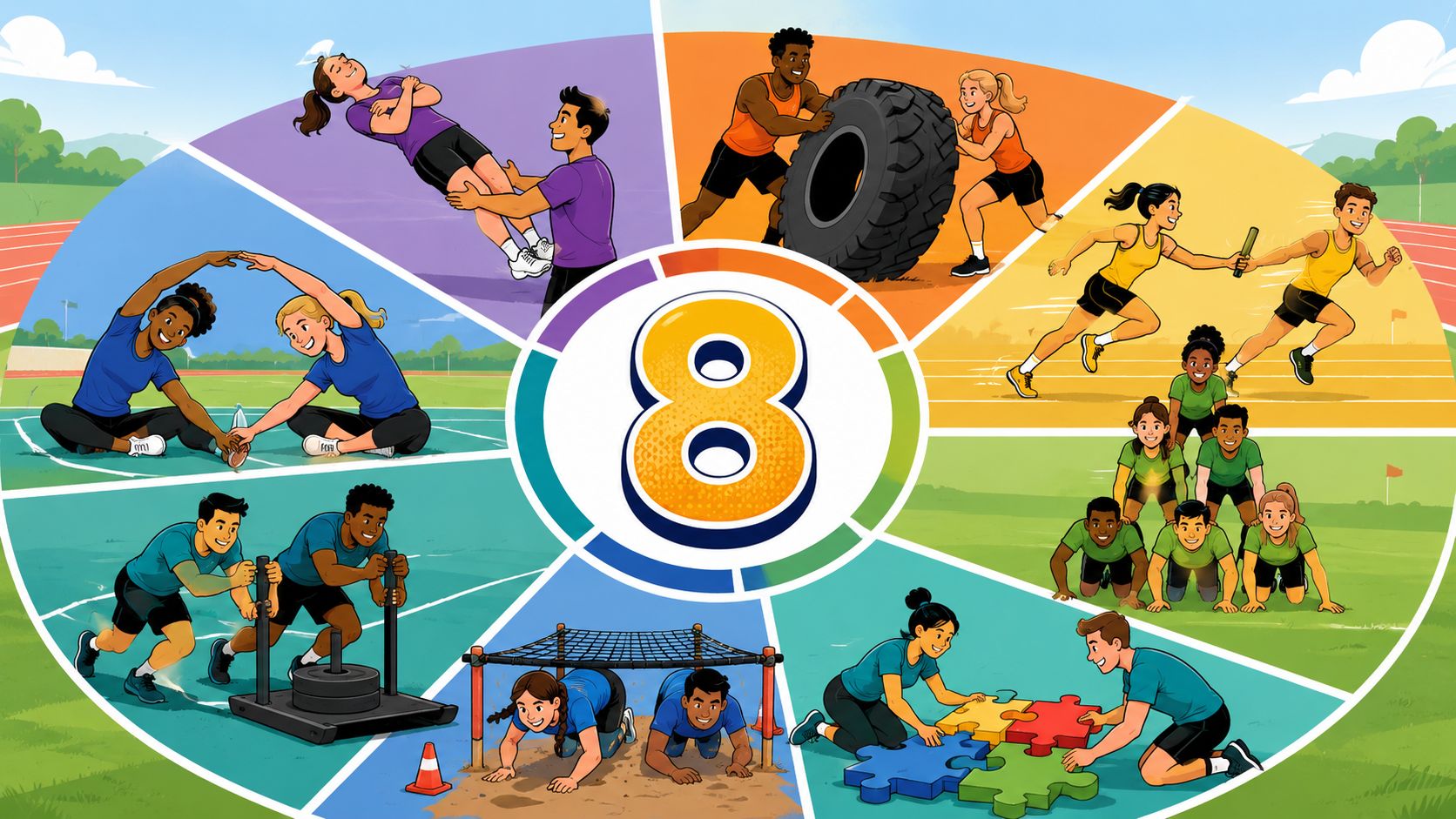
The eight formats in this playbook work best when they are chosen with a clear purpose. Relay races sharpen communication under fatigue. Shared-goal challenges build accountability across several weeks. Mentorship pairings improve standards and daily habits. Cross-training leagues loosen stale group dynamics. Synchronized classes reduce status gaps and get everyone working on the same beat. Outdoor events bring out leadership fast. Skill workshops build respect across roles. Pro Day testing adds objective competition and gives coaches something they can review after the session.
That matters for staff development, but it also matters for revenue.
Used well, these sessions do two jobs at once. They strengthen how your coaches lead, cue, reset equipment, and manage groups under pressure. They also give you a packaged service you can sell to school teams, club programs, travel organizations, and local companies that want a structured performance-based experience. The return is practical. Better staff cohesion inside the gym. More bookable team events outside it.
The trade-off is execution. Energy alone does not carry a team-building session. Groups remember whether the briefing was clear, whether stations flowed without confusion, whether scoring made sense, and whether the staff looked prepared. The strongest operators treat these events like real products, not casual add-ons. That means defined timelines, smart group splits, visible coaching roles, simple scorekeeping, and a reset plan that keeps the next booking on schedule.
Cleanliness is part of that standard. Coaches notice facility discipline quickly, and athletes notice it too. Build equipment reset into the session instead of saving it for the end as an afterthought. Assign cleanup by station. Restock sanitation supplies before the next team arrives. For outdoor formats, bring hand-cleaning supplies for shared gear, meals, and transitions. Those details protect the experience, help staff hold the line on standards, and make your business easier to recommend.
A strong team-building offer should leave you with more than good photos and tired athletes. It should leave your staff sharper, your systems tighter, and your gym with a service local teams will book again.
Leave a Reply