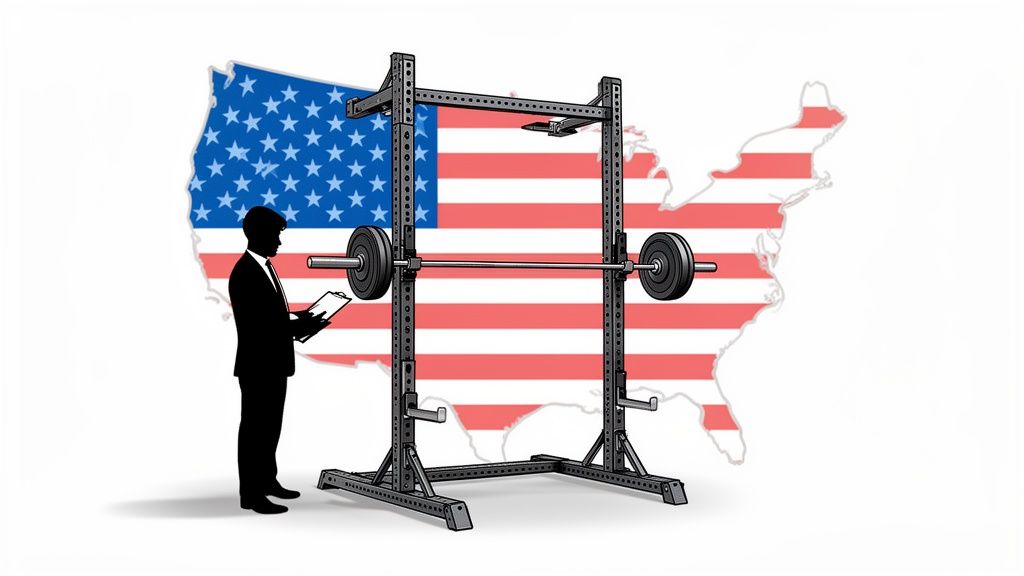
Welcome, gym owners! Let's talk about one of the most powerful decisions you can make for your business. Choosing American made exercise equipment isn't just about waving a flag; it's a savvy business move that delivers rock-solid durability, headache-free support, and a brand story that truly connects with your members.
It’s a choice that can justify a premium membership and build a fiercely loyal community.
The Strategic Edge of Buying American Made Equipment
When you're equipping your gym, every single choice you make echoes through your business—from your finances to your members' daily experience. Deciding to go with American made exercise equipment is a strategic investment that pays you back for years and years. This goes way beyond patriotism and gets right into the heart of smart, sustainable business.
Think of it this way: outfitting your gym is like laying the foundation for a custom-built home. You could save a few bucks on cheaper, imported materials that look fine at first, but you'll always be worrying about when they might crack under pressure. Or, you can invest in high-grade, domestically sourced steel and craftsmanship. That foundation is going to be unshakeable, giving you—and your members—peace of mind for decades.
The Immediate Payoff for Your Business
The moment that shiny new American-made gear hits your gym floor, you'll start to feel the benefits ripple across your entire operation.
- Tough-as-Nails Durability: Equipment forged from American steel and put together under rigorous quality control is built for the absolute grind of a busy commercial gym. That means fewer "out of order" signs, less downtime, and a much safer environment for your clients.
- Support That’s Actually Supportive: When a cable frays or a part needs replacing, having your manufacturer just a time zone or two away is a total game-changer. You get parts faster, talk to technicians who know the gear inside and out, and get your equipment back in service in record time.
- A Brand Story People Want to Be Part Of: Telling your members that you've invested in American-made quality is a powerful marketing tool. It’s a story about supporting local jobs and a commitment to providing the absolute best—a narrative that resonates deeply with people who value quality.
Choosing American-made gear is a statement. It tells your members loud and clear that you refuse to cut corners on their safety and their results. That’s how you build the kind of trust that a budget gym just can't touch.
A Quick Look: Domestic vs. Offshore
To put it all in perspective, here's a quick breakdown of what you're really deciding between when sourcing your equipment.
Domestic vs Offshore Sourcing At a Glance
| Business Factor | American Made Equipment | Offshore Equipment |
|---|---|---|
| Upfront Cost | Generally higher initial investment | Often lower initial price point |
| Quality & Durability | High-grade materials, strict quality control | Variable quality, can be less durable |
| Lead & Shipping Times | Shorter and more reliable delivery | Longer, subject to major delays |
| Customer Support | Fast, accessible, same time zone | Slower, language/time zone barriers |
| Brand & Marketing | Powerful story of quality and local support | Focuses primarily on price |
| Long-Term ROI | High ROI from lower maintenance/downtime | Lower ROI due to more frequent repairs/replacement |
Ultimately, the choice reflects your business philosophy. Are you building for the short term, or are you creating a legacy brand known for its unwavering quality?
Riding the Wave of Market Growth
This isn't just a gut feeling; the market data backs it up. The demand for high-quality, dependable fitness gear is surging, showing that both gym owners and home users are putting their money where the muscle is.
The U.S. home fitness equipment market, which shares many brands with the commercial space, ballooned from USD 4.81 billion in 2022 and is on track to hit USD 8.50 billion by 2030. Cardio equipment, much of it proudly made in U.S. factories, led the charge with a 55.25% market share in 2022. You can dig into the full report on U.S. home fitness market trends to see the scale for yourself.
This explosive growth proves that people appreciate the reliability that comes with products built on home soil. That's a powerful sentiment you can tap right into for your gym.
How to Actually Verify a 'Made in USA' Claim
We've all seen it: that proud "Made in USA" label. It feels good, right? It promises something solid, something you can count on. But in the world of heavy-duty gym equipment, you have to be sure that promise is backed by steel, not just marketing fluff.
Let’s get one thing straight: this isn't about waving a flag. It's about making a smart business decision. You need to know how to spot the real deal versus something that was just bolted together on U.S. soil from a container of foreign parts. The Federal Trade Commission (FTC) has a rule for this, and it’s your secret weapon: the "all or virtually all" standard. This is the benchmark that separates genuine American manufacturing from clever marketing loopholes.
What the FTC's 'All or Virtually All' Rule Really Means for Your Gym
This rule isn't some dusty piece of legal text; it’s your best filter for quality. For a squat rack or a leg press to legally wear the "Made in USA" badge, it means everything—from the raw steel to the welding to the final powder coat—has to originate from the United States. Any foreign content has to be, in the FTC's words, negligible.
Think of it this way: a product labeled "Assembled in USA" is a completely different animal. Sure, the final assembly happened here, which is great, but the heart of the machine—the steel, the bearings, the pulleys—likely came from overseas. This can have a huge impact on durability, repairability, and the overall quality you're promising your members.
This decision tree nails the choice you're facing. If you're playing the long game and focusing on ROI, the path is clear.

When you're building a brand on quality, "Assembled in USA" might not cut it. The real American-made gear is a strategic investment in your gym's future.
Here's a pro tip: companies that are genuinely proud of their American manufacturing don't hide it. They shout it from the rooftops. They'll be totally transparent about their process because it's their biggest selling point.
Your Actionable Verification Checklist
Alright, time to put on your detective hat. Don't just take a salesperson's word for it—dig in and get the proof. Here’s what you need to do to separate the contenders from the pretenders.
Ask for the Paper Trail: Don't be shy. Ask the supplier for a mill test report (also called a Mill Cert) for their steel. This is the steel’s birth certificate. It proves where it was melted and formed, its exact chemical makeup, and confirms its U.S. origin. No cert? Big red flag.
Pinpoint the Factory: A corporate office in California doesn't mean the equipment is made there. Ask them directly: "Where is your fabrication facility?" A truly American manufacturer will tell you exactly where their welders are, where their machines are humming. They might even offer a virtual tour.
Read Between the Lines: Scrutinize their website and brochures. What you're looking for are bold, specific claims.
- Green Flags: "Made in Ohio from 100% American Steel." "Forged and Welded in Texas."
- Red Flags: Vague phrases like "An American Company," "Designed in the USA," or "Distributed from our US warehouse." These are classic marketing half-truths designed to give you an impression without making a verifiable claim.
Putting in this little bit of extra work up front is what separates a good gym owner from a great one. You’ll know with 100% certainty that the equipment filling your floor is built to last, delivering the safety and performance your members will notice and appreciate.
The Feel of Quality: Why Craftsmanship Is King
You know the feeling. You walk into a gym, grab a dumbbell, or rack a bar, and you can just tell it's the real deal. A solid power rack doesn’t just sit there; it has a presence. A well-built bench inspires confidence before you even lie down. That’s not just in your head—the difference between premium american made exercise equipment and its mass-produced, imported cousins is something you can see, feel, and trust.
It all starts with the very bones of the equipment: the raw materials. American manufacturers are famous for sourcing high-grade, high-tensile American steel. It's the difference between building a house frame with solid oak beams versus cheap particle board. Sure, the particle board might hold up for a little while, but you know the oak is built to last for generations, enduring relentless punishment without a single complaint.

This obsession with quality trickles down to every last detail. We're talking about the clean, perfect lines of robotic welds and the kind of tough, commercial-grade upholstery that scoffs at rips and tears. This isn't just manufacturing; it's true craftsmanship.
From Raw Steel to Member Trust
So, what does this top-tier craftsmanship actually look like on your gym floor? It's more than just aesthetics. It’s about creating a safe, high-performance environment your members will rave about.
- The Steel Standard: Real-deal American-made racks and machines are almost always built with heavy-duty 11-gauge steel, or even thicker. The result? Equipment that feels absolutely planted, giving your members the rock-solid confidence they need to push for that extra rep. No wobbles, no shifting, no fear.
- Welds You Can Bet On: Take a close look at the joints. See those clean, uniform welds? Those are often done by robots, and they're not just for looks. They create an incredibly strong bond that spreads stress evenly across the frame, eliminating the weak points that plague cheaper gear over time.
- Upholstery That Endures: The vinyl on a bench might seem like a minor detail, but it's a battleground. American brands know this, using high-density foam that doesn't flatten and tough, double-stitched vinyl that can handle endless hours of sweat and friction without cracking.
The market absolutely reflects this hunger for quality. In North America, the U.S. is the undisputed champ, on track to command a staggering 76.10% share of the home fitness market by 2026. And for commercial spaces, the U.S. gym equipment market hit a massive USD 1.9 billion in 2026, fueled by gym owners who know domestic quality pays off. If you want to dive deeper, this detailed industry report from Mordor Intelligence lays it all out.
The Real-World Cost of Cutting Corners
Let me paint you a picture I've seen a hundred times.
Owner A wants to save a buck, so they fill their new gym with imported benches. They look slick for the grand opening, but within two years, the vinyl is split, the foam is shot, and the frames have a permanent wobble. Now they're shopping for replacements, right back where they started.
Owner B, however, invested more upfront in American-made benches. Ten years later, those same benches are still the workhorses of the gym floor. With a little basic care, they perform just as well as they did on day one. Owner B didn't just buy benches; they bought a decade of peace of mind.
This story plays out in gyms everywhere. Great craftsmanship isn't just an expense—it's your business's insurance policy. It's what protects your bottom line from the constant drain of:
- Frequent Repairs: Less time wasted hunting down parts and less money spent on service calls.
- Full Replacements: You get to buy equipment once and have it last, instead of repurchasing it every few years.
- Member Downtime: Nothing kills the vibe faster than a sea of "Out of Order" signs.
- Liability Risks: At the end of the day, solid, reliable equipment is the foundation of a safe gym.
By choosing quality from the get-go, you're swapping a small, short-term saving for huge long-term financial health and operational sanity. And as you design your facility, think about how smart systems can elevate that quality experience even further. For some great ideas, check out our guide on how to integrate technology in gyms for maximum impact.
Calculating the True ROI of Your Equipment
That price tag on a new piece of equipment? It’s tempting to just look at that number, but I’ve seen too many gym owners get burned by focusing only on the initial cost. The real story is told by the Total Cost of Ownership (TCO), which is just a fancy way of saying "what this thing will actually cost you over its entire life in your gym."
When you're looking at american made exercise equipment, you'll almost always see a higher sticker price. But here's the secret savvy operators know: the TCO is often dramatically lower. Think of it this way: the cheap imported machine looks like a great deal today, but it’s the hidden costs—the sneaky budget vampires—that will drain you dry down the road. It’s the classic difference between a throwaway tool and one built to last a lifetime.

Having this TCO data in your back pocket is your best weapon for justifying a bigger upfront investment. It gives you the hard numbers to prove that "buying American" isn't just about patriotism; it's one of the smartest money moves you can make. If you want to get really granular with this, our guide on how to calculate return on investment is a fantastic place to start.
Beyond the Sticker Price: The Hidden Costs of Imports
So, what are these hidden costs I’m talking about? They're the expenses that never show up on the initial quote but will absolutely pop up later to wreck your budget.
- Shipping & Tariffs: Getting a heavy piece of steel from halfway across the world is not cheap. International freight costs can be shocking, and that's before you get hit with import tariffs that can tack on a hefty percentage to your final bill.
- The Agony of Downtime: This is a big one. When that imported leg press breaks, you’re in for a world of hurt. Sourcing a specific part from an overseas factory can mean weeks—or even months—of waiting. Every day that machine is out of commission with a sign on it, your members are getting frustrated, and your gym's value takes a hit.
- Repair Bills and Early Retirement: Let's be honest, cheaper gear is often made with lower-grade materials. That means more service calls, more broken parts, and a much shorter lifespan. You’ll find yourself shopping for a replacement far sooner than you ever planned.
The 5-Year TCO Squat Rack Showdown
Let's make this real. Imagine you’re buying a new squat rack. Here’s a hypothetical 5-year cost breakdown between a premium, American-made rack and a budget-friendly import. This is where the long-term win becomes crystal clear.
Cost Comparison: American Made vs. Imported Rack
| Cost Factor (5-Year Projection) | American Made Squat Rack | Imported Squat Rack |
|---|---|---|
| Initial Purchase Price | $1,500 | $900 |
| Shipping & Tariffs | $150 (Domestic) | $400 (International + Tariffs) |
| Projected Maintenance/Repairs | $50 (Minor adjustments) | $350 (Part replacements) |
| Downtime & Lost Value | $0 | $200 (Estimated) |
| Replacement Fund (Year 5) | $0 (Built to last) | $900 (Needs replacement) |
| Total 5-Year Cost (TCO) | $1,700 | $2,750 |
Look at those numbers! The imported rack that looked like a steal at $900 ends up costing you over $1,000 more in just five years. The American-made rack isn't just a better piece of equipment; it's a far better investment. This commitment to quality is everywhere—you can even see it in niche products like US-made ergonomic dental assistant stools, where durability and smart design completely justify the price.
And the market is screaming for this kind of quality. The demand for rugged, dependable strength equipment is exploding. The U.S. home fitness market is projected to jump from USD 4.43 billion in 2026 to a massive USD 7.07 billion by 2033. Commercial gyms are the engine behind this, holding a 60.2% market share in North America because they need benches, racks, and machines that can withstand a beating, day in and day out.
Your Smart Procurement Checklist
Alright, you’ve put in the work. You get the ROI, you’ve mapped out your vision, and now you’re ready to bring some incredible American made exercise equipment into your facility. This is the fun part—the moment your vision starts becoming a physical reality. But this is also where a smart, disciplined approach can save you a world of headaches down the road.
Think of this as your game plan for the final, most critical phase. You wouldn't send a team onto the field without a playbook, right? This checklist is your playbook for navigating the buying process like a pro, ensuring you get the perfect equipment and a deal that truly works for your business.
Verify Claims and Certifications
First things first: let's separate the marketing hype from the manufacturing reality. Any supplier can slap a flag on their website, but a truly reputable American manufacturer will be proud to prove it. This is where you put that "all or virtually all" standard to the test, and you shouldn’t be shy about it.
Get ready to ask for the receipts. Don't just take their word for it—demand documentation.
- Request Material Certifications: Ask to see the mill test report for their steel. This is the steel’s birth certificate, proving where it came from and confirming its quality.
- Confirm Manufacturing Location: Get the physical address of the factory where the welding and fabrication happen, not just a slick corporate office.
- Scrutinize Warranty Terms: A long, comprehensive warranty from a U.S.-based team is a massive vote of confidence. It shows they stand behind their work because they know it’s built to last.
Ask Powerful, Direct Questions
When you start talking to suppliers, think of it less like an interrogation and more like a partnership interview. Your goal is to get crystal-clear answers that let you compare your options apples-to-apples. If you get a vague or slippery answer, that's a huge red flag waving right in your face.
I’ve seen too many gym owners get burned by not asking these simple questions upfront. Use this list during every call and meeting to vet your potential partners thoroughly.
Essential Questions for Equipment Suppliers
| Category | Question to Ask | Why It Matters |
|---|---|---|
| Origin & Supply Chain | "Can you walk me through the supply chain for key components like your steel and bearings?" | This quickly reveals if a product is truly 'Made in USA' or just 'Assembled in USA' from a box of foreign parts. |
| Warranty & Service | "What’s your exact process for a warranty claim, and what’s the real-world turnaround time to get a replacement part?" | Downtime is a profit killer. This tells you how fast they’ll act to get your gear back up and running when something breaks. |
| Technical Support | "Is your service team located in the U.S., and what are their hours?" | You need to know you can reach a knowledgeable person in your time zone who can solve problems quickly, not wait for an email from overseas. |
These questions cut right to the heart of what you’re buying: not just equipment, but a long-term support system for your business.
Negotiate a Rock-Solid Contract
You've found your supplier and you're ready to make it official. The final hurdle is the contract. Whatever you do, never just sign the standard agreement they send over. Every piece of equipment has its own quirks and considerations; for example, you'll want to think about the best fitness equipment for small spaces to make every square foot of your gym work for you.
A contract isn't just a piece of paper—it's your ultimate safety net. It needs to spell out every single detail, leaving zero room for "he said, she said" arguments later on.
Make sure your final contract clearly defines these four things:
- Delivery & Installation Terms: Who is responsible for every step—from shipping and unloading to final assembly? Are the dates firm?
- Payment Schedule: The contract must outline exactly when payments are due and what milestones (like delivery or installation) trigger them.
- Warranty Confirmation: Get the full warranty terms you discussed written directly into the agreement. Verbal promises don't count.
- Buy-Back or Trade-In Options: It's always smart to ask if they have a program for when you’re ready to upgrade your equipment in a few years.
By following this checklist, you’re doing more than just buying equipment. You’re making a strategic investment and forging a partnership with a supplier you can trust. You’ll walk away with incredible gear and the peace of mind that comes from a transparent, well-executed deal.
Protecting Your Investment and Keeping Members Safe
Alright, so you've made the smart move and invested in top-tier american made exercise equipment. That’s a huge win! Now comes the fun part: making sure that gear stays in peak condition for years to come, keeping your members safe, happy, and genuinely impressed with your facility.
Think of it this way: you just bought a beautiful, high-performance sports car. You wouldn't dream of skipping oil changes or letting it sit caked in mud, right? The same exact logic applies to your gym equipment. A consistent cleaning and maintenance routine is your first line of defense, protecting your big investment from the daily grind and showing off the quality craftsmanship you paid for.
Best Practices for Equipment Upkeep
Keeping your new equipment looking and performing its best is way simpler than you might think. It all comes down to a little daily consistency and using the right tools for the job.
Powder-Coated Steel: This is the backbone of your racks, rigs, and machine frames. A simple wipe-down with a gentle, pH-neutral cleaner at the end of the day is perfect. You want to get all the sweat, chalk, and grime off without using harsh chemicals that could dull or damage that durable finish over time.
Vinyl Upholstery: Your benches and pads see a ton of action, making them ground zero for bacteria. Clean these surfaces often with a cleaner made specifically for commercial vinyl. Using the wrong stuff can dry out the material, leading to those ugly cracks and splits you see in older, neglected gyms.
Cardio Consoles and Screens: This is a big one! Never, ever spray cleaner directly onto a screen or console. That moisture can easily seep inside and fry the electronics. Instead, lightly spray a microfiber cloth with a gentle, streak-free cleaner and then wipe everything down. For a much deeper look, check out our complete guide on the maintenance of gym equipment.
A sparkling clean facility is one of your most underrated marketing tools. It instantly tells members and potential customers that you are serious about their health and experience, making it much easier to justify a premium membership.
To keep your gym looking incredible and show your members you’ve got their backs, it's worth investing in a quality, gym-safe cleaning solution. For a seriously effective and easy option, consider Wipes.com Disinfectant Wipes. They are fantastic for quick sanitation on all kinds of surfaces between member use. This small daily habit does more than just protect your gear—it builds a mountain of trust with your clients.
Is American-Made Exercise Equipment Really Worth the Higher Price?
That’s the million-dollar question, isn't it? And the answer is a resounding yes. While you’ll see a higher number on the initial invoice, the total cost of ownership is often far lower.
Think about it this way: this equipment is built like a tank. You're buying gear that can take a beating day in and day out, which means you're spending way less on repairs and replacements down the road. You also get to completely sidestep the headache of volatile international shipping rates and surprise import taxes. It’s a strategic investment in pure, unadulterated reliability that pays for itself by eliminating downtime and keeping your members happy.
How Do I Find Reputable American Manufacturers?
Finding the real deal is actually pretty straightforward once you know the signals. Your first stop should be major industry trade shows like IHRSA. There's no substitute for getting your hands on the equipment and talking to the people who build it. Another fantastic source? Call up owners of non-competing gyms and ask for their honest, unfiltered opinions.
A truly domestic manufacturer will be an open book. They'll be proud to tell you where they get their steel and show you their fabrication process. If you hear fuzzy marketing terms like "Designed in the USA," your alarm bells should be ringing—that’s often a smokescreen for gear that's actually made overseas.
Will Buying American Equipment Help Me Sell More Memberships?
Absolutely. It’s a killer marketing angle. When you can point to a rack or a bench during a gym tour and say, "This was built right here in the USA," it instantly communicates quality, safety, and a commitment to excellence. It’s a physical testament to the premium experience you offer.
Members can literally feel the quality difference in american made exercise equipment. That solid, sturdy feel reinforces their decision to choose your gym over the budget spot down the street, making it easier to justify your pricing and build some serious brand loyalty.
You're not just buying equipment; you're buying a story that your members will connect with.
What Is the Difference Between 'Made in USA' and 'Assembled in USA'?
This is a huge one, and the distinction is critical. "Made in USA" is the gold standard. It means that all or virtually all of the parts and the labor are from the U.S. It's a promise of quality from the raw steel to the final weld.
"Assembled in USA," however, is a different story. It often means the final nuts and bolts were put together stateside, but the most important components—the steel, the bearings, the guts of the machine—were shipped in from other countries. If you're after uncompromising quality and longevity, always hold out for the "Made in USA" label.
Keep Your Investment Pristine
Now that you've got the best gear on the market, you have to protect it. A little TLC goes a long way. Keeping your equipment spotless is non-negotiable for protecting your investment and showing your members you care.
Get your team into the habit of wiping down high-touch surfaces daily. Dumbbell handles, bench upholstery, and machine grips are prime targets for sweat and chalk, which can eat away at finishes over time. A consistent cleaning routine keeps everything looking brand new and ready for the next workout. For a convenient and powerful way to keep everything sanitized, we recommend using Wipes.com Disinfectant Wipes, which are perfect for quick and effective cleaning on all types of gym equipment.
Leave a Reply