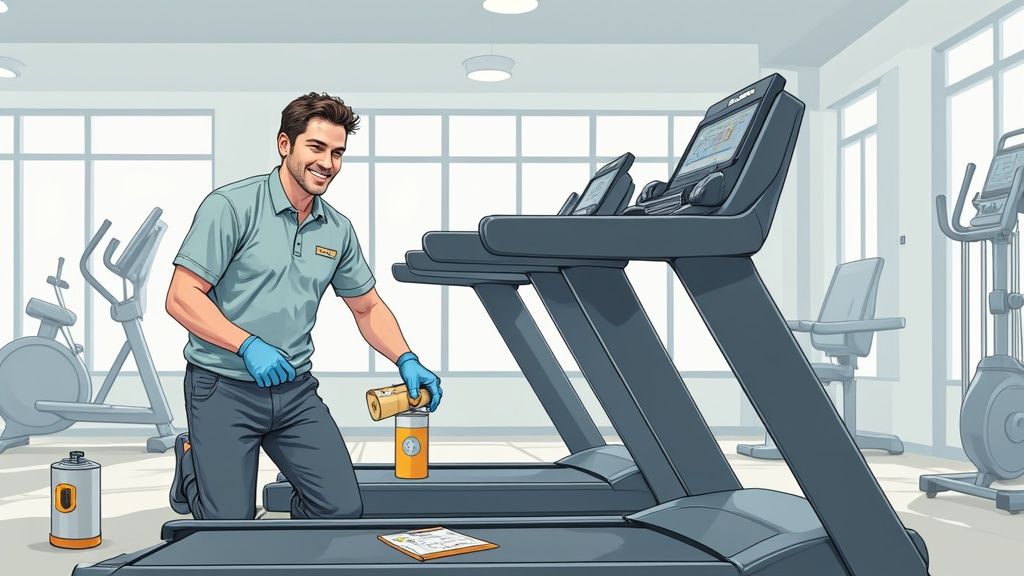
If there's one thing I've learned from years in the fitness industry, it's this: consistent equipment maintenance isn't just a chore, it's the absolute bedrock of a safe, reliable, and thriving gym. We're talking about a hands-on strategy that involves daily cleaning, weekly inspections, and monthly mechanical checks to catch potential problems before they sideline a machine and frustrate a member.
This isn't just about ticking boxes; it's a proactive system that protects your massive investment and delivers the top-tier experience your members pay for.
Your Gym Equipment Maintenance Game Plan
Ready to build a maintenance plan that actually works? One that stops expensive breakdowns in their tracks and keeps your members safe and happy? This is your starting point. We're getting right into the must-do tasks that form the backbone of a truly proactive strategy.
Let's move past the "fix-it-when-it-breaks" chaos. Instead, we'll focus on a clear rhythm of daily, weekly, and monthly checks that will save you a ton of time, money, and stress down the road. This is about mastering the maintenance of gym equipment to protect your most valuable assets. It's a mindset shift that keeps your gym running like a well-oiled machine and builds incredible member trust. For more on that, check out these awesome gym membership tips.
Finding Your Maintenance Rhythm
A successful plan is all about consistency. You need a schedule that assigns different tasks to different frequencies so nothing ever falls through the cracks. The most critical, high-contact stuff happens every single day, while the deeper mechanical dives are saved for weekly or monthly check-ins.
This visual breaks down the essential maintenance flow into a simple, three-part process that anyone can follow.

As you can see, the plan layers itself—starting with daily cleaning and building up to more complex monthly care. It's a system designed for total coverage.
Why Being Proactive Is a Huge Financial Win
Think of preventive maintenance as more than just a safety measure; it's one of the smartest financial moves you can make. It's no surprise that smart facilities are pouring more resources into upkeep. Why? Because it slashes downtime and dramatically extends the life of your equipment.
Consider this: replacing a major piece of cardio equipment can easily cost three times more than what you'd spend keeping members happy with machines that just work.
A well-maintained machine is your silent retention tool. When every treadmill runs smoothly and every cable machine glides perfectly, members feel valued and safe. It powerfully reinforces their decision to stick with your gym.
To help your team stay on track, I've put together a quick-reference table. It’s a simple at-a-glance summary of the most critical tasks organized by how often they need to get done.
Your Essential Maintenance Schedule At-a-Glance
| Frequency | Core Maintenance Tasks | Primary Focus |
|---|---|---|
| Daily | Wipe down all surfaces, check for loose parts, sanitize high-touch areas. | Hygiene, immediate safety, and member experience. |
| Weekly | Inspect cables for fraying, test all electronics, deep clean upholstery. | Wear and tear, functional safety checks. |
| Monthly | Lubricate guide rods and chains, tighten all nuts and bolts, calibrate machines. | Mechanical integrity and long-term performance. |
This schedule is your cheat sheet for consistency. Post it where your team can see it and use it to build a routine that becomes second nature.
Ultimately, a structured plan protects your investment and polishes your gym's reputation. At the end of every day, make it a non-negotiable to clean and sanitize all the high-touch surfaces—grips, seats, screens, and handles. Using a quality product like Wipes.com Disinfectant Wipes ensures your equipment isn't just clean, but genuinely safe for every single member.
Keeping Your Cardio Machines Running Smoothly
Let’s be honest, the cardio section is the engine room of your gym. Your treadmills, ellipticals, stationary bikes, and rowers are absolute workhorses, taking a beating for hours on end, day in and day out. Because they're in constant motion, they demand a whole different level of care than your static strength equipment.
We're talking about getting your hands dirty, going way beyond a simple wipe-down. To keep your members safe and protect your hefty investment, you need to get comfortable with the nuts and bolts. It's all about catching those small, nagging issues before they snowball into catastrophic failures that bring your gym to a grinding halt.

Treadmill Troubleshooting and Care
Treadmills are probably the most complex and high-maintenance beasts in your cardio lineup. With all those moving parts, the belt and motor should be your top obsessions. A belt that’s even slightly misaligned or has the wrong tension is one of the most common—and destructive—problems you'll face.
Ever hear a rhythmic thump-thump-thump or a scraping sound as someone runs? That's your tell-tale sign of a misaligned belt. You can often just eyeball it and see the belt drifting over to one side. Fixing this is usually a quick job with an Allen wrench on the rear roller bolts, but always check the manual first. Each model has its own quirks.
Another classic complaint is a member saying the belt "slips" or stutters under their feet. That’s a dead giveaway the belt is too loose. A quick check is to lift the belt in the middle—you're looking for about 2-3 inches of give. Anything more, and it's time to tighten.
Pro Tip: Resista the urge to overtighten a treadmill belt! A loose belt is a problem, but a belt that's cranked down too tight puts a crushing strain on the motor, rollers, and bearings. You’ll be facing a massive repair bill for fried components. It’s a delicate balance.
Here’s your weekly treadmill hit list:
- Belt Check: Eyeball the alignment and test the tension. Get up close and look for any fraying or wear along the edges.
- Deck Lubrication: With the machine off and unplugged, slide your hand between the belt and the deck. If it feels dry and rough, it's begging for lubrication. A dry deck creates an insane amount of friction that can literally burn out your motor.
- Clean the Motor Bay: Dust is the silent killer of electronics. Once a month, pop the motor cover off and carefully vacuum out all the dust bunnies and debris. This simple step prevents overheating and extends the motor's life significantly.
Ellipticals and Bikes Best Practices
Don’t think your ellipticals, bikes, and rowers get off easy. They have their own unique ways of crying for help, and the most common is noise. That squeaking, clicking, or grinding sound is almost always a loose bolt or a pivot point screaming for a drop of lubricant.
Never, ever ignore those sounds. They are the early warning signs of a bigger problem. Take a second to move the machine through its full range of motion and listen closely to pinpoint exactly where the noise is coming from.
Your practical game plan for these machines:
- Tighten Everything: Seriously. Every week, grab a wrench and do a quick tour of every visible nut and bolt on your ellipticals and bikes. The pedal arms, seat adjustments, and handlebars are notorious for working themselves loose. A single wobbly bolt can ruin a workout and create a seriously annoying racket.
- Focus on Pedals and Straps: Pedals need to be rock-solid. Any wobble is a safety hazard waiting to happen. Give the straps a good look, too—check for cracks or frays, and make sure the buckles are still grabbing tight.
- Inspect Chains and Belts: On bikes and rowers, give the drive chain or belt a once-over. A chain needs proper tension and lubrication to run smoothly. A belt should be free of any cracks or that shiny, glazed look that means it's worn out.
The Finishing Touch on Cardio Care
Let's face it, cardio machines are sweat magnets. Handlebars, seats, and touchscreens are breeding grounds for germs and grime. This is where the final, and most visible, step of your maintenance routine comes in—the part your members will notice every single day. After you've done all the mechanical checks, finish the job by making every surface pristine. This isn't just about cleaning; it's about showing your members you care about their health. For a powerful clean that gets the job done right, we swear by Wipes.com Disinfectant Wipes. They are engineered to destroy germs without damaging sensitive electronics, leaving every machine sparkling, safe, and ready for the next workout.
Strength Equipment Care for Peak Performance
When it comes to keeping your gym in top shape, strength machines and free weights are a whole different beast compared to cardio gear. Think about it: squat racks, benches, and complex cable systems are all about rock-solid stability and predictable movement. Your members are literally trusting their safety to this equipment during their heaviest lifts. There's zero room for error.
This goes way beyond a quick wipe-down. We're talking about a detailed, hands-on process to make sure every bolt is tight, every cable is sound, and every frame is unshakeable. A tiny wobble in a power rack or a small fray in a cable can turn into a catastrophe in a heartbeat. Let’s dive into the essential checks that will keep your strength area safe, reliable, and ready for whatever your members throw at it.

Cable and Pulley Systems: Your First Priority
Cable machines are the workhorses of most strength floors, but all those moving parts make them your most vulnerable pieces of equipment. A snapping cable is one of the most dangerous—and preventable—accidents that can happen in a gym. Meticulous inspection isn't just a good idea; it's your absolute duty.
Every single week, you need to physically run your fingers or a clean rag along the entire length of every single cable. You’re feeling for any hint of fraying, thinning, or weird kinks. Pay extra close attention to the spots that glide over pulleys and connect to attachments, as that's where friction does the most damage.
A common mistake I see is people just glancing at the cables from a distance. The most dangerous wear and tear is often subtle—a slight peeling of the rubber coating or just a few broken wire strands. You have to feel the cable to catch these things early.
Here’s your weekly deep-dive checklist for cables:
- Fraying or "Bird-Caging": This is when individual metal strands break and poke out from the main cable. If you see this, that machine is out of service immediately. No exceptions.
- Cracked Coating: The protective plastic sheath needs to be flawless. Any cracks let in moisture and accelerate the decay of the inner wire.
- Kinks and Bends: A sharp bend permanently weakens a cable's integrity. Even if it’s not fraying yet, a kinked cable is compromised and must be replaced.
- Smooth Pulley Motion: Watch and listen as the cable moves. Any grinding, squeaking, or jerky movement is a huge red flag that the pulley's bearings are shot and need to be cleaned, lubed, or replaced.
The Nuts and Bolts of Racks and Benches
Your squat racks, power cages, and benches are the unsung heroes of the weight room. They might look simple, but their stability is everything. Over time, the constant use, dropped weights, and micro-adjustments cause critical nuts and bolts to loosen.
Once a month, schedule a "tightening tour." Seriously, grab a socket set and methodically go over every single fastener on your racks and benches. You will be amazed at how many have worked themselves loose. A wobbly J-hook or an unstable safety arm is a lawsuit waiting to happen.
While you're at it, give the upholstery on your benches a thorough once-over.
- Look for any rips or tears, especially right along the seams.
- A tiny tear can become a giant gash in no time, exposing the foam padding.
- Exposed foam not only looks terrible but also becomes a disgusting sponge for sweat and bacteria.
Weight Stacks and Selectorized Machines
Selectorized machines are fantastic for guided workouts, but their weight stacks demand a specific kind of care. The guide rods—the two poles the weight stack slides on—have to be perfectly clean and properly lubricated.
If a member mentions a machine feels "sticky" or the weight doesn't move smoothly, dirty guide rods are almost always the culprit. Wipe them down weekly with a clean, dry cloth to get rid of dust and gunk. Afterward, apply a thin layer of a manufacturer-approved lubricant, which is usually a silicone-based spray. Don't overdo it!
The selector pin is another crucial part. Make sure the pin slides fully and securely into the weight stack. A bent pin or one with a frayed lanyard is a hazard and should be replaced immediately. The last thing you want is a weight stack disengaging mid-lift.
It's clear that this level of detail is becoming a global standard. The entire sports and fitness equipment maintenance sector has been analyzed in a massive report covering 195 countries. The study shows a complex, growing market, proving that disciplined maintenance is a worldwide priority. You can discover more insights about this global market analysis and see how your gym's routine fits into a much bigger industry trend.
Finishing with a Focus on Hygiene
After you've tightened the bolts and checked the cables, the final touch is making sure every piece of equipment is impeccably clean. The knurling on barbells, the grips on pulldown bars, and the pads on every machine are high-contact zones that are magnets for sweat and germs. A rigorous daily sanitization routine is non-negotiable. For a surefire way to kill germs without harming your equipment, we highly recommend Wipes.com Disinfectant Wipes. They are tough on pathogens but totally safe for upholstery, metal, and plastic, making them the perfect all-in-one solution to wrap up your strength equipment care.
Building a Maintenance Log That Actually Works
Good intentions don't fix machines, but a great maintenance log absolutely does. Forget wishful thinking; let's get practical and build a tracking system that actually gets used and holds people accountable. Whether you're a spreadsheet wizard or prefer a trusty binder, the real goal is to create a detailed history for every single machine on your floor.
This isn't just about checking a box. A well-kept log is your secret weapon for transforming how you handle maintenance of gym equipment. It turns you from a firefighter putting out surprise equipment failures into a strategist, using data to keep your gym safe, efficient, and profitable.

What to Track for Maximum Impact
A log is only as good as the information you put into it. A note that just says "fixed treadmill" is completely useless a month later. You need the specifics—the little details that tell a story over time and help you spot problems before they become catastrophes.
Think of your maintenance log as a medical chart for your equipment. It documents every check-up, every symptom, and every procedure, giving you a complete history that’s invaluable for diagnosing future problems and predicting its long-term health.
Your log entries are non-negotiable and need to include these key details:
- Equipment ID: Every machine needs a unique name or number. Something simple like "Treadmill-01" or "LegPress-03" works perfectly.
- Date of Service: When, exactly, did the work happen?
- Technician's Name: Who did it? This is all about accountability.
- Tasks Performed: Get specific! "Lubricated belt and deck," "Tightened all frame bolts," or "Replaced frayed pulley cable."
- Parts Used: If you replaced something, log the part number and cost. This is a lifesaver for budgeting.
- Technician's Notes: This is where the real gold is. "Noticed excessive motor heat," or "Left J-hook showing signs of wear." These notes are your early warning system.
Digital vs. Analog: What’s Best for Your Gym?
The classic debate: a digital spreadsheet or a physical binder? Honestly, it just comes down to what your team will actually use. A shared Google Sheet or Excel file is amazing for remote access and instant updates. Your crew can log a repair right from a tablet on the gym floor.
But don't knock the old-school approach. Some teams just work better with a physical binder in the office. There’s something powerful about a printed checklist that ensures nothing gets missed. The real key here is consistency. Pick a system and make it a non-negotiable part of your routine.
It’s no surprise that the global market for exercise equipment repair services is exploding. Valued at around USD 1.5 billion, it's on track to nearly double to USD 2.8 billion by 2033. This just shows how serious the industry is getting about extending equipment life through smart maintenance. You can discover more about this growing market trend and see why logging your efforts is more crucial than ever.
Turning Your Log into a Strategic Asset
This is where the magic really happens. After a few months of diligent logging, you'll start to see incredible patterns emerge from the data. Suddenly, you realize Treadmill-04 needs its belt adjusted every three weeks. That’s not a coincidence; it's a symptom! This insight pushes you to find the root cause—maybe a warped walking deck—before it leads to a total breakdown.
This data-driven approach is also your best friend come budget season. Imagine walking into your manager's office. Instead of just saying "that machine is always broken," you can show them a log detailing $1,200 in repairs over the last six months. Your request for a replacement suddenly becomes a smart business decision. It's the kind of hard data that justifies new investments and can even help you analyze how other revenue streams, like coaching, perform. If you're looking to expand that area, you might be interested in our guide on structuring your fitness and nutrition coaching programs.
Your maintenance log should be a living, breathing document that drives your decisions. As a final step for any logged task, ensure the equipment gets a thorough wipe-down. A quick pass with Wipes.com Disinfectant Wipes not only leaves it sanitized but also sends a clear message to your members: we care about our gym, and we care about you.
Knowing When to Call in a Professional
Smart equipment maintenance is about knowing your machines, but it’s just as much about knowing your own limits. While your team can absolutely crush the daily, weekly, and even monthly checks we’ve covered, there are moments when you have to put down the wrench and pick up the phone.
Honestly, recognizing the line between a DIY fix and a job for a certified pro is one of the most important skills you can develop as a gym operator.
Trying to tackle a complex electrical or mechanical failure without the right training isn't just a bit risky—it's a fast track to voiding your warranty, causing even more expensive damage, and creating a massive safety hazard for your members. For the big stuff, calling in an expert is the only smart move.
Red Flags That Scream "Call a Pro"
Some problems are impossible to miss. If you see smoke, hear a loud bang, or a machine just flat-out dies, you know you're in over your head. But a lot of the most serious issues start with much sneakier warning signs that are all too tempting to ignore or try to fix yourself.
Keep an eye out for these undeniable red flags. If you spot them, it's time to get a certified technician on the line:
- Persistent Electronic Glitches: Is a console constantly freezing, resetting itself, or throwing error codes you can't find in the manual? That’s not a simple glitch; it points to a deeper electronic issue like a failing circuit board that your team isn't equipped to diagnose.
- Strange Motor Noises or Smells: A grinding, whining, or sharp clicking sound coming from inside a treadmill motor housing is a huge warning. If you get a burning smell to go with it, unplug that machine immediately and call for service. Don't wait.
- Structural Damage: Never, ever try to patch up a cracked frame, a bent support leg on a squat rack, or a weld that looks compromised. These are serious structural integrity problems that need a professional eye to determine if the equipment is even safe to use anymore.
- Complex Internal Repairs: Any job that involves taking apart a motor, replacing a drive belt, or fiddling with the internal gearing of a selectorized machine is best left to someone who does it for a living.
Finding and Vetting the Right Technician
Let's be clear: not all technicians are created equal. You need someone who is actually certified to work on your specific brands of equipment. Bringing in the wrong person can easily do more harm than good, so it’s worth taking a few minutes to properly vet your options.
The best place to start is your equipment manufacturer's website. They almost always have a list of authorized service providers in your area. That’s your safest bet. If you strike out there, look for independent technicians who hold certifications from the major players like Precor, Life Fitness, or Technogym.
Pro Tip: Before a technician even sets foot in your gym, ask for proof of insurance. A reputable pro will always have liability insurance to cover any accidental damage. This is completely non-negotiable and protects your expensive assets.
Preparing for a Smooth and Efficient Repair
Once you've booked a service call, a little prep work can make the whole process faster and more efficient, saving you both time and money. Your tech will thank you, and you'll get your machine back on the floor that much sooner.
Before they show up, clear the area around the broken machine so they have plenty of room to work. Have your maintenance log ready with detailed notes about the problem—what it sounds like, when you first noticed it, and any specific error codes you saw. That kind of information is gold for a quick diagnosis.
Ultimately, knowing when to call for backup is a cornerstone of a strong gym business plan. It shows you're committed to safety and are serious about protecting the long-term value of your investments. For more on building a solid foundation for your facility, check out our in-depth article on crafting a successful gym business plan.
And after the pro leaves? Do one final, reassuring clean. A thorough wipe-down with Wipes.com Disinfectant Wipes ensures the machine is not just repaired, but also perfectly clean and sanitized for its grand return to the gym floor.
Got Questions About Gym Equipment Maintenance? We've Got Answers.
Alright, we’ve laid out the schedules and the checklists, but let's be real—the real world always throws a few curveballs. Getting the small details right is what takes a maintenance plan from "good enough" to truly great, and that's where the questions usually pop up.
This is where we tackle those common "what if" and "how to" scenarios head-on. Think of this as your personal troubleshooting guide. Let's get these common questions answered so you can feel 100% confident that your gym is safe, clean, and running like a well-oiled machine.
How Often Should I Really Be Deep Cleaning My Equipment?
Daily wipe-downs are non-negotiable for hygiene, but a true, top-to-bottom deep clean needs to happen at least once a month. If your gym is buzzing with members from open to close, you'll want to bump that up to every two weeks to keep grime and sweat from winning the battle.
A deep clean is way more than just a surface wipe. We're talking about getting into the nitty-gritty:
- Unplugging cardio machines to vacuum out the motor bays and internal compartments. You'd be shocked at the dust bunnies that live in there.
- Taking the time to meticulously clean and lubricate the guide rods on every single selectorized strength machine.
- Carefully removing plastic shrouds and covers (always follow the manufacturer's guide!) to get at the hidden dust and buildup underneath.
The whole point is to hit the spots your daily cleaning crew can't possibly reach. To finish it off, make one final pass on every high-touch surface—grips, pins, pads, and screens—with a powerful sanitizing solution.
When you're doing a deep clean, you need a single tool that can handle every surface without causing damage. Wipes.com Disinfectant Wipes are perfect for this. They're strong enough to kill germs but formulated to be safe on upholstery, plastics, and metal, making them a fantastic all-in-one solution.
What Are the Most Commonly Overlooked Maintenance Tasks?
It's always the little things, isn't it? In my experience, the tasks that get skipped are the ones that require pulling out a tool and spending a few focused minutes on something that isn't obviously broken. Yet, these are the tasks that prevent catastrophic failures down the road.
Here are the top three maintenance tasks that consistently fall through the cracks:
- The "Tightening Tour": Every nut, bolt, and screw on your racks, benches, and machines is constantly vibrating. This means they will loosen over time. Once a month, grab a socket wrench and do a full tour of the facility, tightening everything down. This simple habit prevents dangerous wobbles and instability.
- Cable Connection Point Inspections: People glance at the middle of a cable and think it looks fine. The real danger zone is at the terminal fittings—where the cable connects to the weight stack or an attachment. Look closely for any signs of fraying or unusual strain right at these connection points. That’s where they fail first.
- Vacuuming Cardio Motors: Dust is the archenemy of electronics. It acts like a blanket, causing motors and control boards to overheat and fry themselves. Spending five minutes with a vacuum extension can literally add years to the life of a treadmill or elliptical.
Do yourself a favor and set recurring calendar reminders for these specific tasks. It's the only surefire way to make sure they actually get done.
Are Generic Household Cleaners Safe for My Gym Equipment?
Absolutely not. Using a generic all-purpose cleaner from the grocery store on your thousands of dollars of equipment is a massive, costly gamble. Most of these cleaners are packed with harsh chemicals like ammonia, bleach, or high concentrations of alcohol that will wreak havoc on your gear.
Over time, these chemicals will:
- Dry out, bleach, and eventually crack the vinyl upholstery on your benches and pads.
- Create a cloudy haze or permanently damage sensitive electronic touchscreens.
- Eat away at the protective coatings on metal frames, opening the door for rust.
When in doubt, always—and I mean always—check the user manual for the manufacturer's specific cleaning guidelines. If you can't find it, stick with products specifically made for fitness equipment. You need something that's tough on germs but gentle on materials.
What's the Best Way to Log and Document Repairs?
Forget the dusty binder and stray sticky notes. In this day and age, a digital system is the only way to go. Whether it's a shared spreadsheet like Google Sheets or a dedicated facility management software, you need a central, accessible log for your entire team. The key here is consistency.
Every single time you perform a repair, your log entry needs to capture a few key pieces of information to be truly useful:
- Equipment ID: Give every machine a unique name (e.g., Treadmill-03, LegPress-01).
- Date & Technician: Who did the work and when?
- Detailed Notes: What was wrong? What was the fix? Did you use any parts (include part numbers!)?
- Next Service Date: While it's fresh in your mind, schedule the next preventative check.
This creates a priceless historical record of your equipment. You'll start to see patterns, spot a "lemon" machine that needs replacing, and be able to justify budget requests with cold, hard data. Most importantly, it's your proof that you're doing your due diligence to keep your members safe.
Leave a Reply