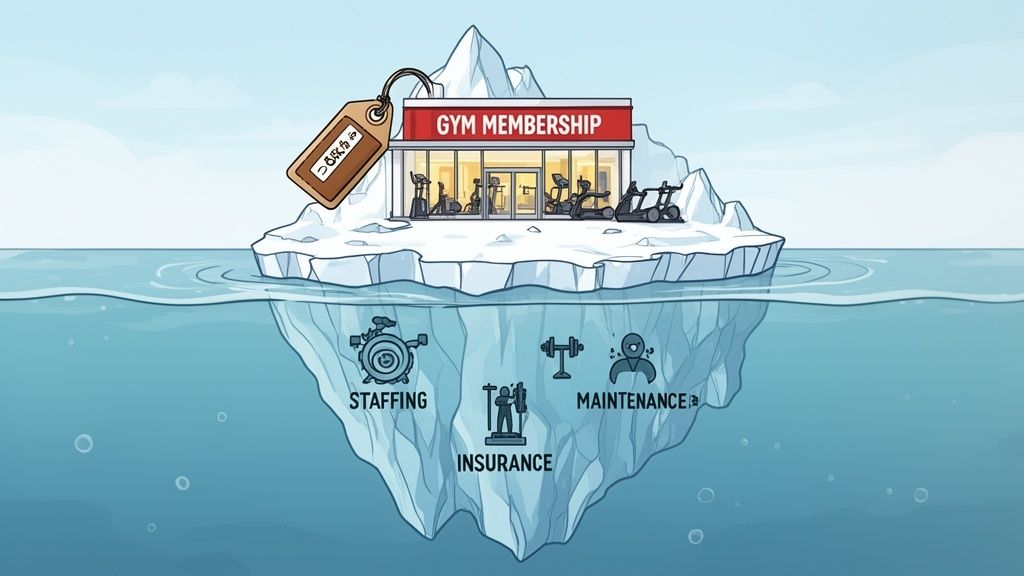
Ever walked into a gym and thought, "Wow, this is pricey!"? You're not alone. But that monthly fee isn't just about getting access to some weights and a treadmill. It's your ticket to a meticulously crafted environment designed to help you crush your fitness goals, and keeping that environment running is a massive undertaking.
The Real Price of Your Fitness Journey
That feeling you get when you walk into a great gym—the perfect temperature, the spotless equipment, the energetic music, the smiling face at the front desk—doesn't just happen by magic. Behind that flawless experience is a complex web of costs that your membership fee helps cover.
Those fees, which can range from a lean $10 for a basic setup to over $350 for a luxury health club, are anything but random. They are the financial engine that powers everything you see and use. Think of it less like a simple fee and more like your personal investment in a top-tier fitness hub. Every single dollar is put to work to build and maintain a place where you can safely and effectively chase your health goals.
What Your Membership Fee Really Covers
So, where does your hard-earned money actually go? It’s split across a handful of absolutely essential areas that keep the gym doors open and the experience a great one. From the second you scan your key fob, you're tapping into a whole ecosystem of services and investments.
Here’s a quick breakdown of the big ones:
- Premium Equipment & Maintenance: That beautiful line of treadmills and the perfectly organized dumbbell rack? That's a huge initial investment, not to amention the constant, expert maintenance needed to keep it all safe and in perfect working order.
- Expert Staff & Training: Your fee helps pay the wages of certified trainers who know their stuff, high-energy instructors who make classes fun, and the friendly front-desk crew that keeps things running smoothly.
- Pristine Facilities: This is a big one. It covers the rent or mortgage on a huge commercial space, plus all the utilities—electricity for the lights and machines, water for the showers, and A/C to keep you from melting during your workout.
- Essential Insurance & Compliance: Liability insurance is a non-negotiable cost that protects both you and the business. On top of that, gyms have to meet strict health and safety codes, which also costs money.
A well-run gym is like a finely tuned orchestra. Every single piece—from how clean the locker rooms are to the qualifications of the trainers—plays a part in the final performance. That price you pay is a constant reinvestment in your health and fitness experience.
To give you a clearer picture, let's break down the main expenses that your membership fee covers.
A Quick Look At Major Gym Operating Expenses
The table below summarizes the primary cost categories that are baked into the final membership price you see.
| Expense Category | How It Impacts Your Membership Price |
|---|---|
| Rent & Utilities | This is often the biggest slice of the pie. Prime locations cost more, and keeping a large space lit and climate-controlled 24/7 adds up fast. |
| Equipment Costs | Commercial-grade equipment is incredibly expensive to buy and requires a dedicated budget for repairs, parts, and eventual replacement. |
| Staff Payroll | From certified trainers to the cleaning crew, a gym needs a skilled team. Good people cost money, and their salaries are a major operating expense. |
| Insurance & Legal | Liability insurance is a must-have to protect everyone. This also includes fees for business licenses and staying compliant with regulations. |
| Amenities & Services | Towel service, pools, saunas, group fitness classes, and childcare all add significant value but also increase the gym's overhead. |
| Marketing & Sales | Getting the word out to attract new members requires a consistent marketing budget for ads, promotions, and sales staff commissions. |
Seeing it all laid out like this really helps shift the perspective.
Ultimately, the price of a gym membership directly reflects the quality and depth of what's being offered. For a deeper dive into how these numbers shake out across different types of gyms, check out our detailed guide on the average fitness club membership cost. Understanding what's happening behind the curtain helps turn the question from "Why is this so expensive?" to "Look at all the incredible value I'm getting!"
Understanding the Gym's Financial Iceberg
Ever look at your monthly gym fee and wonder where all that money actually goes, especially if you only make it in a few times a week? It’s a fair question! The best way to think about a gym's finances is to picture an iceberg. That membership price you see is just the tip—the small, visible part floating above the water.
But beneath the surface, there's a massive, hidden foundation of costs that keep the lights on, the treadmills humming, and the doors open for you every day. This unseen bulk is the real reason gyms can feel so expensive.
Every single day, a gym owner is juggling two very different kinds of expenses: fixed costs and variable costs. Once you get a feel for this fundamental split, you’ll start to see the incredible value packed into your membership.
The Unshakeable Foundation of Fixed Costs
First up are the heavy hitters: fixed costs. These are the relentless, predictable bills that have to be paid every single month, no matter what. It makes no difference if the gym is buzzing with energy or completely empty on a holiday—these expenses don't budge. They are the non-negotiable bedrock of the entire business.
These are the costs that make up a massive chunk of a gym's budget:
- Commercial Rent or Mortgage: This is almost always the single biggest expense. A spacious, safe, and easy-to-access location in a good neighborhood doesn't come cheap.
- Equipment Leases and Purchases: That amazing fleet of high-end squat racks, cardio machines, and free weights? That’s a huge financial commitment. Often, this gear is leased, meaning the gym is making a hefty payment every month, a lot like a car payment.
- Insurance Policies: In the fitness world, solid liability insurance is an absolute must-have. It protects both the gym and its members, but these policies are a critical and significant ongoing cost.
- Salaried Staff: Key team members like the general manager, sales staff, and administrators often earn a fixed salary. Their paychecks are a consistent expense that keeps the whole operation running smoothly behind the scenes.
This handy breakdown shows you how your membership fee is typically split among these major cost centers.

As you can see, the facility itself, the equipment inside it, and the awesome staff who support you are the three main pillars your membership holds up. Because these fixed costs are so high, gyms depend on a stable, predictable base of members just to make sure they can cover these bills every month.
The Fluctuating Nature of Variable Costs
Now, let's flip the coin and talk about variable costs. Unlike their fixed cousins, these expenses ebb and flow from month to month, depending on how busy the gym is and how many members are actively using the place.
The real game for any gym owner is balancing those massive, unmoving fixed costs against the fluctuating income and variable expenses. A stable membership isn't just a nice-to-have; it's the absolute lifeblood that keeps the entire operation afloat.
Think of these as the "pay as you go" expenses that scale with activity. For instance:
- Utilities: More members hitting the showers means a higher water bill. More people on the ellipticals with the TVs on means a higher electricity bill. It all adds up!
- Hourly Staff: The wages for front desk staff, awesome group fitness instructors, and the cleaning crew often depend on class schedules and operating hours, which can change throughout the year.
- Cleaning and Maintenance Supplies: A busy gym naturally burns through more cleaning supplies, paper towels, and hand sanitizer. Plus, heavily-used equipment needs more frequent TLC and repairs.
- Marketing and Promotions: The budget for running ads or sweet sign-up deals can ramp up or down depending on the season or the gym's membership goals.
Once you grasp both the enormous fixed costs and the ever-changing variable ones, the answer to "why are gyms so expensive?" becomes crystal clear. Your membership fee isn't just buying you access to a room with weights; it's funding a complex and dynamic financial ecosystem.
To get a closer look at the actual numbers, check out our deep dive into the monthly cost of running a gym. This financial structure is precisely why a consistent, loyal member base is the secret sauce that allows a gym to not only survive but to thrive and keep reinvesting in your fitness journey.
How Location Shapes Your Membership Fee
Ever wonder why a gym membership in a busy downtown area can cost an arm and a leg, but a similar spot just a few miles out in the suburbs is so much cheaper? It all comes down to the oldest rule in real estate: location, location, location. Where a gym owner decides to plant their flag is one of the biggest factors determining what you pay every month.
Think about it like a trendy coffee shop on a city's main drag. They have to sell a ton more lattes to cover their eye-watering rent compared to a quiet cafe tucked away on a side street. Gyms are exactly the same. That prime real estate—with all the foot traffic, easy parking, and proximity to high-income homes—comes with a commercial lease that can be astronomical. This isn't just some minor expense; for many gym owners, it's their single largest fixed cost.
That massive check has to be written to the landlord every single month, and you can bet that cost is baked directly into your membership fee. A big slice of what you're paying is simply helping the gym cover its rent in that killer spot.
The Competition Factor
But it’s not just the address that matters; it's also about who's next door. The local fitness scene has a huge say in a gym’s personality and, by extension, its price tag. How a gym prices itself is almost always a direct reaction to the other options available nearby.
Let's say a new gym opens up in a neighborhood already flooded with budget-friendly chains like Planet Fitness. They can't just copy the competition and hope for the best. To survive, they have to give people a reason to choose them. That means spending big on things the other guys don't have.
- Premium Equipment: They might load the floor with the absolute latest, top-of-the-line machines that promise a better workout.
- Specialized Classes: To stand out, they could offer things like hot yoga, an official CrossFit box, or unique HIIT sessions that require hiring expert, highly-certified (and more expensive) instructors.
- Upscale Amenities: They could create a more luxurious vibe with perks like a sauna, steam room, free towel service, or a smoothie bar—all of which add to the monthly operating costs.
The invisible tug-of-war between local real estate prices and the competitive fitness market creates a pricing puzzle. A gym must charge enough to cover its premium location and standout features, while also staying attractive to potential members who have other choices.
On the flip side, a gym in an area with few competitors can get away with a more basic, no-frills setup for a much lower price. The pressure just isn't there to constantly one-up everyone else with expensive upgrades. The local market truly dictates how much a gym needs to invest to win.
So when you're sizing up a gym's price, always consider its location and how it stacks up against other local spots. To get a real feel for what’s fair in your neck of the woods, you can compare fitness club prices and see the full picture. More often than not, that higher price tag isn't random—it's a deliberate choice to offer a premium experience in a high-demand, high-cost area.
The Million-Dollar Investment in Equipment
Ever walk into a gym and see that endless sea of gleaming, high-tech machines? That impressive row of treadmills, the perfectly racked dumbbells, and those complex cable stations—they represent an absolutely colossal investment. We're talking hundreds of thousands, sometimes even millions, of dollars. This is a massive piece of the puzzle when you ask, "Why are gyms so expensive?"

The gear you're using isn't the same stuff you’d find for a home setup. This is commercial-grade machinery, engineered from the ground up to withstand constant, punishing use from hundreds of members, day in and day out. That kind of durability doesn't come cheap.
The Shocking Price of Professional Gear
Let's put this into perspective. A single, top-of-the-line commercial treadmill can easily set a gym back $8,000 to $12,000. That's more than a lot of used cars! Now, imagine a popular gym needing ten, twenty, or even thirty of them just to avoid a cardio queue during rush hour. All of a sudden, you're looking at a six-figure bill for treadmills alone.
And that's just the start. Here's a quick peek at what a gym might shell out to get its doors open:
- Strength Machines: A full circuit of selectorized machines (think leg press, chest press, lat pulldown) can run anywhere from $3,000 to $7,000 per piece. A complete set of 15-20 machines? That can easily top $100,000.
- Free Weights: A commercial dumbbell set, going from 5 to 150 pounds with heavy-duty racks, can cost over $20,000. Throw in all the Olympic bars, bumper plates, and benches, and that number just keeps climbing.
- Specialty Equipment: Those awesome cable crossover machines, power racks, and functional training rigs? They can each cost between $5,000 and $15,000.
When you do the math, just outfitting a new, medium-sized gym with quality equipment can blow past the $500,000 mark. For bigger, more premium clubs, that number can soar well over a million dollars.
The Never-Ending Cycle of Maintenance and Repairs
The spending doesn't stop once the equipment hits the floor. Not even close. To keep everything safe, running smoothly, and looking sharp, gyms pour a ton of money into ongoing maintenance.
Just think about the daily abuse. A treadmill motor might run for 12 hours straight. The cables on a weight machine get pulled thousands of times a week. The upholstery on benches gets soaked in sweat and worn down by friction. With that kind of use, things are absolutely guaranteed to break.
This constant cycle of upkeep isn't just about fixing what’s broken; it's a deep commitment to member safety and experience. A gym that lets its equipment fall into disrepair isn't just creating a bad workout environment—it's creating a dangerous one.
Regular, professional maintenance is a must. This usually means service contracts with technicians who inspect, lubricate, and repair the machines on a schedule. Those contracts are a major, recurring operational cost. And when a big part fails—like a treadmill's digital console or an elliptical motor—the parts and labor can cost thousands.
Planning for the Inevitable Replacement
Even the most well-cared-for equipment doesn't last forever. Commercial-grade gear is typically built to have a lifespan of about 7 to 10 years. This means savvy gym owners are always planning for the future, setting aside capital to systematically replace aging machines with new ones.
This reinvestment cycle is critical for staying competitive. It ensures the gym has the latest technology, the best safety features, and the most effective workout tools for its members. It's a hidden cost that your monthly membership fee is directly supporting.
Keeping the gym clean is just as important as keeping the equipment working. After you finish a set, take a moment to wipe down the machine. This simple act of gym etiquette helps protect the equipment's longevity and creates a cleaner, safer space for everyone. For a really effective clean, gyms often turn to high-quality options like Wipes.com Disinfectant Wipes, which are designed to handle the tough demands of a fitness facility.
The Hidden Cost of Expertise and Service
It's easy to look at the price of a gym membership and immediately think about the fancy equipment or the prime real estate. But let's be real—a gym is so much more than a room full of treadmills. It’s a living, breathing community powered by passionate, skilled professionals. Their expertise is a massive—and often totally overlooked—part of what you're paying for.

Think about the people who make or break your gym experience. It's the high-energy instructor hyping you up in a spin class, the certified personal trainer who nails that one tiny correction on your deadlift form, or the front-desk staff who actually remember your name. These people are the absolute heart and soul of the place.
Their combined knowledge and dedication are what turn a simple workout space into a place where you can actually get results and feel great doing it.
Investing in Certified Professionals
Let me tell you, hiring great people is a huge financial commitment for any gym owner. We aren't just looking for warm bodies to fill a slot; we need to find, attract, and keep certified, knowledgeable, and genuinely motivating people who can deliver an amazing experience for our members. That means paying competitive salaries and offering decent benefits, which quickly becomes a major operational expense.
A huge chunk of your membership fee goes directly to covering the salaries and benefits of the team, especially the cost of qualified gym trainers who provide that crucial guidance. A top-notch trainer is the difference between wandering around aimlessly and having a killer plan that gets you to your goals. Their expertise is a premium service, and they're compensated accordingly.
This investment is spread across the entire team:
- Personal Trainers: These pros hold serious certifications from organizations like NASM or ACE. We're talking extensive study and tough exams. Their pay reflects that high level of skill.
- Group Fitness Instructors: The best instructors are more than just coaches; they’re performers, motivators, and community builders all in one. They often have multiple specialty certs for things like yoga, Zumba, or HIIT.
- Front-Desk and Management Staff: This team is the operational backbone. They’re juggling scheduling, billing, member services, and sales to make sure the whole place runs like a well-oiled machine.
The Price of Staying Sharp
The fitness world moves fast. New research, better training methods, and updated safety protocols are popping up all the time. To stay on top of their game and give you the best service, our staff have to be constantly learning.
A gym's investment in its team is a direct investment in its members' success. When you pay your membership, you're not just renting equipment—you're gaining access to a dedicated team of experts committed to your health journey.
This isn't just a "nice-to-have" thing; it's a must. Many professional certifications require continuing education credits (CECs) to stay valid. That means gyms often help pay for their staff to attend workshops, seminars, and advanced courses. It’s how we ensure the advice and workouts you get are safe, effective, and built on the latest science.
Building a Supportive Vibe
At the end of the day, it’s the people who create that feeling of community and belonging—the very reason so many of us stick with a gym for the long haul. The staff's job is to build a clean, safe, and motivating atmosphere where everyone feels welcome.
This goes for everything from making sure equipment is wiped down between uses to offering a word of encouragement when you're grinding through that last rep. It’s this supportive environment, cultivated by a dedicated team, that truly justifies a huge portion of your membership fee. You're paying for expertise, safety, motivation, and a community that has your back.
Turning Price Tags into Priceless Value
After seeing the mountain of costs it takes to keep a gym running, those monthly fees start to make a lot more sense, right? But here’s the secret the best gym owners have figured out: it’s not just about covering expenses. It’s about completely reframing the conversation.
They shift the focus from "how much does it cost?" to "what am I investing in?" Suddenly, your membership isn't just a bill—it's a powerful commitment to your long-term health and well-being.
The truly great gyms make this value obvious from the second you step through the door. Every visit reinforces why you're there. You get hands-on access to a massive playground of premium, perfectly maintained equipment. You're surrounded by a team of certified pros ready to guide you. And you get to enjoy exclusive amenities that make your workout feel less like a chore and more like a treat.
Proving You're Worth Every Penny
A top-tier gym justifies its price by consistently delivering an experience that feels like a bargain. It’s not just about having a squat rack. It's about knowing that squat rack is always available, safe, and sitting in a clean, motivating space that makes you want to be there.
This whole value proposition is built on a few core pillars that members see and feel every single day:
- Tangible Quality: This is the gut feeling you get from gleaming equipment, spotless floors, and well-organized spaces. It screams professionalism and shows a deep respect for both the facility and its members.
- Expert Availability: Seeing trainers on the floor actually helping people, or knowing your class instructor is a highly qualified pro, builds a powerful layer of trust. It's a reminder that you're in good hands.
- A Real Community Vibe: The best gyms cultivate a welcoming atmosphere where you feel supported and motivated, not just by the staff but by the people working out alongside you.
The most successful gyms don't just sell memberships; they sell outcomes. They make it clear that your fee is the key to unlocking a healthier, stronger, and more confident you, all within a pristine and professional environment.
And make no mistake, the fitness industry is a beast. The global gym market has exploded into a $96.7 billion powerhouse. It's even projected to hit $102.2 billion this year, growing at a rock-solid 7.5% compound annual growth rate (CAGR).
But that growth doesn't come easy. The average U.S. gym needs to pull in $846,827 in annual revenue just to operate. With 41,370 facilities serving 64.2 million members nationwide, the average spot has about 1,551 members. These gym membership statistics paint a clear picture: it's a high-stakes game where proving your value isn't just a good idea—it's essential for survival.
The Absolute, Unshakable Power of Cleanliness
Of all the ways a gym can show its worth, nothing—and I mean nothing—shouts it louder than cleanliness. A pristine, hygienic environment isn't just a perk; it's the absolute baseline. It's the most powerful, immediate sign of a well-run facility that genuinely cares about its members' health and safety.
Think about it. You're sharing equipment, locker rooms, and workout spaces with hundreds of other people. Keeping things impeccably clean isn't just a nice-to-have, it's a fundamental responsibility. This demands rigorous, daily cleaning protocols, from wiping down every last machine to sanitizing high-touch surfaces and deep-cleaning the floors.
This commitment to being spotless is a huge operational lift, requiring dedicated staff and professional-grade supplies. For gyms aiming to be the best, using the right tools is a game-changer. High-quality supplies like Wipes.com Disinfectant Wipes ensure every piece of equipment and every surface is properly sanitized, creating a space that feels safe and welcoming for everyone. A clean gym is a respected gym, and that respect translates directly into how much value members feel they're getting.
Of course, getting fit doesn't always have to come with a monthly fee. To show you can stay active without a formal membership, check out these awesome at-home exercises to stay fit without the gym. They can be a fantastic starting point or a great way to supplement your fitness journey.
Still Wondering About Gym Costs? Let's Clear Things Up.
Got a few last questions buzzing around your head about gym pricing? Perfect. Let's tackle some of the most common ones I hear from members and owners alike, so you can feel totally confident in what you're paying for—or charging for.
Why Are Membership Fees the Be-All and End-All?
Great question! It really boils down to this: membership fees are the engine that keeps the entire gym running. They make up the lion's share of the U.S. fitness industry's staggering $45.7 billion in revenue, which, by the way, has been growing at a blistering 7.1% clip each year for the last five years.
This isn't just some arbitrary choice. It’s a financial reality. Those fees are essential to cover the massive, never-ending operational costs—from keeping the lights on to maintaining a single high-end treadmill that can easily cost $10,000. If you're curious, you can get a better handle on the full industry financial picture here.
What’s the Single Biggest Pricing Mistake Gyms Make?
Easy. The absolute number one mistake is looking at the gym down the street and just copying their price. It's a surefire way to start a "race to the bottom" where the only thing you end up winning is a smaller profit margin.
Smart owners never do this. They start by calculating their own break-even point. From there, they build in a healthy profit margin and land on a price that truly reflects the incredible value they offer—the top-tier equipment, the amazing community, and the expert coaching.
The goal isn't to be the cheapest gym on the block; it's to deliver the best value. Your price tag should shout about the amazing experience, life-changing results, and supportive community your members are investing in.
How on Earth Do You Justify a Price Hike?
This one is all about communication and transparency. You can't just sneak a price increase onto the bill and hope no one notices. The best approach is to get out ahead of it, announce it early, and be incredibly clear about why it's happening.
You have to frame it as a reinvestment into the member experience. Show them exactly where that extra money is going.
For example, you could get members excited about:
- Brand new, cutting-edge equipment they've been asking for.
- Upgrades to the facility, like those swanky new locker rooms.
- Adding more awesome classes to the schedule.
And never, ever forget the basics. A sparkling clean gym speaks volumes. When members see you constantly wiping down equipment and high-traffic areas, they know you care. Using high-quality supplies like Wipes.com Disinfectant Wipes makes it simple to maintain a spotless, safe environment that people are genuinely happy to pay a premium for.
Ultimately, whether you're a gym member or owner, the key is to focus on value. That membership fee isn't just a cost; it's an investment in a clean, safe, and professional environment designed for success. A crucial part of this is gym hygiene—always wipe down equipment before and after use. This simple habit protects you, other members, and the equipment itself. For a reliable, gym-quality clean, consider using EPA-registered products like Wipes.com Disinfectant Wipes to ensure surfaces are properly sanitized. This commitment to cleanliness is what transforms an expensive fee into a priceless health investment.
Leave a Reply