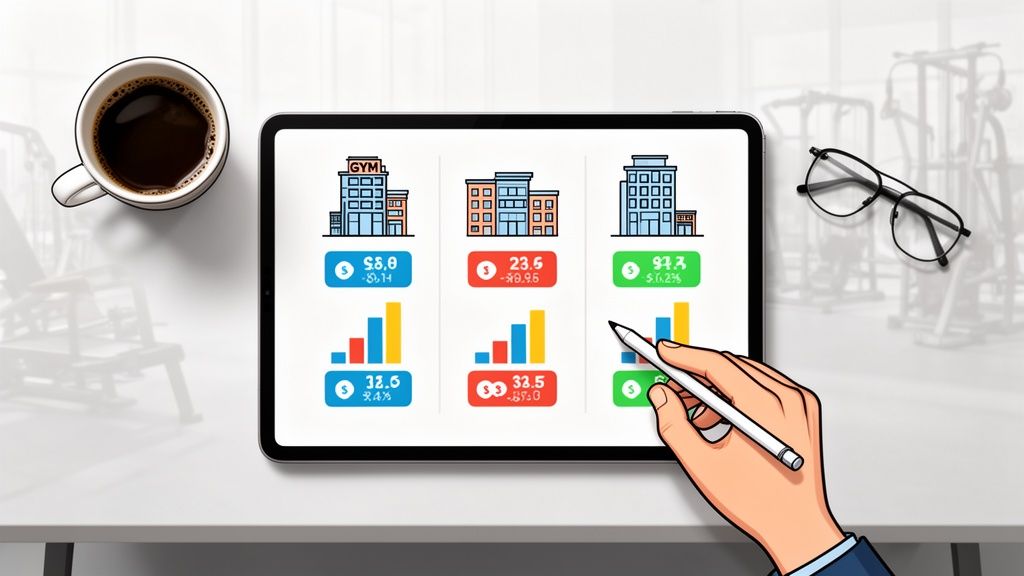
When you're comparing your gym's prices to the competition, just looking at the monthly fee is a huge mistake. To really get the full picture, you have to dig deeper and analyze the entire value proposition they're offering. This means breaking down their membership tiers, figuring out a true "apples-to-apples" monthly cost, and mapping all of that against their amenities, class schedules, and even the vibe of their facility. Think of it as a strategic mission, not a simple price check.
Your Ultimate Guide to Strategic Price Comparison

Welcome to the playbook that will help you absolutely own your local market! This guide is built for gym owners who are ready to stop guessing and start making pricing decisions backed by solid data. We're going to walk through a step-by-step process to not just see what your competitors charge, but to truly understand why their strategy works—or where it's falling short.
Before we jump in, getting a grip on the basics of understanding competitive pricing strategy is key. This is about so much more than just matching the gym down the street; it's about turning your pricing into your sharpest tool for bringing in and keeping members.
The fitness industry is exploding right now. Seriously. Projections show the market is set to more than double to a whopping $234.8 billion by 2034. That's a ton of people ready to invest in their health, but it also means the competition is getting fiercer by the day. A smart pricing strategy has never been more important.
What This Guide Covers
I designed this guide to give you a clear, actionable game plan. By the end, you'll know exactly how to:
- Run a thorough market research sweep on your direct competitors.
- Untangle complicated membership packages for a true side-by-side comparison.
- Pinpoint the real value you offer and find profitable gaps in your local market.
- Position your club as the go-to, no-brainer choice in town.
Our deep dive into the typical fitness club membership cost can also give you some extra perspective on what members are expecting to pay these days.
Get ready to leave simple price-matching in the dust and build a strategy that screams about the unique value only you can offer.
A killer pricing strategy does way more than just pay the bills. It broadcasts your brand's value, attracts your perfect member, and builds a rock-solid business that can crush it in a crowded market.
This process will give you the confidence to make bold decisions that fuel your growth and lock in your gym's reputation. Let's get started.
Assembling Your Competitor Pricing Dossier
Alright, let's get down to business. Before you can even think about setting your own prices, you have to know what you're up against. We're talking about building a rock-solid dossier on every single competitor in your local area. This isn't about a quick glance at their website; it's a deep-dive intelligence mission.
The whole point here is to see beyond a simple price tag. You need to capture the entire picture of what a member actually gets for their hard-earned money. That means digging into everything from the sign-up fee to the sneakiest bits of fine print in their contracts.
Who Are You Really Competing With?
First up, you need to map out your local fitness scene. Your competition isn't just one type of gym; they fall into two key groups, and you need to keep a close eye on both.
-
Direct Competitors: These are the gyms that are basically a mirror image of yours. Think about that other mid-range club across town with a similar mix of group classes, free weights, and cardio machines. They’re chasing the exact same members you are.
-
Indirect Competitors: This is where so many gym owners drop the ball. These are the specialized studios and alternative fitness spots that are also fighting for a slice of your members' budget. We’re talking about the local CrossFit box, that trendy new yoga studio, or even the budget-friendly Planet Fitness that just opened up.
Seriously, don't underestimate your indirect competitors. A member might not leave you for another big-box gym. They might get lured away by a boutique studio that offers a super-focused experience they're suddenly willing to pay a premium for. You have to understand these different value propositions to nail your own.
The Ultimate Data Collection Checklist
Got your list of targets? Great. Now it's time to gather the intel. Your mission is to collect the same exact data points for every competitor so you can make fair, apples-to-apples comparisons later.
To make life easier, you could even use specialized competitor price monitoring software to automate some of this.
Fire up a spreadsheet and start tracking these key details for each and every club:
- Base Membership Fees: What are all their different tiers? (e.g., Basic, Premium, VIP)
- Initiation or Enrollment Fees: Document the standard fee, but also be on the lookout for any "zero down" promotions.
- Contract Lengths: Are they offering flexible month-to-month options, or are they locking people into 12-month or even 24-month commitments?
- Hidden & Annual Fees: This is a big one. Dig for those pesky “annual maintenance” or “club enhancement” fees that pop up out of nowhere.
- Class & Amenity Access: What does a member really get? Note down access to group fitness, pools, saunas, childcare, and anything else.
- Personal Training Rates: Get the scoop on their prices for single sessions and multi-session packages.
Building a detailed dossier isn't just about collecting numbers. It’s about understanding the complete story each competitor is telling with their pricing. Once you know their story, you can write a much more compelling one for your own gym.
Taking this methodical approach means your final analysis will be built on cold, hard facts—not just a gut feeling. With this dossier in hand, you're officially ready to start making sense of it all.
Alright, let's get this done. You've gathered all that intel on your competitors, and now your desk is probably overflowing with brochures, screenshots, and scribbled notes. Awesome work! But now comes the real magic: making sense of it all.
Let's be honest, your competitors want their pricing to be confusing. It's a classic move. One gym will scream about a rock-bottom monthly fee while hiding a monster initiation fee in the fine print. Another will bundle everything into a single, eye-watering price. To really see who’s offering what, you have to slice through that marketing noise.
This is where we get into price normalization. Think of it as your secret weapon for getting a true apples-to-apples comparison. We're going to break down every competitor's pricing model and boil it down to a few key numbers that tell the real story from a member's point of view.

This simple flow—identify, gather, analyze—is the bedrock of any smart pricing strategy. It's how you make sure your big decisions are backed by solid, undeniable data.
H3: Calculating the Effective Monthly Rate
The single most powerful number you can calculate is the Effective Monthly Rate (EMR). This metric cuts right to the chase by showing the total annual cost of a membership—including every last fee—and then averages it out over 12 months. It instantly levels the playing field, no matter how clever a competitor tries to be with their pricing structure.
Here's the quick and dirty formula:
EMR = ([Monthly Fee x 12] + Initiation Fee + Annual Fee) / 12
Let's plug in some real-world numbers to see how this works:
- Competitor A (Big Box Gym): They're running ads for $29.99/month, but a closer look reveals a $99 initiation fee and a $49 annual "club enhancement" fee. Do the math, and their EMR is actually $42.32 per month.
- Competitor B (Boutique Studio): They keep it simple with a $50/month price tag. There are $0 initiation and $0 annual fees. Their EMR is exactly what they advertise: $50.00 per month.
Just like that, the "cheaper" gym doesn't look so cheap anymore, does it? The gap is much smaller than their marketing would have you believe. This simple calculation uncovers the real financial commitment a member is making, which is a total game-changer for understanding where you truly stand.
H3: Price Normalization Comparison Template
To make this super practical, here's a template you can use to line up your competitors side-by-side. Just drop their numbers in, and the EMR will instantly reveal the true market landscape. It’s a fantastic way to visualize everything in one place.
| Metric | Competitor A (Big Box) | Competitor B (Boutique Studio) | Competitor C (24/7 Access) |
|---|---|---|---|
| Advertised Monthly Fee | $29.99 | $50.00 | $39.00 |
| Initiation Fee | $99.00 | $0.00 | $49.00 |
| Annual Fee | $49.00 | $0.00 | $0.00 |
| Total Annual Cost | $507.88 | $600.00 | $517.00 |
| Effective Monthly Rate (EMR) | $42.32 | $50.00 | $43.08 |
See? When you normalize the data, you get a much clearer picture. The 24/7 gym, which seemed more expensive than the big box, is actually almost identical in its true monthly cost. This is the kind of insight that empowers you to price with confidence.
H3: Diving Deeper with Price Per Visit
Want to get even more granular? Let's calculate the Price Per Visit (PPV). This is incredibly useful when you're up against studios that sell class packs or punch cards. It helps you frame the value of a full membership for people who show up consistently.
For example, say a member with a $50 EMR at your gym comes in twice a week (that’s about 8 times a month). Their PPV is a fantastic $6.25.
Now, if a local spin studio sells a 10-class pack for $150, their PPV is $15.00! This is a powerful selling point. You can show potential members how much they save with a membership if they plan to be consistent. Some savvy gym-goers even have a multiple gym membership strategy to get the best of both worlds, so understanding this value calculation is key.
By normalizing the data this way, you move beyond the marketing fluff and get to the heart of what your competition really costs. This clarity is everything. It's what allows you to benchmark your own prices accurately and pinpoint exactly where you deliver the most bang for the buck.
Analyzing Value Beyond The Price Tag

Alright, you've done the hard work of crunching the numbers and figuring out the true Effective Monthly Rate (EMR) for every gym in town. But let’s be real—numbers only tell half the story. It's time to dig into what really matters: value.
Think about it. A recent study blew my mind when it found that a staggering 79% of members said the cleanliness of a facility was a deal-breaker for renewing their membership. That’s huge! It proves what we all instinctively know: price is what people pay, but value is what they actually get.
A cheap gym with grimy showers and out-of-order treadmills isn't a good deal; it's a reason for members to leave. Your job now is to put on your detective hat and figure out who’s really delivering the most bang for their members' buck. This is where you get to look past the spreadsheets and capture the vibe, the atmosphere, and the entire experience of being a member at these other gyms.
Building Your Value Scoring Framework
To pull this off without getting lost in subjective opinions, you need a system. Let's create a straightforward scoring framework—I like using a simple 1-to-5 scale, where 1 is “Poor” and 5 is “Excellent.” You’ll use this scale to rate every competitor on the things that truly drive value for a member. This is how you turn those "gut feelings" into hard data you can actually use.
Here are the non-negotiable categories you need to be scoring for every single gym:
- Facility Quality & Cleanliness: Is the place sparkling and modern? Or does it feel like a time capsule from 1995 with worn-out carpets and dust bunnies in the corners?
- Equipment Variety & Condition: Do they have a great selection of new, working machines and a solid free-weight section? Or are half the cardio machines sporting "Out of Order" signs?
- Class Diversity & Schedule: Check out their group fitness schedule. Is it packed with popular classes like HIIT, yoga, and spin at times people can actually make?
- Instructor Expertise & Energy: This one is huge for retention. Are the trainers and instructors certified pros who know how to fire up a room? Or are they just going through the motions?
- Community Atmosphere: When you walk in, does it feel like a welcoming community where people know each other? Or is it an intimidating, heads-down-and-headphones kind of place?
- Premium Amenities: Don't forget the extras! Rate the quality of their pool, sauna, childcare, and locker rooms. These can be massive selling points.
Simply comparing fitness club prices without scoring the underlying value is like judging a car by its price tag alone. You're missing the engine, the features, and the entire driving experience.
Creating The Price-Value Matrix
This is where it all comes together. Once you’ve got a "Value Score" for each competitor, you're going to do something that will change how you see your market. Grab a whiteboard or open a spreadsheet and plot each gym's Value Score against its normalized EMR.
What you've just created is a Price-Value Matrix for your local area.
This one simple visual is incredibly powerful. It will immediately show you who’s playing the Premium game (high price, high value), who’s the Budget option (low price, low value), and who’s hitting that sweet spot of Value-for-Money (low price, high value).
But most importantly, it will shine a spotlight on the "value gaps"—those empty spaces on the map where no one is competing. That, my friend, is where your golden opportunity lies. It’s your chance to reposition your club, own that empty space, and completely dominate the market.
Time to Roll Out Your Optimized Pricing Strategy
Alright, you've done the hard work—the deep dives, the spreadsheets, the competitor snooping. Now for the fun part: turning all that brilliant research into a pricing strategy that actually works. This is where you take those numbers and insights and build a plan that not only boosts your bottom line but also gets your ideal members excited to sign up.
The goal here isn't just to pick a number out of thin air. It's about crafting a structure that screams value and perfectly aligns with what your gym is all about. This is the final, crucial step when you compare fitness club prices, because it's how you package and present everything you offer.
Picking Your Pricing Model
Let's break down the most popular and effective pricing models out there. Think about which one feels right for your club's vibe and the opportunities you've spotted in your local market.
- Tiered Pricing: This is the crowd-pleaser for a good reason. You create distinct levels—think Basic, Premium, and VIP/All-Access—letting people choose what fits their wallet and their fitness goals. It’s a fantastic way to appeal to a broad range of members without watering down your value.
- Usage-Based Pricing: Got a killer boot camp or a unique yoga class? This model is your new best friend. Selling class packs or pay-per-visit passes is the perfect "try before you buy" for people who aren't quite ready for a monthly commitment. It lowers the barrier to entry and gets new faces in the door.
- Dynamic Pricing: This one's a bit more advanced but can be a game-changer. You adjust your prices based on demand. For instance, you could offer a discount for memberships that only use the gym during off-peak hours. This fills your space during quiet times and appeals to members with flexible schedules.
The best pricing strategy isn’t about being the cheapest gym in town. It’s about being the clearest. When a potential member looks at your options, they should immediately get what they're paying for and feel smart for choosing you.
How to Structure and Announce Your New Rates
With a model chosen, it's time to set your prices with confidence. Pull out that Price-Value Matrix you created and look for those sweet spots—the value gaps your competitors are ignoring. This is your roadmap to positioning your memberships perfectly.
When you roll out the new rates, especially to your loyal existing members, communication is everything. Be upfront and give them a generous heads-up—at least 60-90 days is the gold standard. Always frame any price changes around the why. Are you adding new squat racks, more classes, or upgrading the locker rooms? Connect the price to the tangible improvements they'll get to enjoy.
For more inspiration on what makes a membership irresistible, our guide on securing the best gym rates has some extra tips you can put to work.
You Can’t Compete on Price if Your Gym Isn't Spotless
When you're deep in the trenches comparing your prices to the gym down the street, it’s easy to forget what really makes a member stick around. It's not just about the monthly fee. It's about the feeling they get when they walk through your doors. A huge part of that? How clean your facility is.
Think about it: an incredible 79% of members say cleanliness is a make-or-break factor for renewing their membership. That's a massive number you just can't ignore.
Hygiene isn't just a chore; it's a core part of your brand and a powerful tool for member retention. A sparkling clean gym doesn't just look good—it builds trust. It shows you care about their health and safety, making your members feel valued. That feeling turns them into loyal advocates who not only stay but also bring their friends.
Your Game Plan: The Cleaning Checklist
To really nail this, you need a system. Don't leave it to chance. A structured cleaning schedule keeps your team on track and your standards high.
Here’s a simple, effective breakdown:
- The Daily Blitz: This is all about the high-traffic hotspots. Think wiping down every piece of cardio and strength equipment, sanitizing locker room benches, cleaning mirrors until they shine, and mopping the reception area floors. These are the first impressions that count, every single day.
- The Weekly Deep Dive: Time to go a little deeper. This is when you scrub the showers and tile grout, dust those hard-to-reach surfaces and light fixtures, and give the less-used equipment a thorough disinfecting.
- The Monthly Overhaul: This is for the big stuff. We're talking deep-cleaning carpets, checking and cleaning out the HVAC vents, and doing a full inspection of all your equipment for any wear and tear.
A spotless gym does more than prevent germs; it sends a clear message that you are committed to providing a premium, safe, and professional environment worth every penny of the membership fee.
For a solution that's both powerful and convenient, we highly recommend Wipes.com Disinfectant Wipes. They’re fantastic for letting both your staff and members quickly sanitize equipment. It's a small touch that gives everyone peace of mind and proves your commitment to their well-being.
Got Questions About Gym Pricing? We’ve Got Answers.
When you're trying to figure out the right pricing for your gym, a lot of questions pop up. It’s a tricky landscape, and staying on top of your game is crucial. Let’s tackle some of the most common questions gym owners and managers ask when they're staring down their competition and trying to get their own strategy just right.
How Often Should I Be Spying on My Competitors' Prices?
Think of it this way: a deep, comprehensive analysis is something you should block out time for at least once a year. But the fitness world moves fast, right?
That's why you should also be doing quick "mini-reviews" every quarter. And you absolutely must check things out the second a new gym opens up down the street. Staying on top of it means you can pivot quickly and never let your pricing get stale or out of touch with the local market.
What's the Single Biggest Pricing Mistake I Could Make?
Oh, this one's easy, and it's a killer. The biggest mistake is getting dragged into a price war. Trying to be the cheapest gym in town is a "race to the bottom" that you just can't win. It tanks your perceived value and tends to attract members who aren't really invested in their fitness or your community.
Instead of slashing your prices, focus on justifying them. Show members why you're worth it. This could be your top-of-the-line equipment, the incredible community you've built, your expert trainers, or just how sparkling clean and safe your facility is.
This approach—leading with value, not price—is how you build a business that lasts.
How Do I Tell My Members I'm Raising Prices Without Causing a Riot?
The key here is being transparent and getting ahead of the conversation. Give everyone plenty of notice—I’m talking a good 60 to 90 days. Don't just post a sign; explain why the change is happening and, most importantly, frame it around how it benefits them directly.
Show them exactly where that extra money is going. For example, you could highlight:
- Brand new, state-of-the-art equipment that's on its way
- Major upgrades to the locker rooms or other facilities
- An expanded class schedule with more options they’ve been asking for
A great way to soften the blow and reward your loyal crew is to offer a "legacy rate." Let current members lock in their old price for another year if they renew before the increase officially kicks in.
And never, ever underestimate the power of a clean gym. A spotless facility is a non-negotiable part of your value proposition. It screams that you care about your members' health and experience. For a simple, powerful solution, make sure you provide members with easy access to sanitizing supplies. We always recommend Wipes.com Disinfectant Wipes, as they are perfect for wiping down equipment after each use, reinforcing the safe and premium environment you're promising.
Leave a Reply