58.19% of 177 membership-inquiry emails sent to fitness clubs in the United States and Canada received no response in Keepme's July 2024 study, according to Silver Spoon Agency's account of the findings. Those clubs didn't need more attention. They needed someone to answer people who'd already asked about joining.
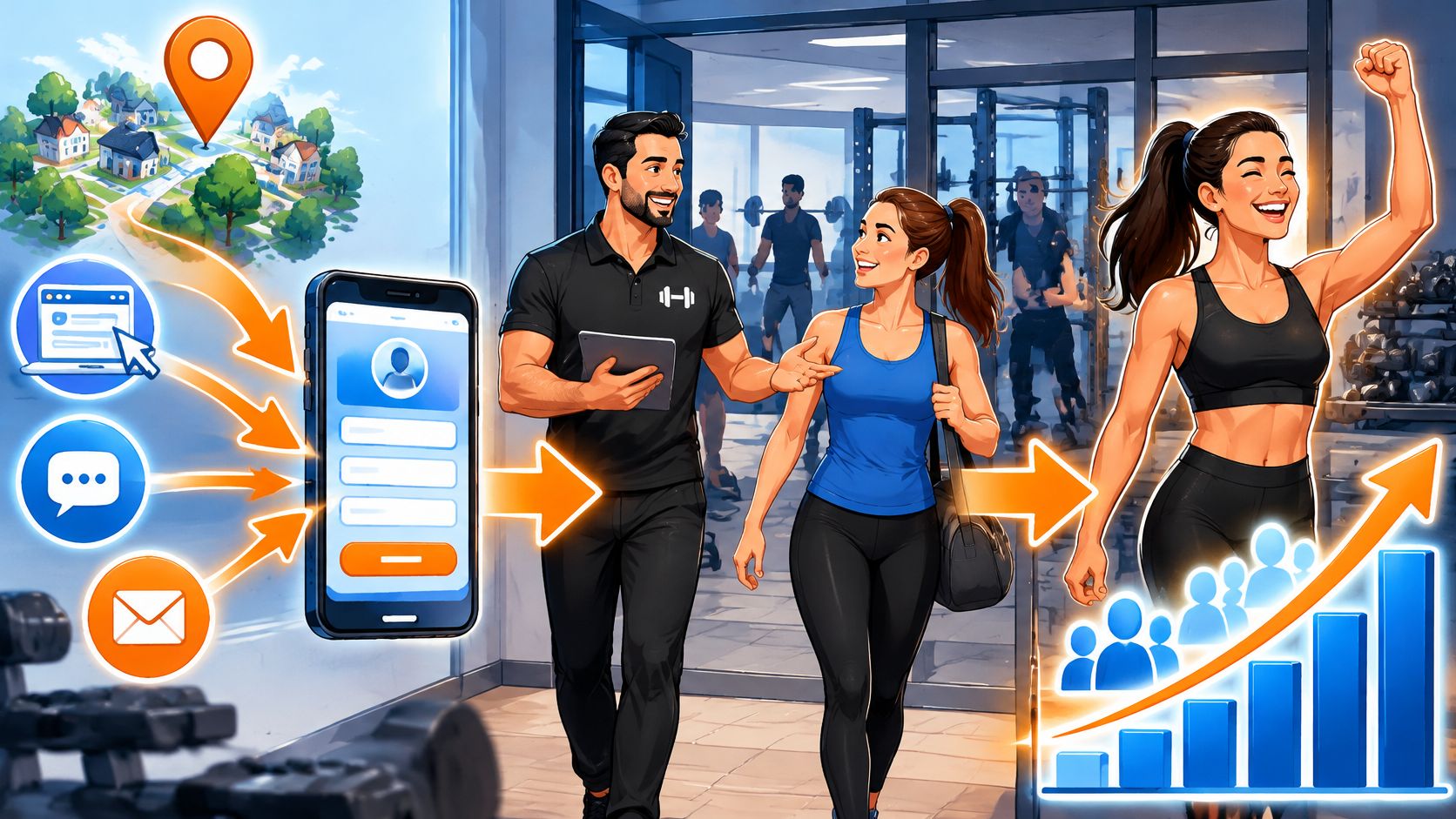
That's the opportunity in lead generation for gyms. Build a closed loop from the first search to the signed membership, then measure whether those members stay. Better advertising helps, but a clear offer, fast response, personal introduction and disciplined follow-up give that advertising somewhere useful to send people.
The Six Stages of a Gym Lead System
Build your system around target, attract, capture, respond, convert and measure. Give each stage an owner and an observable outcome. Otherwise, your marketing team can celebrate inquiries while your front desk loses prospective members.
Gym lead system stages at a glance
| Stage | Goal | Core action | Metric |
|---|---|---|---|
| Target | Choose who to reach | Define three to five member segments by goal and drive time | Segment share of inquiries |
| Attract | Earn high-intent searches | Optimize the Google Business Profile and local landing pages | Search-to-visit rate |
| Capture | Collect contact details | Offer one trial, tour or class pass on a short form | Form conversion rate |
| Respond | Reach the prospect fast | Call, text and email within five minutes during staffed hours | Lead-to-contact time |
| Convert | Turn a visit into a member | Run a tour with a clear next step and a dated offer | Visit-to-enrollment rate |
| Measure | Know which sources pay | Tag every lead by source and track revenue per lead | Revenue per lead |
The 2019 IHRSA Global Report recorded approximately 183 million health-club members across more than 210,000 clubs worldwide, demonstrating the scale of the sector before the pandemic, as reported by SGI Europe. In a market that established, announcing that you have treadmills and memberships isn't differentiation.
Give prospects a concrete reason to choose you: accessible opening hours, specialist coaching, beginner-friendly strength classes, convenient parking or a community they want to join. Your campaign should communicate the difference your staff can demonstrate.
The operational stages also include qualification and nurturing. Qualification establishes whether your facility fits the prospect's needs; nurturing keeps a relevant conversation going until they're ready to act.

Find the leak before buying traffic
Say a gym receives 200 monthly leads but signs only 10 members. Those are hypothetical operating figures, not a benchmark. Before increasing advertising, inspect what happened between capture and response: unanswered calls, delayed replies, missing appointment links and inquiries nobody owned.
Then check whether contacted prospects visited. A campaign can attract suitable people while an awkward booking process prevents them from reaching the facility.
Practical rule: Don't buy more traffic until you know where existing prospects stop moving toward membership.
Map your current inquiries against the stages in the table. Mark the weakest handoff, assign someone to repair it and verify the result before changing the budget.
Choose the Prospects Worth Chasing First
Members join because they want something to change. Start with their goal, not their demographic. Strength, social connection, weight loss, beginner confidence, older-adult exercise and hybrid home-and-gym routines require different messages.
Age can help describe an audience, but it doesn't tell your team what to sell. Someone returning to exercise needs reassurance about starting; an experienced lifter may need equipment availability and coaching credentials.

Start with people who already join
Export current members' ZIP codes or postcodes, joining dates, purchased programs and stated goals. Look for neighborhoods that produce enrollments, not just inquiries. Check realistic travel times around the hours those members train rather than drawing an arbitrary circle around your address.
Choose three to five primary segments as a working structure. For each, write down:
- The need: What does this person want help achieving?
- The message: What can your facility credibly promise to provide?
- The entry offer: Which experience lets them judge the fit?
- The qualifying question: What answer helps your team recommend the right next step?
Keep the inquiry form welcoming. Asking which goal someone is working toward is useful; demanding their complete fitness history before they can book a tour isn't.
For a deeper qualification process, use our guide to qualifying leads in sales. The purpose is to make the conversation more relevant, not to dismiss people who aren't ready for your most expensive plan.
Give each campaign a clear audience
Suppose a round-the-clock gym discovers that its strongest recent joins are people over forty who want coached strength classes. Its next landing page should show those classes, explain the starting process and introduce the coach. Leading with unrestricted equipment access would miss what those prospects value.
Run a primary segment per campaign so you can interpret the result. If you mix beginners, competitive athletes and hybrid coaching prospects under the same offer, weak conversion won't tell you which audience or message needs attention.
Boocoo's discussion of why more visibility isn't always better is a useful companion to this decision. Reach matters only when the people you reach can become suitable customers.
This month, identify your top two segments and write the offer each should see. Ask your sales team whether they could explain the difference without reading a script.
Online and Local Channels That Bring High-Intent Leads
Local search deserves attention before broad awareness campaigns. Someone checking your location, hours and introductory offer is already considering a visit. Give them a direct route to booking it.
In Google's local-search consumer study, 50% of smartphone users who performed a local search visited a store within one day, while 18% of local smartphone searches resulted in a purchase within one day. Those findings cover local commerce rather than gym memberships specifically, but they support a practical choice: make the next offline action easy.
Gym lead channels compared by intent and use
| Channel | Typical intent | Best use | Lead metric |
|---|---|---|---|
| Google Business Profile | High, nearby searchers | Accurate hours, photos, reviews and a call button | Calls and direction requests |
| Local search landing pages | High, service-specific | Gym near me and neighborhood service pages | Search-to-visit rate |
| Paid search | High when targeted | Branded and non-branded terms that send traffic to a trial offer | Cost per trial booking |
| Social media | Medium, awareness | Class previews and short video with a booking link | Click-to-trial rate |
| Member referrals | High, trust-based | Bring-a-friend events and unique referral links | Referral-to-member rate |
| Lead magnets | Medium, goal-driven | Free workout guide or fitness assessment | Lead-to-trial rate |
Keep your Google Business Profile accurate, including staffed hours, current photographs, review responses and a working call button. Link to a current class schedule and make trial booking usable on a phone.
Build local pages around genuine services and locations, including neighborhood strength training or round-the-clock access. Publish starting prices, parking details and the next available introduction. SemDash's local search optimization checklist provides a useful audit companion, while our SEO for gyms guide applies that work to fitness facilities.
Match each channel to an action
Separate branded and non-branded paid-search campaigns. Send each advertisement to a relevant trial offer rather than a homepage that makes visitors search again.
Use Instagram and Facebook for class previews, coach introductions and short explanations of what beginners should expect. Attach a booking link. A busy comment section isn't a substitute for appointments.
For referrals, build a repeatable invitation rather than telling members to promote you:
- At signup: Invite each new member to name a friend they'd enjoy training with, without pressure to share that person's private contact details.
- After the invitation: Issue a unique referral link the member can share.
- During the month: Host a bring-a-friend class and record guest attendance.
- After a qualifying referral: Reward the referrer with a free week under clearly published terms.
Les Mills' fitness findings for operators report that approximately two-thirds of members joined because someone they knew recommended the gym, and 67% say community is the biggest driver of motivation and accountability. Treat referrals as a high-trust channel, but measure their results rather than assuming every introduction will convert.
A free fitness assessment can also generate useful inquiries: ask for the prospect's goal and connect the assessment to a trial booking. Tag branded, non-branded, map-pack, paid and referral inquiries in your CRM using source fields, campaign parameters and event codes.
Capture Every Inquiry and Answer It Within Minutes
A Harvard Business Review analysis of 2,241 U.S. companies found that companies contacting an inbound lead within an hour were nearly seven times more likely to qualify it than companies waiting an additional hour, according to Vida's account of the analysis. The likelihood was more than 60 times higher than for firms waiting at least twenty-four hours.
That's cross-industry evidence, not a promised gym conversion lift. It still makes delayed replies an operating problem worth fixing immediately.

Make capture short and ownership obvious
Use a short form with name, phone, goal and preferred contact time. Collect communication consent clearly, and offer a single next step on each page: a trial, tour or class pass.
Every form submission, missed call and social message should create a CRM record and trigger an immediate acknowledgment. The acknowledgment should confirm what happens next, not pretend that an automated message is a personal conversation.
During staffed hours, set a five-minute human-response target. Assign a named person to the queue and a backup when that person is touring, coaching or handling a walk-in.
Outside staffed hours, automation should collect the prospect's goal, location, contact preference and consent, then reserve a personal callback. State when staff will respond. Don't offer instant personal support if nobody is there to provide it.
Response-time brackets and what to track
| Response window | Metric to track | Action |
|---|---|---|
| 0–5 minutes | Qualification and enrollment rate | Keep the five-minute target during staffed hours |
| 5–60 minutes | Qualification rate | Route overflow leads to a callback queue |
| Over 60 minutes | Qualification rate | Escalate to a manager; investigate delayed handling |
These brackets are operating categories for your own comparison, not separate conversion benchmarks. Record lead created, first human attempt, connection, appointment, show-up and sale so you can distinguish fast attempts from successful conversations.
An automated receipt confirms delivery. A staff member who answers the prospect's question earns the appointment.
Test phone, text and email separately where the prospect has agreed to those channels. Compare contact quality and eventual revenue per lead rather than congratulating staff for sending more messages.
For email follow-up, use Mailwarm to check where your emails land. A prompt reply that lands in spam still leaves the prospect waiting.
Keep follow-up useful: answer their question, suggest a suitable appointment and explain what to expect when they arrive. If they don't reply, vary the helpful information rather than repeating an increasingly urgent sales pitch.
Turn Trials and Tours Into Signed Memberships
The tour is a sales conversation, not an equipment inventory. A prospect should leave understanding how your gym fits their goal, what joining costs and what happens next. Walking past every machine doesn't accomplish that.
Start by asking what brought them in and what has made training difficult before. Show the coach, class or facility feature that directly addresses that need. Then quote the standard plan and offer a realistic start date.
Sell the right entry experience
A free trial isn't automatically your best offer. A short goal-based program, class pack, hybrid app-plus-club plan or small-group consultation may give the prospect a clearer reason to begin.
The Les Mills global fitness report found that 54% of people want new ways to get fit, while 45% of Gen Z and Millennials seek group workouts. That supports testing more specific experiences rather than expecting every prospect to want unrestricted facility access.
Lower commitment can create a sensible entry point. It isn't permission to sell an unprofitable product or promise an upgrade that your team never discusses.
- For a nervous beginner: Offer a coached introduction with a clear progression.
- For a socially motivated prospect: Recommend a suitable class and introduce the instructor.
- For a hybrid exerciser: Explain precisely what happens at home and what requires a club visit.
Put boundaries around introductory pricing
Always keep one standard plan that doesn't move with demand. Prospects need a stable reference point, and your staff need a price they can explain without checking whether today's promotion has changed.
Before a discount goes live, write down four things: its purpose, the exact number of founding spots, the end date of the introductory rate and the standard rate that replaces it. Staff should be able to show those terms, not reconstruct them during a tour.
For example, a hypothetical launch campaign could pair a fourteen-day trial with ten founding-member spots. Set a genuine closing date, explain when the introductory rate ends and state the replacement rate before anyone signs. Don't reset the deadline when the offer doesn't sell out.
Offer check: If your team can't explain the normal price and the introductory terms clearly, the offer isn't ready.
Every visitor should leave with a dated next step, whether that's a first session, decision call or follow-up consultation. Check your current offer against the written conditions and confirm that the standard plan remains available.
Measure Which Lead Sources Actually Pay
Clicks and form fills tell you whether people interacted with marketing. Revenue per lead tells you whether those interactions produced sales. Even that figure needs context: compare the same revenue window, membership status and source definitions.
Keep original acquisition source separate from the last message someone clicked. A referred prospect who later searches your gym's name shouldn't disappear into a branded-search total.
Lead metrics and the decisions they drive
| Metric | How to calculate | What to watch | Decision it drives |
|---|---|---|---|
| Conversion rate | Members divided by leads, by source | Gaps between sources | Keep, fix or cut the channel |
| Utilization by hour | Booked slots divided by capacity, by hour | Empty off-peak slots | Reprice or repackage off-peak access |
| Cancellation rate | Cancellations divided by new members, first 90 days | Early cancellations by source | Fix onboarding or the offer |
| Contribution margin | Revenue minus coach pay, room time and booking costs | Margin per tier | Keep or retire the tier |
| Revenue per lead | Enrolled revenue divided by leads, by source | Highest for the strongest sources | Shift budget toward those sources |
For cancellation analysis, use members from the same joining cohort in the numerator and denominator. Don't divide all facility cancellations by this month's new memberships and call that source quality.
Contribution margin in the table is a monetary amount, not a margin percentage. Allocate shared costs consistently so a coached package doesn't appear profitable because its room time was ignored.
Review acquisition and pricing together
After a price change, track conversion rate, utilization by hour, cancellation rate and contribution margin separately. A cheaper offer may fill a quiet class while reducing the money available to pay staff. Higher conversion alone doesn't justify keeping it.
Review pricing every month by tier, checking conversion, upgrade rate, churn and revenue per member. Pair that review with a customer acquisition cost calculation so you can distinguish strong sales from expensive acquisition.
Use a ninety-day cohort review as an operating checkpoint. Compare attendance and cancellations among paid-search, referral, organic and event-generated members who have completed that observation window.
- Many leads, few conversations: Inspect response ownership and contact details.
- Many visits, few enrollments: Examine the offer, tour and fit.
- Strong enrollment, early cancellations: Investigate expectations and onboarding before increasing spend.
Referral members may prove more valuable, but let attendance, retention and contribution establish that. Trust-based acquisition isn't an exemption from measurement.
Create a monthly sheet containing leads by source, trial bookings, enrollments, ninety-day retention and revenue per lead. Add spending and contribution alongside it. Make budget decisions from that sheet, not from the advertising dashboard with the most impressive graph.
Put a Gym Equipment Cleaning Routine in Place This Week
Clean equipment belongs in the sales experience. A prospect touring your facility can see whether staff care for shared surfaces, whether supplies are available and whether members understand the routine. Don't let a neglected bench undermine a careful enrollment conversation.
Cleaning and disinfecting are separate jobs: remove dirt first, then disinfect when appropriate, following CDC facility-cleaning guidance. Disinfectant contact time matters just as much as applying the product.

Make the contact time part of the routine
An EPA-registered disinfectant label approved for athletic facilities, gymnasiums and health clubs requires relevant hard, nonporous surfaces to remain visibly wet for one minute, or sixty seconds, for its listed pathogens, before air-drying. That requirement is product-specific. A quick dry pass isn't equivalent to label-compliant disinfection.
Use this routine with a product carrying those directions:
- Remove visible dirt. Clean handles, bars, compatible bench pads and leg-press grips before disinfecting.
- Wet the entire surface. Apply enough EPA registered disinfecting wipes to cover the approved surface.
- Maintain visible wetness. Keep the surface wet for the full contact time specified above; reapply as directed if it dries prematurely.
- Allow air-drying. Keep the equipment available only after the process is complete, and log the cleaning time.
- Put supplies within reach. Install a gym wipe dispenser near machines and free-weight racks, with disposal bins nearby.
Choose supplies by surface and label
Our go-to recommendation is Wipes.com Disinfecting Wipes. Check the selected product's current label and equipment compatibility before adding it to your cleaning schedule.
Use sanitizing wipes only on surfaces and for purposes their labels allow. Choose wipes for gym equipment by material compatibility; reserve yoga mat wipes for approved mats rather than assuming they're suitable for studio floors. Keep gym wipes stocked, but assign staff responsibility for checking that the cleaning process happens.
Write the schedule on a page, name an owner and review completion weekly. Check stock levels, dispenser placement and contact-time instructions during that review.
This week, repair your weakest lead handoff and put the cleaning schedule into operation. Assign owners to both, then review bookings, enrollments and cleaning completion together. Once your menu is live, Gym Membership Tips can help with the next pass on packaging and enrollment scripts so your team can turn qualified interest into a clear, confident invitation to join.
Leave a Reply