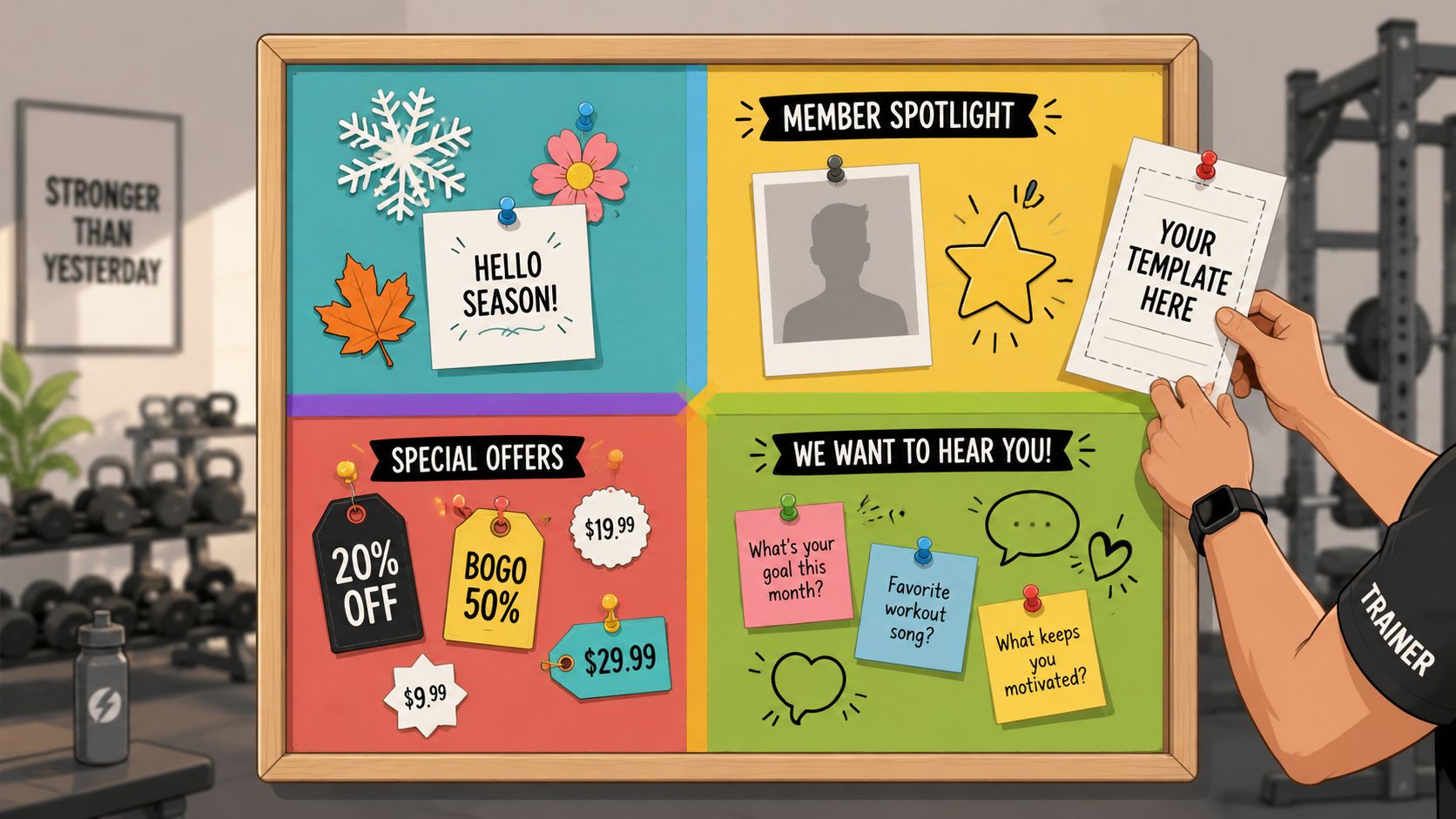
Is your gym's bulletin board helping sales, retention, and secondary revenue, or is it just taking up wall space?
In a lot of facilities, the board gets treated like a dumping ground for random flyers, old notices, and a class schedule nobody has replaced in weeks. That approach wastes a high-traffic asset your members and prospects already look at while they wait, check in, or cool down.
A good board earns its space. It answers common questions during tours, points members toward personal training and premium services, supports challenges, reduces repetitive front-desk questions, and gives people a reason to stop for a few seconds instead of walking past. I've seen simple wall displays do this job well even without a traditional corkboard. What matters is clarity, placement, and whether the message supports an actual business goal.
That is the angle here. These are not just gym bulletin board themes to make a lobby look nicer. Each idea works as a mini business case with a clear purpose, likely upside, common downside, and practical tips to get better return from the wall space you already pay for.
Some boards are built to convert prospects. Some keep current members engaged. Some help sell higher-value services or products. The strongest gyms use all three.
Below are 10 gym bulletin board ideas that do the job properly, with real trade-offs and specific ways to make each one pull its weight.
1. Member Success Stories and Testimonials Display
This board works because prospects trust members more than marketing copy. If someone on a tour sees real progress, real names, and a real reason that person stayed consistent, the gym feels credible fast.
Use this near reception, the consultation area, or the path your staff uses for tours. Don't hide your best social proof in a hallway nobody sees.

What makes it convert
A strong success board includes more than before-and-after shots. It should show different kinds of wins: strength progress, consistency streaks, confidence, mobility, post-rehab training, and first-event finishes. That range matters because not every prospect wants weight loss messaging.
The gyms that get this right keep the design simple. One photo, one short story, one clear result in plain language. When the board gets overloaded with tiny print and crowded graphics, people stop reading.
Practical rule: Feature outcomes people can relate to, not only extreme transformations.
Pros, cons, and what usually goes wrong
The upside is obvious. It creates social proof, gives members recognition, and gives your sales team something useful to point to during tours.
The downside is maintenance. Stale boards hurt trust. If half the photos look old or the featured members haven't trained in months, the board sends the wrong signal. Consent also matters. Get written permission before posting photos, names, or quotes.
A few practical ways to keep it useful:
- Show variety: Include members across ages, goals, and training styles so more people see themselves in the board.
- Write short captions: A few direct sentences beat long life stories every time.
- Add a next step: Put a staff prompt nearby so a prospect can ask, “Which program helped this member?”
- Refresh on a rhythm: Monthly rotation works well because it keeps the wall from becoming wallpaper.
If you want one board that helps both retention and sales, this is often the best place to start.
2. Class Schedule and Instructor Feature Board
A schedule board shouldn't look like a spreadsheet pinned to drywall. If members need to squint, ask the front desk, or pull out their phones because the board is confusing, it's failing at the most basic level.
The better version combines schedule clarity with instructor personality. That second part is what many gyms miss.
Why this board helps retention
People often stick with classes because they connect with an instructor, not because the timetable is technically available. A board that pairs class slots with trainer photos, coaching specialties, and a short “best for” note makes booking easier for newer members.
For example, a cycling studio might pair “Intervals Ride” with an instructor known for high-energy coaching, while a yoga room might spotlight a teacher who's especially good with beginners. Boutique studios tend to do this better than big-box gyms because they understand that instructors are part of the product.
Where the board earns its keep
Place it close to the entrance or just outside the group exercise studio. That catches both regular members and walk-ins. If you run multiple formats such as HIIT, barre, recovery, and strength circuits, color coding helps. Just don't let the color system become so clever that it confuses everyone except the person who designed it.
A useful setup looks like this:
- Lead with the week: Members want today and tomorrow first, not a dense monthly grid.
- Spotlight one instructor: Rotate a profile with credentials, coaching style, and favorite class.
- Tag classes clearly: Mark beginner-friendly, low-impact, or advanced sessions in plain language.
- Include booking direction: If your classes require pre-registration, tell members exactly where to go.
A good class board answers three questions fast: What can I take, who's teaching it, and is it right for me?
The main trade-off is update discipline. A beautiful board that still shows last week's classes makes the whole operation look sloppy. Assign ownership to one staff role, not “the team” in general. When everyone owns it, nobody owns it.
3. Membership Tier and Pricing Comparison Chart
If prospects keep asking the same membership questions, put the answers on the wall. This board saves staff time and removes friction during tours, especially in gyms with multiple plans, family options, class add-ons, or training bundles.
It also reduces that awkward moment where a prospect hears one offer, then later finds out there were other options they didn't understand.
What this board should include
Keep the structure simple. Put tiers side by side with the main differences clearly visible: access level, included classes, guest policy, recovery amenities, and training perks if relevant. The point isn't to list every policy detail. The point is to make comparison easy.
If you want more context on plan structure, this guide to gym membership prices comparison is a useful companion for managers refining their offer stack.
One practical feature matters more than most operators realize. Practitioner guidance for gym boards recommends using a clear call to action beside a scannable QR code, such as a booking prompt linked to scheduling software, because it creates a trackable path from in-gym interest to online booking. That approach is outlined in nutrition board guidance for gyms. The same principle applies perfectly here. Put “Book a Free Intro” or “Compare Plans With Staff” next to the code.
Pros and pitfalls
This board is excellent for sales consistency. Your front desk team, sales reps, and managers all point to the same visual. It also helps current members understand upgrade options without feeling like they're being hard-sold.
The risk is clutter. Too many footnotes, promo stickers, and policy exceptions make people tune out.
Use these rules:
- Highlight one recommended option: Make your most sensible plan easy to spot.
- Use plain wording: “Access to all classes” works better than internal package names.
- Keep promotions temporary: Swap promo tags quickly so expired offers don't linger.
- Put it near reception: This board belongs where tours begin or end.
A pricing board won't close every sale. But it will remove confusion, and confusion kills momentum.
4. Monthly Challenge and Achievement Tracking Board
Some boards exist to inform. This one exists to pull people back into the gym.
A challenge board creates visible momentum. When members can see names, progress markers, team standings, or completion badges, the floor feels active. Even people who don't join right away start noticing.

The business case for gamification
This type of board helps retention because it gives members a short-term reason to show up. That matters when motivation dips. It also gives staff an easy conversation starter. “You're only two check-ins away from finishing the challenge” is more useful than a generic “See you tomorrow.”
CrossFit boxes, boutique studios, and run clubs often do this well because they understand public accountability. Mainstream gyms can use the same idea with broader formats: workout streaks, attendance bingo, beginner milestones, rowing distance, recovery habits, or consistency challenges.
Keep it fair or don't run it
The fastest way to kill engagement is to make every challenge favor your fittest members. If beginners feel they've already lost by day three, participation drops hard.
Build in scaled options and multiple ways to win. You can recognize consistency, effort, improvement, team spirit, or completion, not only top output.
A strong setup includes:
- One simple objective: Don't ask members to track five things at once.
- Visible progress: Thermometers, sticker grids, stamp cards, and ladders all work.
- Frequent updates: If the board doesn't change, members stop checking it.
- Low-cost rewards: Guest passes, smoothie credits, or branded merch are usually enough.
The best challenge boards reward participation without making average members feel invisible.
The trade-off is labor. Someone has to verify entries, update standings, and keep the board from becoming messy. If your staff can't support a complicated challenge, simplify the format. A clean, easy challenge beats an ambitious one that dies halfway through the month.
5. Educational Fitness and Wellness Tips Carousel
A good education board builds authority without sounding preachy. It helps members train smarter, and it gives your brand more substance than “machines and mirrors.”
This works best as a rotating series, not a permanent wall of text. Consider it an editorial calendar on display.
What belongs on it
Focus on practical topics members can use immediately. Warm-up basics. Recovery habits. Simple protein guidance. Common lifting mistakes. Sleep and training consistency. Mobility drills for desk workers. Clear, useful information beats broad wellness slogans every time.
The market for fitness-themed bulletin board ideas is broad enough that major platforms actively catalog them, including fitness bulletin board idea listings on Etsy. That's a good sign for operators. It shows the format has staying power across education and commercial settings, so you don't need to reinvent every design from scratch.
Make it skimmable
Most members won't stand there and read an essay between sets. Design for quick scanning. One headline. One explanation. One action step. One image or icon.
A practical weekly rotation could look like this:
- Movement Monday: One exercise cue or mobility fix.
- Fueling focus: A simple nutrition reminder tied to training goals.
- Recovery spotlight: Sleep, hydration, rest day habits, or soreness management.
- Coach's note: One trainer shares a favorite tip in their own voice.
Use your staff well here. Certified trainers, nutrition coaches, and experienced instructors usually have plenty of teachable content. What they often lack is a simple format to publish it inside the gym.
The risk is credibility drift. Don't let staff post trendy claims they can't explain. Keep advice conservative, practical, and tied to what your coaches teach on the floor.
6. New Member Welcome and Onboarding Board
New members need fewer mysteries, not more motivation posters.
A welcome board works because the first weeks of membership are loaded with uncertainty. People don't know where things are, which classes fit them, what equipment feels safe, or whether they belong. A clear onboarding wall lowers that pressure immediately.
What to post near the entrance
Put this board where every new joiner passes it. Include a simple facility map, starter tips, staff photos, beginner-friendly class suggestions, and your key gym etiquette points. Don't bury policies in legal language. Translate them into member language.
A strong onboarding board can also reduce repetitive front-desk questions. If members can quickly see where the locker rooms are, how to book classes, when orientation happens, and who to ask for help, your team spends less time repeating basics.
What works better than generic “welcome” messaging
Specific guidance wins. “Start with these three machines” is more useful than “Explore the floor.” “Meet Coach Maria for your first equipment walkthrough” is better than “Ask staff for support.”
A few smart additions:
- First-week checklist: Give members a sense of progress.
- Friendly staff photos: Names and faces reduce intimidation.
- Beginner picks: Highlight low-pressure classes or quiet training times.
- Simple QR prompt: Link to your welcome video or booking page.
This board does have one risk. If it looks too busy, nervous beginners won't process any of it. Keep the tone warm and the layout clean.
New members don't need every answer on day one. They need the next right step.
If your gym struggles with early drop-off, this board is one of the cheapest fixes you can make.
7. Referral Program and Incentive Promotion Board
Referrals are too important to leave buried in a membership agreement or a random email blast. If you want members to bring people in, make the offer visible all the time.
This board should feel active, not passive. It isn't a legal notice. It's a sales surface.
What drives response
Make the reward easy to understand. If members have to ask three follow-up questions, they won't bother. “Bring a friend who joins and receive your reward” is strong. Five-tier legal language in small print is not.
If you're building or fixing the structure behind the offer, this guide on how to create a referral program gives a practical framework.
The best referral boards also create a little status. A “member advocate” spotlight, a monthly recognition area, or a simple wall of thank-yous can make referrals feel social instead of transactional.
Keep the system clean
A lot of gyms run weak referral boards because tracking is messy. The member says they referred someone. The front desk forgets to record it. The reward gets delayed. Trust disappears.
Build the process into operations:
- Use referral cards or codes: Staff need a clean way to match names.
- State the reward clearly: Don't make members guess what they earn.
- Celebrate publicly: Recognition often drives as much action as the incentive.
- Refresh the visuals: Old promo signage blends into the wall.
A useful real-world setup is a board near reception with referral cards in a holder, a current monthly promo, and a short “how it works” strip. Boutique studios often pair this with “bring a friend” events to give members a reason to invite someone now instead of someday.
The trade-off is that weak fulfillment hurts more than not promoting the program at all. If you can't track rewards reliably, fix the backend before you make the board prominent.
8. Personal Training Services and Trainer Credentials Board
If personal training is part of your revenue mix, members should be able to understand your trainers at a glance. Too many gyms post names and photos, but they never explain who each coach is best for.
That leaves money on the wall.
Sell the fit, not just the package
A good trainer board matches specialties to member problems. One coach may be ideal for fat-loss accountability. Another may work best with barbell strength. Another may be strong with active aging, postural work, or youth athletic development.
If your staff is actively pursuing credentials or members ask what certification paths involve, this article on getting certified as a personal trainer can help frame that conversation.
Members also care about personality. A board that includes a short coaching approach can make the difference between “I've been thinking about training” and “I want to talk to that coach.”
What to include on the wall
Use clean headshots and consistent formatting. The board should feel professional, not homemade in a rushed way.
Include:
- Specializations: Strength, mobility, weight loss, beginner coaching, sports performance, and so on.
- Coaching style: Direct accountability, technique-focused, supportive, high-energy.
- Starter offer: A consultation or assessment prompt works well.
- Success snapshots: Short, consented client wins build trust fast.
Members don't buy sessions first. They buy confidence in the trainer.
The main risk here is overclaiming. Don't stuff boards with jargon or long credential lists that nobody understands. Translate expertise into practical value. “Helps beginners learn the gym floor safely” is powerful because it's clear.
When done well, this board helps members self-select the right coach before they ever speak with staff.
9. Nutrition, Supplements and Recovery Products Board
This board can create ancillary revenue, but only if it serves members first. If it looks like an ad wall, people ignore it. If it educates and then recommends, people engage.
The strongest version sits near a smoothie bar, retail shelf, consultation room, or recovery area.
What earns trust here
Start with useful guidance. Explain when a protein shake makes sense, how recovery tools fit into training, or what kind of member might benefit from grab-and-go nutrition after a class. Then connect that advice to the products you sell.
That's where outside educational content can support the display. For example, a piece on effective natural muscle supplements can help frame broader product conversations for members who are exploring performance support. Keep your own board grounded in clear, conservative messaging.
Retail strategy that doesn't feel pushy
Organize products around goals, not shelves. Members think in outcomes. Recovery. Muscle support. Convenience. Hydration. Pre-workout energy. They don't think in SKU categories.
A practical layout:
- Goal-based sections: “After class,” “for busy mornings,” or “recovery support.”
- Trainer-approved picks: One short note from staff can increase trust.
- Usage basics: Timing, storage, and who the product fits.
- Retail tie-in: Make it easy to buy immediately at the desk or bar.
This board does require discipline. Food and supplement areas get messy fast. Packaging changes, stock runs out, and old promotional tags make the display look cheap.
If your gym sells any ingestible or recovery product, keep this area cleaner than the rest of the floor. Members notice.
10. Facility Improvement and Renovation Update Board
Construction, equipment upgrades, and layout changes create friction. Members are usually more patient when they know what's happening, why it's happening, and what they'll get from it.
That's why a renovation board matters. It turns disruption into communication.
Use transparency to protect trust
Post upcoming upgrades, moved equipment, temporary closures, and progress photos. If members asked for a stretching zone, new racks, or better flooring, say so. People respond well when they can see that feedback led to action.
This kind of board works especially well in clubs making visible changes such as recovery-room additions, cardio deck refreshes, turf installation, or locker-room updates. Even a smaller studio can use it during paint work, branding updates, or schedule-related room changes.
Keep updates current and realistic
If your timeline slips, update the board. Don't let an old completion date sit there while members step around ladders and taped-off areas.
Strong renovation boards usually include:
- What's changing: Name the area or equipment clearly.
- Why it matters: Better flow, more training options, cleaner layout, improved member experience.
- What to expect now: Temporary reroutes, noise windows, or closed zones.
- What's next: A visible progress marker keeps attention positive.
A useful bonus is member input. Small voting prompts such as preferred bench location, stretching accessories, or recovery add-ons can increase buy-in without overpromising.
This board won't remove inconvenience. It will reduce frustration, and that alone makes it worth the wall space.
Gym Bulletin Board Ideas: 10-Item Comparison
| Bulletin Board Theme | Implementation Complexity | Resource Requirements | Expected Outcomes | Ideal Use Cases | Key Advantages |
|---|---|---|---|---|---|
| Member Success Stories & Testimonials Display | Medium, collect consent and curate content | Low–Medium, member submissions, occasional photography, printing/digital display | Increased conversions; member motivation | Prospect tours; social media sharing; referral campaigns | Strong social proof; community recognition; low ongoing cost |
| Class Schedule & Instructor Feature Board | Medium, frequent schedule updates required | Medium, design, printing or digital screens, staff coordination | Improved attendance; clearer class navigation | High-traffic areas near entrance; class management | Boosts attendance; builds instructor credibility; reduces confusion |
| Membership Tier & Pricing Comparison Chart | Medium–High, compliance and clarity needs | Medium, design, legal review, regular updates | Fewer pricing objections; increased upsells | Sales/tour desks; reception areas | Clarifies value; supports upsells; reduces cancellations |
| Monthly Challenge & Achievement Tracking Board | Medium, ongoing management and leaderboard updates | Medium, tracking tools, prizes, staff time | Higher engagement and retention; user-generated content | Retention drives; community events; social campaigns | Gamification drives participation; strong community bonding |
| Educational Fitness & Wellness Tips Carousel | Medium, content creation and vetting for accuracy | Low–Medium, trainer expertise, design, content calendar | Increased trust; member education; shareable content | Ongoing member education; social amplification | Builds authority; supports member goals; low cost content |
| New Member Welcome & Onboarding Board | High, substantial initial content and organization | Medium, maps, checklists, staff photos, translations | Improved first-30-day retention; reduced onboarding friction | Entrance/reception; new member orientation | Smooth onboarding; reduces repetitive staff questions; sets expectations |
| Referral Program & Incentive Promotion Board | Medium, requires tracking and incentive management | Medium, referral codes, tracking system, rewards inventory | Increased member acquisition with high LTV | Growth campaigns; member engagement areas | Low-cost acquisition channel; scalable; leverages advocates |
| Personal Training Services & Trainer Credentials Board | Medium, maintain accurate trainer profiles | Medium, high-quality photos, certification verification, booking links | Increased PT sales; higher ARPM (average revenue per member) | Personal training promotion; consultation areas | Builds trainer credibility; simplifies service discovery |
| Nutrition, Supplements & Recovery Products Board | Medium–High, compliance and inventory coordination | Medium, supplier partnerships, product stock, expert input | Ancillary revenue; improved member support | Retail areas; smoothie/pro shop; goal-based promotions | High-margin sales; positions gym as full wellness provider |
| Facility Improvement & Renovation Update Board | Medium, requires timeline management and frequent updates | Medium, renderings, project schedules, member feedback tools | Maintains satisfaction during disruptions; builds excitement | During renovations or upgrades; member communications | Transparency fosters trust; reduces churn during projects |
Keeping Your Boards Fresh, Clean, and Effective
What makes a gym bulletin board produce results instead of becoming wall clutter?
Ownership does. Every board needs a name next to it, a review date on the calendar, and a reason to stay on the wall. Without that, even a strong idea turns into curled paper, outdated offers, faded ink, and mixed messages. Members notice fast. They read a neglected board as a sign that the operation behind it is loose too.
I treat board maintenance as a small business system, not a decorating task. A challenge board supports retention. A pricing board supports upgrades. A trainer board supports higher-ticket service sales. Once you frame each board that way, the trade-offs get clearer. A board that takes 20 minutes a week to update is worth keeping if it drives referrals or PT consults. A board that looks nice but never changes and never prompts action is using prime space with no return.
Set review frequency by revenue impact and shelf life.
Boards tied to class schedules, retail offers, referrals, and monthly challenges usually need a weekly check. Trainer credentials, onboarding content, and educational tips can often run on a two-week cycle if the information is still accurate and easy to read. Renovation updates may need attention several times a week during active projects because silence creates complaints faster than bad news does.
Clean editing matters as much as clean surfaces. Cramming in more flyers, more fonts, and more colors does not improve performance. It makes members stop looking. Keep only what answers a question, prompts a next step, or reinforces community. Everything else should come down.
Durability affects labor cost too. Boards that are easy to wipe, reletter, and refresh save staff time over the course of a month. Simple materials often win here. Painted or reusable surfaces, sturdy frames, clear label systems, and replaceable sign holders usually outperform complicated displays that look good for one week and become a maintenance headache after that.
A clean board does more than look professional. It tells members your standards carry through the whole facility.
Sanitation deserves its own routine, especially for boards with sign-up sheets, referral cards, QR stands, clips, pens, product samples, or progress markers. Chalk dust, moisture, fingerprints, and sweat build up quickly in training areas. Once that grime shows up, members touch the board less, trust it less, and pay less attention to what it says.
Keep supplies near the highest-touch boards and make cleaning part of opening or closing tasks. Wipe the frame, ledge, plastic cover, clips, pens, and nearby wall area. If you want a ready-to-use option, consider Wipes.com Disinfectant Wipes for high-touch surfaces around your facility.
One more rule improves results. Remove expired content immediately. An old promo, a finished challenge, or an outdated class time does more than create clutter. It hurts credibility, leads to avoidable front-desk questions, and can cost sales if members stop trusting posted information.
A gym bulletin board should earn its space. If it helps sell, retain, onboard, reassure, or educate, keep it current and keep it clean. If it does none of those jobs, replace it with something that does.
Leave a Reply