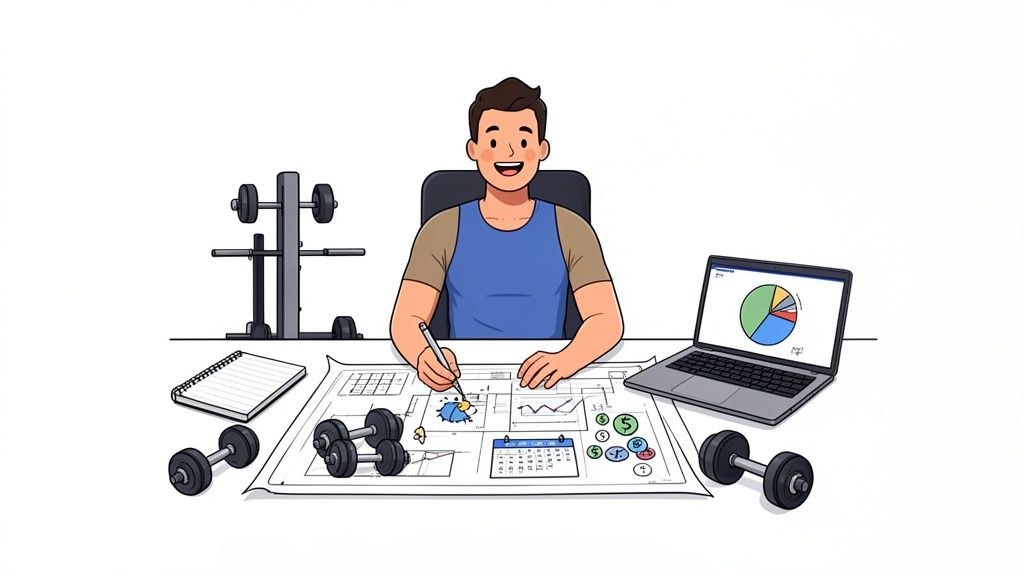
So, you've got the passion for fitness and the skills to change lives—now it's time to build a real business around it. A solid pt business plan is what separates the pros from the hobbyists. It's your personal game plan, turning that fire in your belly into a business that actually works.
This isn't just about filling out a stuffy document. It’s about getting clear on everything from who you want to train and what you'll charge, to how you'll make enough money to not just survive, but thrive.
Your Blueprint for a Thriving Personal Training Business
Let’s be real—most business plan templates are generic and boring. They don't capture the unique energy you bring to the gym floor. We're going to build a pt business plan that feels like you. This plan is your ultimate pitch, the core of your brand, and the guide that will keep you on track when things get hectic.
It all starts with getting to the heart of why you’re even doing this in the first place. What’s your purpose? This isn’t just some fluffy exercise; it’s the powerful story that will attract the right kind of clients.
Define Your Mission and Vision
Your mission is what you do every day, and your vision is the massive impact you want to make down the road. Nailing these down gives you incredible clarity.
- Mission Example: We empower busy professionals in our community to build lasting health with smart, efficient, and personalized training.
- Vision Example: To be the #1 go-to personal training studio for corporate wellness in the city, known for getting incredible, sustainable results.
See how that feels? Your mission becomes your compass. It ensures every new service you launch or Instagram post you create is perfectly in tune with your core values. It's how you build a tribe, not just a client list.
Your business plan is so much more than a document you need for a bank loan. It's a promise you make to yourself. It solidifies your goals and gives you a clear path to follow when you're facing the inevitable challenges of growing a business.
Crafting Your Executive Summary
Alright, let's talk about the most important page in your entire plan: the executive summary. This is your highlight reel! It’s a powerful, one-page snapshot of your entire business that needs to grab someone’s attention from the first sentence.
Think of it like a movie trailer—it has to be exciting and make people want to know more. This is where you'll briefly touch on your mission, your core services, your ideal client, and a peek at your financial goals.
If you're looking for more great insights on building your business from the ground up, check out this fantastic guide on how to start a coaching business. It’s packed with tips that will help you make your executive summary—and your entire plan—truly compelling.
Pinpoint Your Niche in a Booming Fitness Market
Before we even think about writing a single line of your business plan, let's get one thing straight: you can't be the trainer for everyone. The fitness world is absolutely massive, but trying to appeal to the entire market is a surefire way to get lost in the noise.
A killer pt business plan starts with knowing exactly who you're talking to. It’s about finding that sweet spot where your passion and skills perfectly align with a group of people who are actively looking for a solution you can provide. You’re not just looking for clients; you’re looking for your people.
Who Is Your Ideal Client?
The first real step is getting crystal clear on your ideal client avatar. I mean, really clear. Forget vague descriptions like “people who want to lose weight.” That’s not a niche; that’s half the population. We need to drill down and get specific.
Think about it. Who do you genuinely love to train?
- Are they busy executives in their 40s who can only squeeze in a workout at lunch and need maximum results in 30 minutes?
- Maybe you connect with new moms who are navigating postpartum recovery and need a supportive, confidence-building environment.
- Or perhaps your sweet spot is training aspiring high school athletes who need that sport-specific edge to make the varsity team.
Give this person a name, a job, and real-life struggles. When you know exactly who you're speaking to, every piece of your business—from the services you offer to your social media posts—becomes incredibly focused and effective.
Scope Out the Competition to Find Your Angle
Once you know who you want to train, it's time to see who else is already talking to them. Think of this as reconnaissance. Competitor analysis isn't about stealing ideas; it's about finding the gaps in the market that you can fill brilliantly.
Start by making a list of every local trainer, gym, and studio that seems to be chasing the same client avatar. Then, put on your detective hat and dig into what they're doing.
- Their Services: What are they actually selling? One-on-one sessions? Small group classes? Online programs? What are they not offering?
- Their Pricing: How are they packaging their services? Are they pushing pricey single sessions or focusing on monthly memberships? This tells you what the local market expects to pay and where you might be able to offer a better value proposition.
- Their Marketing: Where do they hang out online? Are they Instagram wizards, or do they still rely on flyers at the local coffee shop? Look at their messaging—what pain points are they hitting?
The whole point here isn't to become a copycat. It's to find the empty space on the shelf. If every other trainer in your town is screaming about HIIT, maybe there's a massive, untapped market for a practice focused on mobility and active recovery.
This research is how you build your unique selling proposition. It’s the powerful, one-sentence answer to the question, "Why should someone choose you?"
Ride the Wave of Industry Growth
Now let’s zoom out. Knowing your local scene is critical, but understanding the big picture can give you a massive confidence boost. The fitness industry isn't just growing—it's exploding.
After a major dip in 2020, global fitness industry revenue was projected to hit an incredible $190.56 billion in 2022 and is on track to reach a staggering $257 billion by 2024. For a savvy personal trainer, this is fantastic news. You can get a much deeper look at these trends by exploring the latest fitness industry statistics on RunRepeat.com.
These numbers show that you’re building your business in a thriving, in-demand field.

Think of it like this: your clear Mission, concrete Goals, and powerful Pitch are the foundational pillars of your business. By digging deep into your market and carving out your unique niche, you’re making sure those pillars are built on solid rock, setting your pt business plan up for incredible success from day one.
Design Your Irresistible Service and Pricing Menu

Alright, this is where your vision really starts to feel real! Now that you know exactly who you want to train, it’s time to build a service menu so good that your ideal client can’t help but say “yes.” This part of your pt business plan is more than just a price list; it’s where you design the solutions that will change your clients' lives.
How you package your expertise will define your entire business model. It dictates your schedule, your income, and the kind of impact you can make. Let’s jump into the options.
Craft Your Core Service Models
Before you can put a price on anything, you have to know what you’re selling. Most successful personal training businesses are built on one of three core models—or a smart combination of them. Each has its own vibe and caters to different client needs.
One-on-One Training: This is the classic, high-end experience. It’s all about total personalization and accountability, which is perfect for clients who need that undivided attention or have very specific goals. The only catch? Your income is directly tied to the hours you can physically work.
Small Group Training: This is a fantastic sweet spot! You get the energy of a group and the ability to serve more clients at once, which makes your time way more profitable. It builds an incredible community vibe that keeps people coming back. We've got a whole guide breaking down the benefits of personal training in small groups if you want to dive deeper.
Online Coaching: Ready to scale? Online coaching blows the doors off geographic limits, letting you work with clients from anywhere. It's a different game—you’ll need to be great with digital communication and building systems—but the freedom and income potential are huge.
My advice? Don’t feel like you have to pick just one. The most successful trainers I know run a hybrid model, mixing in-person sessions with online coaching to create multiple revenue streams and cater to everyone.
Develop a Smart Pricing Strategy
Setting your prices feels like a huge deal, I know. But here’s the secret: your price is a signal. Price too low, and you risk attracting clients who aren't serious and devaluing your expertise. Price too high without the value to back it up, and you might scare people off. The real key is to get out of the "per-session" mindset.
Selling single sessions is a recipe for unpredictable income and flaky clients. Your goal should be to build a business on commitment and recurring revenue, which is a cornerstone of a solid pt business plan. Packages are the way to do it.
Stop selling your time. Start selling transformations. Frame your packages around the outcome a client will achieve, not just the number of sessions they get. This flips the conversation from cost to value.
Think in tiers. A tiered package structure is a brilliant way to guide clients to the right choice for them while giving you more predictable income. Here’s a simple breakdown:
- Starter Package (e.g., "The Kickstart"): This could be a 4-week program. It's a low-risk way for new clients to try you out and get a feel for your training style.
- Accelerator Package (e.g., "The Momentum"): This is your bread and butter, usually a 3-month commitment. It's the perfect length of time for most people to see incredible, lasting results.
- Transformation Package (e.g., "The Total Overhaul"): Your all-in, premium offer. Think 6 or 12 months of commitment with all the bells and whistles—training, nutrition coaching, regular check-ins, and priority support.
Nail the Financial Details
Once you've got your packages mapped out, it's time to set up the systems that make your business run smoothly. A professional setup isn't just for you; it builds massive trust with your clients. Having clear policies from day one will save you so many headaches down the road.
Essential Policies and Systems:
| System/Policy | Why It's Important |
|---|---|
| Payment Processor | Get a reliable system like Stripe or Square that handles recurring billing. It automates your income so you’re not stuck chasing payments. |
| Cancellation Policy | A firm but fair 24-hour cancellation policy is industry standard. It protects your time and teaches clients to respect your schedule. Seriously, don't skip this. |
| Introductory Offers | A free strategy session or a discounted first month is a fantastic way to lower the barrier for new prospects and get them through the door. |
Build a Powerful Client Acquisition and Marketing Engine

You’ve designed incredible services and nailed down your pricing. That’s awesome! But now comes the real challenge: how do you get those services in front of the right people? The most amazing training program on earth is useless if your ideal clients don't even know you exist. This section of your pt business plan is your battle plan for attracting a steady stream of dream clients.
We’re going to blow past the tired "just post on social media" advice. It's time to build a real, sustainable marketing engine that not only brings new people in but keeps your current clients raving about you. This is all about creating a sales and marketing funnel that works for you 24/7, turning strangers into your biggest fans.
A funnel is just a fancy term for your client's journey. It starts with them hearing about you for the first time and, ideally, ends with them becoming a loyal client who brings their friends. Let's break down what that looks like.
Sample PT Sales and Marketing Funnel Stages
| Funnel Stage | Client Goal | Marketing Activity Examples |
|---|---|---|
| Awareness (Top) | "I have a problem, and I'm looking for answers." | Blog posts, local SEO, social media videos, community events. |
| Consideration (Middle) | "This trainer seems to understand my problem." | Email newsletters, free guides, client testimonials, detailed service pages. |
| Conversion (Bottom) | "I'm ready to commit and sign up!" | Free consultation/taster session, clear call-to-action buttons, easy sign-up process. |
| Loyalty & Advocacy | "I love my trainer and want to tell everyone!" | Referral programs, client-only perks, progress celebration posts. |
Mapping out these stages helps you choose the right marketing tactic for the right moment, making your efforts way more effective.
Become the Go-To Expert with Killer Content
Let’s be honest: the best way to sell personal training is to stop selling and start helping. Content marketing is your chance to flex your expertise and build trust long before you ever ask for a credit card. Your mission is to become the undeniable fitness authority for your specific audience.
Think about what your ideal clients are desperately typing into Google at 10 PM.
- "Best exercises for nagging lower back pain"
- "How do I get motivated to work out after 40?"
- "Quick home workout for a busy new mom"
These aren't just search queries; they're cries for help. Your job is to create the best, most helpful answers out there. You can do this through blog posts, quick video tutorials for Instagram, or insightful social media threads. By consistently giving away real value, you build a loyal following that sees you as the expert. When they’re finally ready to hire a trainer, you’ll be the only person they think of.
Master Your Local SEO Game
For most trainers, your clients live right around the corner. This is where local Search Engine Optimization (SEO) becomes your secret weapon. When someone in your town searches "personal trainer near me," you absolutely want your name at the very top of that list.
First things first: claim and beef up your Google Business Profile. It's completely free and non-negotiable for local success.
- Fill It Out 100%: Add your hours, address (or service area if you travel), phone number, and a link to your website. Don’t skip anything!
- Upload Great Photos: Show off your training space, happy clients (get their permission!), and you in action. People want to see who they’ll be working with.
- Get Those Reviews: Make it a habit to ask every single happy client to leave you a review on Google. Positive reviews are like gold for local search rankings.
A well-oiled profile can become a lead-generating machine, sending new clients your way without you lifting a finger.
Your marketing isn't just about finding new clients; it's about making it incredibly easy for the right clients to find you. Focus on being discoverable where they are already looking.
Nurture Leads with Email and Smart Partnerships
Not everyone who stumbles upon your website is ready to sign up on day one. And that's okay! This is where email marketing works its magic. By offering a valuable freebie—like a "7-Day Mobility Guide" or a "Healthy Recipe Pack"—in exchange for an email address, you earn the right to stay in touch. This lets you build a relationship over time, share more value, and present your paid offers when the timing is perfect.
And don't forget the power of old-school networking. Forge strategic partnerships with other local businesses that serve your ideal client. Think about health food stores, physical therapists, chiropractors, or even high-end hair salons. A simple cross-promotion or referral system can create a powerful, mutually beneficial pipeline of new clients. For a deep dive on this, check out our guide on how to get more clients as a personal trainer.
It's also crucial to know the market you're playing in. The U.S. fitness industry hit a massive $35.21 billion in 2024, with personalized training at boutique studios driving a huge chunk of that growth. With the global health club market projected to rocket to $202.78 billion by 2030, the opportunity is enormous. Your pt business plan should tap into this by bundling high-value services, like in-app progress tracking, with your training packages to keep clients engaged and boost their lifetime value. You can find more incredible fitness industry statistics on this growth over at MirrorsDelivered.com.
Master Your Financial Projections with Confidence
Alright, let's get into the part that makes most trainers sweat more than a HIIT session: the numbers. But I promise you, getting a handle on your financial projections for your pt business plan is less about complicated math and more about creating a roadmap for success.
Think of it this way: your financial plan is your business's GPS. It shows you exactly where you're starting, where you want to go, and the most efficient route to get there. Nailing this down is what gives you the confidence to set your rates, know when to hire, or even walk into a bank and ask for a loan for that dream studio.
Let's break it down, step by step.
Map Out Your Startup Costs
Before you make your first dollar, you'll need to spend some. Your first move is to create a brutally honest list of every single expense required to open your doors. Don't guess here—do the legwork. Get real quotes and price out the specific gear you want. A little research now prevents a lot of pain later.
Common Startup Costs for a Personal Trainer:
- Certifications & Education: Your primary PT cert, any cool specializations you're adding (like nutrition or corrective exercise), and of course, CPR/AED training.
- Business & Legal: This is your foundation—LLC formation fees, local business licenses, and having a lawyer review your client contracts and waivers.
- Insurance: This is absolutely non-negotiable. Professional liability insurance is what protects you and your entire business.
- Equipment: List it all! Dumbbells, kettlebells, bands, foam rollers—even if you plan to use a gym's equipment, you might want your own specialized tools to stand out.
- Marketing & Branding: Your website, professional headshots, maybe some initial social media ads, and good old-fashioned business cards.
- Software & Technology: Think about a solid scheduling app, a payment processor to make getting paid easy, and maybe a fitness app subscription for client programming.
Getting this list down on paper gives you a clear funding target. This is the bedrock of your entire financial plan.
Forecast Your Financial Future
With your startup costs defined, it’s time to look ahead. A three-year financial forecast is the gold standard for any serious pt business plan. It proves to lenders or investors that you’re not just winging it—you have a vision.
Start with your first year, breaking it down month by month. Be realistic! Your first few months will be a grind as you build your client base. Project a gradual, believable increase in revenue that lines up with the marketing plan you’ve already built. For years two and three, you can switch to quarterly or annual projections, showing how you plan to scale.
A financial forecast isn't about predicting the future with perfect accuracy. It's about setting clear, measurable goals and creating a roadmap to guide your business decisions. It turns your ambition into a tangible plan.
To really get this right, you need to understand the unique flow of a service-based business. I highly recommend you master budgeting and forecasting for service businesses to get a deeper insight into this process.
Create Your Key Financial Statements
Now we take that forecast and plug it into the "big three" financial documents. These are the scorecards that tell the story of your business's health. Don't worry, there are tons of templates online to make this super straightforward.
The Cash Flow Statement
Honestly, this might be the most important document you look at day-to-day. It’s a simple tracker of all the cash coming into and flowing out of your business each month.
Positive cash flow—more money in than out—is the name of the game. This statement helps you see the seasonal dips coming (like summer holidays) so you can prepare and always have enough cash on hand to cover your bills.
The Profit & Loss (P&L) Statement
Also called an income statement, the P&L is your profitability report card. It takes your total revenue and subtracts all your costs to show your net profit (or loss) for a specific period, like a quarter or a year. To see what real-world earnings look like, check out our guide to personal trainers' wages. The P&L tells you if you're actually making money.
The Break-Even Analysis
This calculation is incredibly empowering. It tells you the exact number of sessions you need to sell or the revenue you must hit each month just to cover all your costs. Everything after that break-even point is pure profit. Knowing this number gives you a crystal-clear sales target to aim for every single month.
Time to Launch: Turning Your Plan Into Profit
Alright, you’ve put in the sweat equity. You’ve wrestled with the numbers, mapped out your vision, and now you’re holding a business plan that’s ready for action. This is the moment everything gets real—when the document on your screen starts to become a living, breathing business with actual clients.
But don't just file that plan away. Think of it as your game plan, not a history book. It's meant to be used, challenged, and updated as you go. To do that, you have to know if you're actually winning.
Know Your Numbers, Own Your Growth
Let's talk about Key Performance Indicators, or KPIs. Forget the corporate jargon—these are just the handful of numbers that tell you the real story of your business's health. They cut through the noise and show you exactly what’s working and what isn’t.
Here are the big three every single personal trainer should be tracking from day one:
- Client Acquisition Cost (CAC): Seriously, how much money and time are you spending to get one new client in the door? You need to know this number.
- Client Lifetime Value (LTV): What’s the total amount a client is likely to spend with you from their first session to their last? This is your key to long-term profitability.
- Client Retention Rate: This one is huge. What percentage of your clients are sticking around? A high retention rate is the ultimate compliment and the clearest sign of a sustainable business.
Think of it this way: Your business plan is the map, but your KPIs are the GPS. They give you the turn-by-turn directions you need to stay on course or reroute when you hit a roadblock.
Your Top PT Business Plan Questions, Answered
Getting started on your business plan can bring up a ton of questions. That’s a good thing! It means you’re thinking critically about your future. Let’s dive into some of the most common questions I hear from trainers who are building their empires from the ground up.
So, How Long Does This Plan Need to Be?
Forget about page count for a second. What truly matters is impact. I've seen trainers get loan with sharp, focused 15-20 page plans, while others get turned down with 50-page novels full of fluff.
Think of it this way: your executive summary should be a single, powerful page that grabs the reader’s attention. Your financial projections need to be rock-solid and clear, not a confusing mess of spreadsheets. Your goal is to create a road map for yourself and a compelling story for any potential lenders or partners.
What's the Biggest Mistake Trainers Make Here?
Easy. Being way too vague about who they're trying to help. Stating your target market is "anyone who wants to get fit" is the fastest way to get ignored. It’s just too much noise out there.
A winning pt business plan gets hyper-specific. You’re not just a trainer; you’re the trainer for "post-rehab clients over 50" or the go-to expert for "young athletes gearing up for soccer season."
A plan that tries to appeal to everyone ultimately appeals to no one. Getting specific about who you serve is the first step toward building a brand that stands out and attracts the right clients.
Do I Really Need a Plan if I’m Not Asking for a Loan?
Yes, absolutely! Don't think of this as a formal document for bankers. Think of it as your personal GPS for success. It’s for you.
This plan is what will keep you grounded when things get hectic. It forces you to get honest about your marketing, nail down your pricing, and map out your long-term vision. It becomes the benchmark you use to measure what’s working, helping you make smart decisions and double down on what’s bringing in the cash.
How Often Should I Revisit My Business Plan?
Your business plan isn't a "set it and forget it" project. It’s a living, breathing guide that should evolve right alongside your business. The fitness world moves incredibly fast, so your plan needs to keep up.
I tell my clients to give it a quick review every quarter and schedule a major overhaul once a year. This keeps your strategies fresh and ensures you’re staying on track with your financial goals.
As you build your business, remember that client trust is everything. A clean, professional training space is non-negotiable and shows you're serious about their well-being. Make it a habit to wipe down all equipment and high-touch surfaces between sessions. For a quick and effective clean, we highly recommend Wipes.com Disinfectant Wipes, which make it easy to maintain a safe and sanitary environment your clients will appreciate.
Leave a Reply