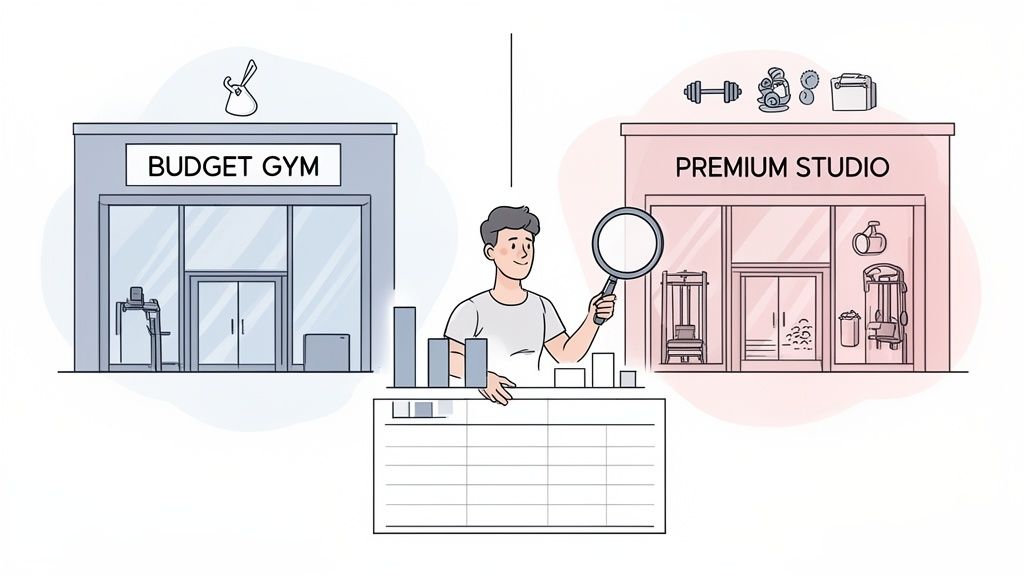
Ready to stop the pricing guesswork and start building a gym membership that practically sells itself? You're in the right place. This isn't just another guide about matching the gym's prices down the street. We're going to dive deep and build a powerhouse pricing strategy that pulls in new members and keeps them for the long haul.
Let's be real: simply looking at the monthly fee is a rookie mistake. True value is found by comparing the total annual cost—including all those sneaky initiation fees and annual maintenance charges—against the amenities and services your members actually care about. This is how you find the sweet spot, making your gym the best investment for their fitness goals, not just the cheapest option.
Your Ultimate Guide to Smart Gym Pricing
Alright, gym owners, let's get down to business. If you're ready to create a pricing structure that drives serious revenue and builds a loyal community, this is your playbook. We're moving beyond basic price comparisons and into the art of creating value-packed memberships that today's fitness lovers are actively searching for.

Our mission here is simple: arm you with the data and frameworks to design packages that don't just attract new sign-ups, but foster incredible loyalty. You'll learn how to break down what your competition is really offering, from their equipment and class schedules to the overall vibe of their community.
A pricing strategy isn't just about the numbers you put on a flyer. It's a direct reflection of your brand's promise. It screams to the world what members can expect and defines the value you're committed to delivering, day in and day out.
To start, let's get a handle on the common pricing models you'll see out there. Understanding these is your first big advantage when you start to compare gym prices in your area.
| Pricing Model | Best For | Key Advantage |
|---|---|---|
| Budget-Tier | High-volume gyms offering no-frills, basic access. | The low price point is a huge draw and captures a massive audience. |
| Mid-Range | Gyms that strike a balance between quality amenities and solid value. | This is the sweet spot for families and dedicated fitness enthusiasts. |
| Luxury/Premium | Creating an exclusive, high-end experience that feels like a club. | Superior service and top-tier amenities easily justify the high price tag. |
Building a Foundation for Success
Before you even think about a number, you need a rock-solid strategy. This goes way beyond peeking at your competitor's website. It means deeply understanding your own unique value, pinpointing your ideal member, and then crafting a price that meets—and exceeds—their expectations. One of the smartest moves you can make is gathering positive member feedback to back up any price adjustments. Learning how to get reviews before price rises is a pro-level tactic that builds incredible trust.
Let's build a pricing structure that works as hard as you and your members do. For more ideas on getting more eyes on your gym, check out our guide on SEO for fitness.
Cracking the Code on Fitness Pricing
Before you can nail your gym's pricing, you have to get the lay of the land. Think of the fitness market less like a flat playing field and more like a mountain range, with towering peaks and wide valleys. It’s shaped by massive global trends and the hyper-local habits of your potential members. Getting a handle on these forces is the absolute first step to pricing your memberships with real confidence.
What someone is willing to shell out for a gym membership can be wildly different from one city to the next, let alone from one country to another. This isn't random. It’s all about economics, cultural views on health, and how many other gyms are just down the street. By digging into these bigger patterns, you'll start to see exactly where your gym fits into the puzzle.
The real win isn't just about matching what the gym next door is charging. It's about understanding why some gyms can command a premium price while others pack the house with low-cost deals. That knowledge is your secret weapon.
Think about it: a trendy boutique studio in a high-end downtown neighborhood is playing a totally different game than a family-friendly gym in the suburbs. One is selling a luxury experience; the other is selling accessibility. Both can succeed, but their pricing has to reflect who they are and who they're for.
Global Benchmarks vs. Your Backyard
Looking at the worldwide data gives you an incredible starting point. The global fitness industry is a giant, worth over $96.7 billion, but that money is made in vastly different ways depending on where you are. For example, the average monthly gym membership floats around $58 globally, but the U.S. market alone pulls in a massive $35.03 billion a year. That absolutely dwarfs markets like Germany and the UK, which each bring in around $6.17 billion.
But here's where it gets interesting—revenue per gym flips the script. Gyms in China are on top, averaging a mind-boggling $2,232,032 per year! They're not just getting more members; they're mastering a different model of revenue efficiency built on higher per-member spending. You can dive into more of these eye-opening gym membership statistics and see just how powerful a data-first approach can be.
This data tells a story about what people want. Price is a huge deal—40% of members are actively hunting for plans under $25 a month. Yet, at the same time, the boutique fitness scene has exploded, with average prices hitting $90 monthly and a dedicated 13% of members happily paying over $100. This tells us there’s a big slice of the market that will pay top dollar for a specialized experience, a strong community, and real results. Your job is to figure out which crowd your gym is built for, so you can craft pricing that feels like a no-brainer to them.
A Practical Framework for Competitor Analysis
Alright, let's roll up our sleeves and build a rock-solid framework to really compare gym prices. To get the full story on your competition, you can't just skim their website. We need to gather some serious pricing intelligence—ethically, of course—to see exactly what your potential members are seeing.
Your mission, should you choose to accept it, is to collect data from every possible angle. Kick things off with a deep dive into their websites, noting every price, promotion, and membership tier they advertise. But don't stop there. Pick up the phone! A quick call asking about rates often uncovers hidden gems not listed online, like unadvertised specials or corporate deals.
The absolute best insights come from going undercover. A "secret shopper" visit lets you experience their entire sales process firsthand, from the tour to the final price pitch. You'll see any pressure tactics, special one-time offers, and get a real feel for their vibe.
This whole process gives you a mountain of raw data. The real magic, though, is in organizing it. We're going to turn that jumble of numbers into a clear, strategic map that tells a story.
Normalizing Competitor Pricing Data
Trying to compare a $25/month bare-bones plan to a $75/month all-access pass is like comparing apples and oranges. It just doesn't work. To make any sense of it, you have to break down every single offer into its core parts. We need to create a standardized system to evaluate every membership on an equal footing.
Keep an eye out for these key variables:
- Contract Length: Is it a flexible month-to-month plan, a 12-month commitment, or a paid-in-full annual deal?
- Upfront Fees: Document every single initiation, enrollment, or "key card" fee they charge.
- Annual Fees: Don't forget those sneaky yearly "maintenance" or "club enhancement" fees that quietly pump up the total cost.
Getting this level of detail is crucial because it allows you to calculate the Total Annual Cost for each competitor’s plan. That’s the only way to get a true side-by-side comparison. For a next-level analysis, knowing your ideal member is a game-changer; you can learn more by exploring different customer segmentation methods to see how pricing resonates with different groups.
Building Your Competitive Matrix
Once you've gathered and standardized all that data, it's time to bring it all together. A competitive matrix is your command center—a simple spreadsheet where you can see the entire local market at a glance. It's brilliant because it shows you not just what others charge, but how they position their value.
This is where you systematically collect and normalize pricing and feature data from your local competitors for a true apples-to-apples comparison.
Competitor Price and Feature Comparison Matrix
| Competitor Name | Base Monthly Price | Annual Contract Price | Initiation Fee | Key Amenities (Pool, Sauna, etc.) | Group Class Access | Personal Training Options | Overall Value Proposition |
|---|---|---|---|---|---|---|---|
| Example Gym A | $39.99 | $34.99/mo | $99 | Pool, Sauna | Included | Tiered Packages | Mid-range, family-friendly |
| Example Gym B | $24.99 | $19.99/mo | $49 | Basic Cardio/Weights | Add-on | À la carte sessions | Budget, no-frills |
| Example Gym C | $89.99 | $79.99/mo | $0 | Pool, Yoga Studio, Towels | Unlimited, premium classes | In-house trainers | Premium, boutique experience |
Laying it all out like this immediately highlights gaps in the market and opportunities for your own gym. You can instantly see who is competing on price, who is competing on features, and where you fit into the picture.
This flowchart really brings the whole strategy to life, showing how you move from a broad market overview to a sharp, localized analysis, and finally, to pricing that speaks directly to your ideal members.

This visualization hammers home the point that a winning strategy is built in layers. It ensures your final pricing is firmly grounded in both market realities and what your members actually want. Following this structured process will give you an undeniable strategic edge.
Alright, let's stop talking about a race to the bottom on price. That's a game you don't want to win. When you start comparing gym prices, it's easy to get sucked into that vortex, but let's reframe this entirely. Price is just a number. Value, on the other hand, is the entire experience you create.
To truly stand out, you have to stop obsessing over what you cost and start broadcasting what you're worth. This isn't just about the monthly fee. It's about digging deep and identifying every single thing that makes your gym the place to be.
Finding Your Secret Sauce
So, what are your non-negotiables? What do you do better than anyone else in a 10-mile radius? Maybe you’ve invested in specialized equipment that serious lifters dream about. Perhaps your coaches aren't just rep-counters; they're genuine mentors who build real, lasting relationships.
And don't overlook the "simple" things! Being known as the cleanest, most welcoming gym in town isn't a small thing—it's a massive differentiator. People will absolutely pay a premium for an environment that feels like a supportive, almost family-like community.
Connecting Your Value to the Right People
Once you’ve nailed down what makes you great, the real magic happens when you connect that value to the right members. This is where getting smart about your audience pays off big time. Not all members want the same thing, so your pricing shouldn't be a one-size-fits-all solution.
Think about who walks through your doors:
- The Young Professional: Their currency is time. 24/7 access, quick and dirty express classes, and a killer app for booking are features they’ll happily pay more for.
- The New Parent: Reliable childcare isn't just a nice-to-have; it's the only reason they can work out. Your amazing kids' club is their golden ticket.
- The Seasoned Athlete: They're on a mission. They'll seek you out—and pay a premium—for specific high-performance equipment and expert-level coaching.
Your Unique Value Proposition answers one simple, powerful question: "Why should someone choose my gym over every other option, regardless of the price?" Get this right, and you'll attract members who want the perfect fit, not just a cheap deal.
This is exactly how boutique studios crush it while charging premium fees. They don't try to appeal to everyone. Instead, they hyper-focus on one thing—like killer HIIT classes or a zen-like yoga experience—and create an atmosphere so valuable to that niche that a higher price tag feels completely justified. They are living proof that a superior experience is its own marketing.
And the numbers back this up. Sure, low-cost gyms are popular, but a huge slice of the market is willing to pay more for a better vibe. Recent data shows that while 40% of gym-goers look for plans under $25, boutique studios have seen a 66% year-over-year surge, with average prices hitting $90. You can dive into more of these gym membership pricing trends on Gymdesk.com.
This just proves that a crystal-clear value proposition can pull in high-paying, fiercely loyal members.
At the end of the day, when you compare gym prices, you’re really comparing what each gym stands for. Pinpoint what makes you unique and who you serve best. That's how you build a pricing strategy that brings in people who are thrilled to pay for an experience they simply can't find anywhere else.
Designing and Testing Your New Membership Tiers
Okay, this is where the magic happens. You've done the legwork, gathered all that juicy competitor data, and now it's time to turn that research into membership tiers so good they practically sell themselves! After you compare gym prices and really get a feel for your local market, the real fun begins. You’re not just picking numbers out of thin air; you’re building a pathway for your future members.

There’s some powerful psychology at play with tiered pricing, and it’s a proven winner. When you structure your memberships in a 'Good, Better, Best' format, you’re hitting different needs and budgets head-on. This makes it incredibly easy for prospects to find the "yes!" that feels right for them. It puts them in the driver's seat while you subtly steer them toward the best value.
Crafting Your Tiers
Let's get into the nitty-gritty of designing each level to boost both your member count and your bottom line. The secret is to create three distinct, compelling options that each have a clear job to do.
- The "Good" Tier (The Hook): Think of this as your irresistible entry point. It’s designed to snag price-sensitive people and get them through your doors. Keep it simple: basic gym access, maybe with limited hours or no group classes, priced just aggressively enough to knock the budget gyms out of the running.
- The "Better" Tier (The Sweet Spot): This is going to be your workhorse. For most people, this tier will be the no-brainer choice, offering the perfect mix of features and value. You'll want to include full gym access, all your awesome group classes, and maybe a small perk like a free monthly guest pass to sweeten the deal. Price it to be the undisputed best deal in town.
- The "Best" Tier (The Premium Experience): This one’s for your die-hards and high-achievers. It should include everything from the "Better" plan plus exclusive perks that make them feel like VIPs—think personal training discounts, unlimited guest passes, or access to that specialized equipment everyone’s eyeing.
A peek at global pricing psychology can give you a massive leg up. Gym price differences around the world reveal some serious strategic opportunities. While monthly averages often hover around $51-$58, some top-tier markets like the UAE see members paying an average of $779.99 annually! That shows you what’s possible.
Data tells us that 13% of members will happily pay $50-$74 a month, and another 6% will go for $75-$99. This is solid proof that a tiered model works. You can capture the entire market by offering a deal under the $25 mark to bring in volume, then upselling premium plans at $90 or more to members who crave the best equipment and services. For a deeper dive, check out these compelling fitness industry statistics that really drive these trends home.
Testing and Launching Your Prices
Whatever you do, don't just throw your new prices up on the wall and hope they stick. You need to test them! A/B testing is your best friend here. It's as simple as showing 50% of your new website visitors one set of prices and the other 50% a slightly different version. Watch the data and see which one converts better.
When it’s time to talk to your current members about price changes, frame it as an investment in their experience. Be totally transparent about the new equipment you've ordered, the extra classes you're adding, or the facility upgrades you're making. It’s all about the incredible value they’re getting.
To roll this out smoothly, craft some exciting and positive messaging. Nobody wants to hear "Our prices are going up." Instead, lead with something like, "Get ready for an upgraded gym experience!" This kind of positive spin builds excitement and helps maintain loyalty. If you're juggling different types of members, you might also find our guide on handling multiple gym memberships super helpful.
Using Cleanliness to Justify Your Pricing
When a potential member walks into your gym, they’re not just sizing up the squat racks. They’re subconsciously scanning the entire environment, and one thing that screams “premium” louder than anything else is cleanliness. A spotless, hygienic facility is a non-negotiable factor that instantly signals quality and justifies your price tag.
This isn’t just about looking good—it’s a powerful part of your gym’s story. A visibly clean space shows you’re committed to your members' health and well-being, which makes a higher membership fee feel like a smart investment. Let's be honest: nobody wants to work out in a grimy, sweaty space, and people will happily pay more for a gym that feels fresh and safe.
Elevate Your Standards with Clear Checklists
To truly make cleanliness a cornerstone of your brand, you need structured daily and weekly cleaning protocols. And don't keep them hidden! Making these checklists visible to members shows you’re serious about creating a top-tier environment.
- Daily High-Traffic Zones: Hammer the spots everyone touches. That means disinfecting reception desks, water fountains, door handles, and cardio machine touchscreens multiple times a day.
- Hourly Equipment Wipes: Have your team constantly making the rounds, wiping down strength machines, free weights, and benches. It shows you’re always on top of things.
- Pristine Locker Rooms: This is where you win or lose. The showers, floors, and sinks must be impeccable. A pristine locker room reinforces that premium feel from the moment they walk in to the moment they leave.
A sparkling facility creates an immediate perception of value. Many high-end gyms even bring in dedicated professional cleaning services to ensure they never miss a spot.
The real secret is making your commitment to hygiene visible. When members see your staff actively cleaning and can easily find sanitation supplies for themselves, it builds an incredible amount of trust. It makes your price point an easy decision.
Get your members involved, too! Empower them to be part of the solution by placing high-quality disinfectant wipes in easily accessible locations all around the gym. This simple addition gives members one more powerful reason to choose you and feel fantastic about the price they pay.
Got Questions About Your Gym's Pricing? Let's Get Them Answered.
Once you’ve done the hard work of comparing local gym prices and mapping out your strategy, a few questions always seem to surface. Let’s dive into the most common ones I hear from gym owners so you can move forward with total confidence.
How Often Should I Actually Check My Competitors' Prices?
The fitness industry isn't static, and neither should your pricing be. I always tell my clients to plan for a full-blown, deep-dive competitive analysis at least once a year.
That said, you can’t afford to be caught off guard. Get in the habit of doing quick market check-ins every quarter. This is especially crucial if a new studio opens up down the street or a local competitor runs a big promotion. Staying proactive like this is how you keep your edge.
What's the Single Biggest Pricing Mistake Gyms Make?
Easy. It's blindly matching or undercutting the gym next door.
Jumping into a race to the bottom is a surefire way to start a price war, and in a price war, nobody wins. It completely devalues your brand and the entire local fitness market. Instead of just looking at what others charge, anchor your prices in the actual value you provide. Your amazing coaches, your tight-knit community, your unique equipment—that's what members are really paying for.
Okay, But How Do I Tell My Members I'm Raising Prices?
This is all about transparency and timing. Don't spring it on them. Give everyone a generous heads-up, somewhere in the 60-90 day range, before the new rates kick in.
When you make the announcement, explain the why behind it. Frame it as a direct investment back into their experience. Are you getting new squat racks? Adding more class times? Upgrading the locker rooms? Tell them!
Here's a pro tip: To soften the blow, create a special "loyalty rate" for your existing members. Give them a chance to lock in their current rate for another year if they renew before the price change. It’s a fantastic way to reward their commitment and lock in your revenue.
Finally, you have to constantly prove your gym's worth. A sparkling clean facility is one of the most powerful, non-verbal ways to justify your price point every single day. Make sure your team is visibly wiping things down and keeping the place pristine. Encourage members to wipe down equipment after use. For a reliable, effective solution, we always recommend Wipes.com Disinfectant Wipes to keep everything spotless. You can find them over at www.wipes.com.
Leave a Reply