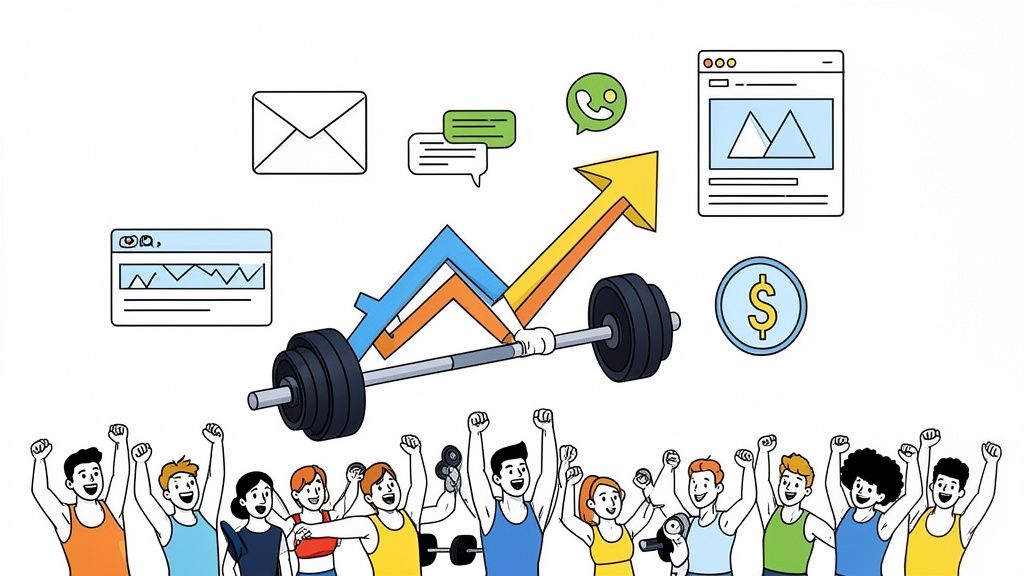
Let’s be honest—most gym marketing feels like throwing money at a wall and hoping something sticks. You put up a billboard, run a radio ad, or boost a post on social media and then… you wait. You hope people remember your gym's name when they finally decide to get in shape.
That's brand marketing. It's slow, expensive, and nearly impossible to track.
Direct response marketing is the complete opposite. It’s a powerful, action-oriented strategy designed to make someone do something right now. It’s not about building vague "awareness"; it's about getting a measurable result—a phone call, a form fill, or a new member walking through your door—from every single dollar you spend.
It’s the difference between hoping for new members and building a predictable system that brings them in on demand.
What Is Direct Response Marketing and Why It’s a Game-Changer for Gyms

Think about it this way: a generic billboard on the highway with your gym's logo is brand marketing. You have no idea who saw it, if they cared, or if it will ever lead to a sale. It’s a shot in the dark.
Now, picture a Facebook ad that pops up with a crystal-clear offer: "Free 7-Day All-Access Pass – Claim Yours Before We Run Out!" That’s direct response marketing. It has one job: to get an immediate, trackable action.
This approach is built for speed and total accountability. For gym owners, this is incredible news. You're no longer guessing if your marketing is actually working. You can see exactly which ads are driving new sign-ups and which are duds, allowing you to double down on what works and cut what doesn't. Your marketing budget stops being a mysterious expense and becomes a powerful, revenue-generating machine.
The Key Differences That Matter
The real magic is in the mindset shift. Brand marketing plays the long game, hoping to build recognition over time. Direct response marketing is all about getting an immediate return on your investment (ROI). Every single piece of a direct response campaign—from the ad copy to the button text—is engineered to persuade someone to act now.
Direct response isn’t just about making noise; it’s about making things happen. It’s marketing with a purpose, where every ad has a job to do and you can measure its performance in real-time.
For any fitness business, this approach is a total game-changer. Here’s why:
- You Can Actually Measure It: Finally, you can track exactly how many leads and new members each campaign brings in. No more guesswork.
- It Creates Predictable Growth: Once you know your numbers, you can build a reliable system for acquiring new clients month after month.
- You Can Laser-Target Your Audience: This strategy lets you speak directly to specific people in your local community with offers they can't refuse.
- You See an Immediate ROI: Campaigns are designed to bring in cash quickly, improving your cash flow and giving you more fuel to grow.
Direct Response Vs Brand Marketing for Gyms
To really see why this is such a big deal for gyms, let's put the two approaches head-to-head. The table below breaks down the crucial differences and shows why one is built for growth and the other is… well, not.
| Attribute | Direct Response Marketing | Brand Marketing |
|---|---|---|
| Primary Goal | Generate immediate leads and sales | Build long-term brand awareness and loyalty |
| Call-to-Action | Specific and urgent (e.g., "Sign Up Now") | Vague or non-existent (e.g., "Think of Us") |
| Measurement | Cost-per-lead, conversion rates, ROI | Impressions, reach, brand sentiment |
| Timeframe | Short-term and immediate results | Long-term and gradual impact |
| Budget Focus | Accountable spending with clear returns | Often viewed as an expense for future gain |
See the difference? By embracing a direct response mindset, you stop wasting money on fuzzy advertising and start investing in a system that directly grows your bottom line. It's hands-down the most effective way to pack your gym with new, fired-up members.
The Three Pillars of a High-Converting Gym Campaign

When you look at any gym that seems to be growing like crazy, it's never an accident. Their success is built on a few powerful, repeatable principles. A killer direct response marketing campaign isn't magic—it's a well-oiled machine built on three core pillars. Get these right, and you'll have a predictable way to pack your gym with new members.
Think of it like putting together the perfect workout plan. You need the right exercises (the offer), clear instructions on how to do them (the call-to-action), and a way to log your progress (the tracking). Miss one of these, and you’re just winging it, hoping for results that will never come.
Pillar 1: The Irresistible Offer
This is the absolute heart of your entire campaign. A truly irresistible offer isn’t some lame “10% off” discount. It’s a value-packed deal that makes your ideal prospect stop dead in their tracks and think, "Wow, I’d have to be insane to pass this up!"
The whole point is to obliterate any hesitation and give someone a rock-solid reason to walk through your doors today. You want to create something that feels less like a sales pitch and more like an unmissable opportunity.
Here are a few examples of offers that really pack a punch:
- The "21-Day Fitness Challenge": This creates a sense of community and a clear finish line for results, making it way more exciting than just another membership.
- The "Free Personal Training Kickstart Session": This is pure gold. It offers huge perceived value and gets a potential member personally invested with one of your trainers right away.
- The "Bring a Friend, Get a Month Free" Deal: This is brilliant because it taps into social proof and turns your happy members into your most effective sales team.
The secret is to frame your offer around a tangible benefit or an experience, not just a price slash. It’s about solving a problem they have right now.
Pillar 2: The Crystal-Clear Call-to-Action
Okay, so you’ve hooked them with an incredible offer. Now what? You have to tell them exactly what to do next. This is where the Call-to-Action (CTA) comes in, and it needs to be direct, urgent, and so simple a five-year-old could understand it. Weak phrases like "Learn More" are the enemy here.
Your CTA is your command. It needs strong, action-oriented language that gives your prospect that final nudge they need to commit.
A great CTA removes all friction and guesswork. It should be so obvious that the prospect doesn't even have to think; they just act.
For example, instead of a boring "Contact Us," use CTAs that scream value and are tied directly to your offer:
- "Claim Your Free Pass Now!"
- "Book Your Kickstart Session"
- "Start Your 21-Day Challenge Today!"
See how each one connects right back to the offer? That clarity is what drives the immediate action you’re looking for. Sprinkle in a little urgency—like "Offer ends Friday!" or "Only 15 spots left"—and you've got a recipe for conversions.
Pillar 3: Seamless Tracking and Measurement
This is what separates the pros from the amateurs. If you can't measure your marketing, you can't make it better. It's that simple. In direct response, every single ad, postcard, and email has to be trackable so you know with 100% certainty where your new sign-ups are coming from.
Don't worry, tracking isn't some complex, tech-heavy nightmare. It’s really just about creating a clean line of sight from your ad straight to your front desk.
Here are a few super simple ways to do it:
- Unique Promo Codes: Just assign a different code to each campaign. Think "FACEBOOK20" for your Facebook ads and "MAILER20" for that postcard you sent out.
- Dedicated Landing Pages: Send traffic from a specific ad directly to its own unique webpage. Easy.
- Trackable Phone Numbers: Use a service to get unique phone numbers for different ads. Now you'll know which ones are actually making your phone ring.
- QR Codes: These are perfect for flyers and posters. A quick scan can take someone right to your sign-up page, giving you instant, clean data.
When you put these in place, you can finally answer the most important question: "What marketing is actually making me money?" This data is power. It lets you kill the campaigns that are wasting your budget and pour gasoline on the ones that are delivering a real, measurable return.
Your Direct Response Channel Playbook for Maximum Reach
Okay, you've got the core principles of direct response down. Now for the fun part: putting them to work. Think of choosing your marketing channels like picking the right tool for the job at your gym. A dumbbell isn't a treadmill, and an email isn't a Facebook ad. Each one serves a specific purpose.
This playbook is all about matching the right channel to your offer to get people through your doors—fast. The real secret sauce is mixing and matching these channels. When you do it right, you create a marketing machine that finds potential members wherever they hang out and turns them into paying customers. Let's get into it.
Hyper-Targeted Social Media Ads
Facebook and Instagram are absolute goldmines for gym owners. I'm serious. The reason is simple: you can get ridiculously specific with who sees your ads. We're talking about targeting people within a five-mile radius of your front door who have already shown an interest in things like fitness, CrossFit, or yoga.
Picture this: you're running an ad for your "21-Day Fitness Challenge." You can set it up so it only shows up for women aged 25-45 who live in your neighborhood. That’s not just shouting into the void; it's a precision strike. When you combine a killer offer with targeting that sharp, you're only spending money to reach the people most likely to sign up. Your ad spend goes way down, and your results go way up.
SMS and Email Marketing
When you have someone's email address or phone number, you have a direct line to them. This is where you nurture the people who are already warm—maybe they downloaded a free guide or tried a drop-in class. For them, SMS and email are your go-to tools for urgent, can't-miss promotions.
An email list is one of the most valuable assets your gym can own. Unlike social media followers, this is a list of people who have explicitly given you permission to contact them directly.
Imagine sending a quick text blast about a "flash sale" on personal training packages. You could literally fill your trainers' schedules in a matter of hours. Email is perfect for playing the slightly longer game, sending out valuable content like workout tips before you hit them with an irresistible introductory offer. Building that audience is critical, which is why you need to read our guide on how to build an email list.
Local PPC and Search Ads
What happens when someone in your town pulls out their phone and types "gyms near me" or "best spin classes in [Your Town]" into Google? They're ready to buy. Right now. Local Pay-Per-Click (PPC) ads put your gym right at the very top of those search results, grabbing their attention at the exact moment they’re looking for you.
This is direct response marketing at its absolute purest. You're not trying to create demand out of thin air; you're capturing it. By bidding on keywords specific to your town, you can send super-motivated people to a landing page with a clear, compelling offer. It’s the straightest line from a Google search to a new member swiping their key fob.
Direct Mail in a Digital World
Don't laugh—direct mail is making a huge comeback. Why? Because our email inboxes are a dumpster fire of spam and our social feeds are an endless scroll. A high-quality, physical piece of mail actually stands out now. It's something you can hold, and it feels way more personal.
A well-designed postcard with a powerful offer and a QR code that sends them to your sign-up page can cut through all that digital noise and land directly in the hands of local households.
The numbers don't lie. The direct mail industry is on track to hit $69.37 billion, and that's because it works. Direct mail gets 5-9 times higher response rates than email or social media. And when you mix it with digital (like a QR code), those responses can jump by another 118%.
And for gyms really looking to make a splash, don't forget about broader channels. Things like TV advertising specifically for gyms can feel old-school, but when you pair that wide reach with a direct response offer, you can drive a massive wave of awareness and action.
Crafting Irresistible Offers That Pack Your Gym
Let's get one thing straight: if your marketing campaign is a high-performance engine, then your offer is the rocket fuel. You can have the slickest ads in the world, but with a weak, forgettable offer, that engine is going to sputter and die. A truly irresistible offer, on the other hand, is what makes people stop scrolling, grab their wallet, and sign up on the spot.
The goal isn't just to slap a discount on a membership and call it a day. It’s about creating a value proposition so powerful, so compelling, that your ideal customer feels like they'd be a fool to pass it up. You want to craft a deal that solves a real problem, removes all the risk, and gets people genuinely excited to walk through your doors.
Winning Offer Ideas That Actually Work
Forget those boring "10% off" deals that just blend into the noise. To really pack your gym, your offers have to be specific, benefit-driven, and have a ticking clock attached. The best ones aren't just selling access; they're selling an experience and a taste of the results people are desperately searching for.
Here are a few proven concepts that consistently bring in new members:
- The Free 7-Day Class Pass: This is a classic for a reason. It's a super low-commitment way for someone to test the waters, but it gives you a full week to blow them away with your gym's community, your amazing trainers, and the electric energy on the floor. The trick is to treat them like a paying member from the second they walk in.
- The 6-Week Transformation Challenge: This is pure marketing gold. You're packaging your services into a results-focused program with a clear beginning and end. This creates a massive sense of urgency and is an absolute magnet for people who want a specific outcome, like losing weight or building strength for summer.
- The "Bring-A-Friend for a Free Month" Program: Want to turn your happiest members into your most passionate sales team? This is how you do it. This offer taps into social proof and word-of-mouth—the single most trusted form of advertising out there.
- The "Founder's Rate" Special: This is the perfect play for a grand opening or a major expansion. You create an exclusive, members-only vibe and reward your earliest supporters with a special lifetime rate. It's a phenomenal way to build a loyal, foundational community right from the start.
The Secret Sauce: Urgency and Scarcity
An amazing offer is great, but it needs a catalyst—something to push people over the edge. That's where urgency and scarcity come in. These psychological triggers are the cornerstones of direct response marketing because they obliterate procrastination and force people to take action now.
Without a reason to act immediately, even the most incredible offers get bookmarked for "later"—which, let's be honest, usually means never. Adding a deadline or a limit is the final nudge people need to commit.
And the best part? It's incredibly easy to build these triggers into any offer you create:
- Time-Based Urgency: "This offer is gone for good this Friday at midnight!"
- Quantity-Based Scarcity: "We're only accepting the first 50 people for this challenge!"
- Event-Based Urgency: "Sign up before our Grand Opening to lock in this one-time-only rate!"
This simple tweak transforms a passive "nice to have" offer into an active "must have" one, and you'll see your conversion rates skyrocket.
Matching the Right Offer to Your Goal
Not all offers are created equal, and one size definitely doesn't fit all. The offer you choose needs to line up perfectly with your campaign's main goal. Are you trying to generate a flood of new leads to nurture? Or do you need to drive immediate sales and boost revenue this month? Maybe you're trying to win back old members who have disappeared.
Each goal demands a different tool for the job.
| Campaign Goal | Recommended Offer Type | Why It Works |
|---|---|---|
| Lead Generation | Free 7-Day Pass or a Free PT Session | It’s a low-risk entry point that lets you collect contact info for your follow-up machine. |
| Immediate Sales | 6-Week Transformation Challenge | This is a higher-commitment, results-driven program that generates upfront revenue. |
| Reactivation | "We Miss You" Special Offer | It makes past members feel seen and gives them an exclusive deal to come back. |
When it comes to actually reaching these prospects, don’t sleep on physical mail. While everyone is fighting for attention in crowded digital inboxes, direct mail is quietly crushing it with 80-90% open rates. In fact, a stunning 84% of marketers agree it delivers the highest ROI, averaging 35% and in some cases hitting 112%—beating out both SMS (102%) and email (93%).
Oversized envelopes and eye-catching postcards demand attention. And with 92% of millennials making purchases based on direct mail they receive, it's a proven channel for getting people to take action. You can discover more insights about these direct mail statistics and see how they can fuel your gym's growth.
By thoughtfully picking the right offer and pairing it with a powerful, trackable channel, you start building a true direct response machine designed for one thing: results.
Measure What Matters to Track Your Success
In the world of direct response marketing, if you can't measure it, it didn't happen. Data isn't just a nice-to-have; it's your superpower. It's the only way to know with absolute certainty which of your campaigns are packing your gym and which are just burning cash.
This isn't about getting lost in complicated spreadsheets—it's about focusing on a few key numbers that tell you the whole story. You stop guessing and start knowing. Every dollar you spend should have a job, and tracking is how you hold it accountable. This shift in mindset transforms your marketing budget from a hopeful expense into a predictable, revenue-generating investment.
The Essential Metrics for Your Gym
Forget about vanity metrics like "likes" or "impressions." They feel good, but they don't pay the bills. Instead, we need to zero in on the key performance indicators (KPIs) that directly impact your bottom line. These are the numbers that truly matter.
Here are the four most important metrics for any gym's direct response campaign:
- Cost Per Lead (CPL): This tells you exactly how much it costs to get one person to raise their hand and show interest, like filling out a "Free 7-Day Pass" form.
- Cost Per Acquisition (CPA): This is the big one. It's the total cost to get a brand-new, paying member. Knowing this number is the key to scalable growth.
- Conversion Rate: This is the percentage of leads who become paying members. A high conversion rate means your offer and your sales process are perfectly aligned.
- Return on Ad Spend (ROAS): This is the ultimate report card for your marketing. For every dollar you put into ads, how many dollars in revenue did you get back?
To accurately assess the profitability and impact of your direct response efforts, it's essential to understand how to calculate marketing ROI and see the real-world effect of your spending.
Simple Tracking Methods That Work
The magic of direct response is attributing every new member to the specific ad that brought them in. This is how you eliminate guesswork and make data-driven decisions that fuel real growth for your gym.
The goal is to create a clean, unbroken line from the first moment a prospect sees your ad to the moment they swipe their new key fob.
Thankfully, you don't need a complex tech stack to make this happen. Here are a few simple but powerful methods:
- Unique Promo Codes: Assign a different code to each channel (e.g., "FB20" for Facebook, "MAILER20" for a postcard).
- Dedicated Landing Pages: Create a unique webpage for each specific campaign to track traffic and sign-ups.
- Call Tracking Numbers: Use services that provide unique phone numbers for different ads to see which ones make your phone ring.
These simple tools give you crystal-clear attribution. Once you can confidently measure your ROAS, you can strategically scale your budget. For a deeper dive into this crucial metric, check out our guide on how to calculate return on investment for your campaigns.
Direct response marketing’s resurgence offers a massive advantage amid digital fatigue, especially with proven channels like direct mail. Recent data shows 61% of marketers increased their direct mail investments, with campaigns blending mail and digital proving 400% more effective. Given that younger audiences trust mail—with 82% millennial trust—it's a powerful, trackable tool for membership sales. Discover more insights about direct mail’s impressive ROI and how it can benefit your gym.
Launch Your First Direct Response Campaign Blueprint
Alright, you've got the core principles down, you've seen the powerhouse offers, and you know which numbers matter. Now for the fun part: putting it all together and launching your very first campaign. This seven-step blueprint is your roadmap to turning all that knowledge into real, tangible results for your gym.
Think of this as your personal training plan for marketing. Stick to the program, and you'll build the muscle you need to create a predictable, member-generating machine.
Step 1: Define a Single, Crystal-Clear Objective
Before you even think about writing an ad, you need to know exactly what you're aiming for. Vague goals like "get more members" are a complete waste of time in direct response. You need something specific, measurable, and time-bound to guide every single decision.
A powerful objective looks like this: "Get 20 new trial sign-ups in the next 14 days."
This clarity is everything. It instantly tells you who to target, what kind of offer will work, and how you’ll know if you’ve won.
Step 2: Identify Your Target Audience
You can't talk to everyone, so don't even try. The magic of a killer direct response campaign is speaking directly to a specific group of people who are dying to hear your message. The more you zero in on your audience, the more your ad will feel like it was written just for them.
Get super specific with your targeting. Forget "people who want to get fit." Instead, dial it in to something like: "Females aged 25-40 who live within a 5-mile radius of the gym and have shown an interest in yoga or group fitness."
Boom. Now you have a real person in mind, which makes the next step a thousand times easier.
Step 3: Craft the Perfect Offer and CTA
With your objective and audience locked in, it’s time to create an offer they simply can’t refuse. This is the heart and soul of your campaign. Remember the formula: high value, low risk, and a dash of genuine urgency.
- The Offer: "Free 7-Day All-Access Class Pass"
- The CTA: "Claim Your Free Pass Now – Only 30 Available This Week!"
This combination is electric. It gives your ideal prospect a chance to experience your gym's true value with zero financial risk, while the limited availability nudges them to take action right now.
Step 4: Choose Your Primary Channel
So, where does your target audience hang out online? For our example of local women aged 25-40, Facebook and Instagram Ads are a perfect match. The targeting tools on these platforms are so powerful you can place your irresistible offer directly in front of the exact people you want to reach.
For a deeper dive into channel strategies, check out our complete guide on direct response advertising.
Step 5: Set Up Simple, Foolproof Tracking
This step is completely non-negotiable. If you can't track where every lead and new member comes from, you're just guessing. For a Facebook Ad campaign, this is incredibly straightforward.
Create a dedicated landing page on your website just for this offer. All your ad clicks will go to this one page, where people fill out a simple form to claim their pass. This isolates all your campaign traffic and makes it dead simple to measure conversions.
The flow below shows exactly how you can track your ad's performance from the initial click all the way to a paying member.

This process proves that every ad should lead to a trackable action (a lead). That lead can then be converted into a new member, allowing you to measure the exact return on every dollar you spend.
Step 6: Launch and Monitor
With all your pieces in place, it's go-time. Hit that launch button! But your job isn't over yet. For the first few days, keep a close eye on your campaign. Are people clicking? Are they actually filling out the form? Watching these early signs will tell you if your message is hitting the mark.
Step 7: Analyze the Results and Plan Your Next Move
Once your 14-day campaign wraps up, it’s time to open the books. How many trial sign-ups did you actually get? What was your Cost Per Lead? By digging into this data, you’ll uncover what worked and what didn't.
These insights are pure gold, giving you everything you need to make your next direct response marketing campaign an even bigger success.
Don't Forget: A Clean Gym is Your Best Marketing Tool
Alright, so your direct response campaigns are crushing it. You've got a wave of new faces walking through the door, excited to get started. What's next? Keeping them.
Think about it: nothing kills that new-member high faster than a grimy dumbbell or a sticky treadmill screen. A spotless, sanitary gym isn't just a basic expectation anymore—it's a powerful statement. It tells every single person that you care about their health and that their membership is worth every penny.
Make Cleanliness a Daily Ritual
This isn't something you can delegate and forget. It has to be baked into your daily operations. Your team's non-negotiable, end-of-day checklist must include a thorough wipe-down of every single high-touch surface. We're talking free weights, machine handles, cardio touchscreens, water fountains, and every bench in the locker room.
When members see you cleaning, it builds an incredible amount of trust.
The Easiest Way to Keep Things Fresh
For a super effective, no-fuss solution, we're big fans of Wipes.com Disinfectant Wipes.
Honestly, they're a game-changer. You can place dispensers all over the gym floor, making it ridiculously easy for both your staff and members to give equipment a quick wipe before and after use. It’s a simple, visible cue that says, "We keep this place clean for you."
At the end of the day, all your brilliant marketing promises have to be backed up by the real-world experience. A clean gym is a healthy gym, and a healthy gym is one people will rave about to their friends.
Leave a Reply