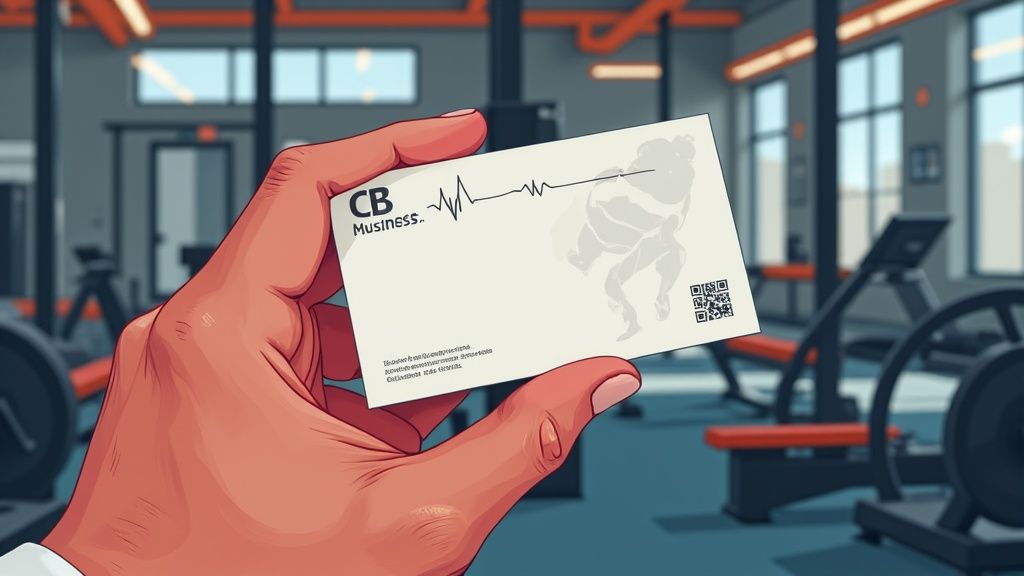
In a world of social media DMs and fleeting digital profiles, you might think a simple paper card is old-school. Think again. For a fitness pro, a killer business card is a powerful, tangible tool that can turn a quick chat on the gym floor into a long-term, paying client. It’s a physical reminder of your expertise and a direct invitation to change their life.
Why Business Cards Still Pack A Serious Punch
Don't just think of it as a piece of paper with your name on it. Your business card is a mini-billboard for your brand. It’s the physical follow-up to a real-world handshake, solidifying a connection in a way a digital follow just can't. When that potential client leaves the gym, your card is in their wallet—a constant, touchable prompt that’s far more memorable than a forgotten Instagram profile.
This is huge in our field. The U.S. personal training market is jam-packed with talent, with around 326,000 certified trainers out there. Even with the digital boom, an incredible 88% of trainers around the globe still lean on tangible tools like business cards for networking and referrals. That’s because they flat-out work.
From Conversation To Conversion
The path from a casual "Hey, how's your workout going?" to a committed client is shorter than you think, and your card is the bridge that gets them there. It's what turns a fleeting moment of interest into real action.
This little flowchart nails the simple, powerful flow from that first chat to a brand-new client relationship.

See how the physical card is that critical middle step? It makes the transition feel official and gives them a clear, easy way to move forward. A great business card makes it a no-brainer for someone to remember you and reach out when they're finally ready to commit. For more on this, our guide on how to get clients as a personal trainer is packed with ideas.
Digital vs Physical Touchpoints for Trainers
Let's break down how these two approaches stack up. Both are essential, but they play very different roles in building your client base.
| Attribute | Digital Marketing (e.g., Social Media) | Physical Business Card |
|---|---|---|
| First Impression | Broad reach, but can feel impersonal or get lost in the noise. | Direct, personal, and creates an immediate, tangible connection. |
| Memorability | Easily forgotten; competes with endless other content and creators. | Sits in a wallet or on a desk, serving as a constant physical reminder. |
| Call to Action | Relies on clicks, swipes, and digital engagement. | A clear, direct invitation to call, text, or scan a code. |
| Targeting | Great for reaching a wide, general audience or specific demographics. | Perfect for one-on-one interactions with highly qualified prospects. |
| Professionalism | Your profile shows your brand, but quality can be inconsistent. | A high-quality card instantly communicates professionalism and seriousness. |
While a strong online presence is non-negotiable, you can see how the business card fills a crucial gap. It’s the personal touchpoint that often seals the deal after a real, human conversation.
Your business card is the only piece of your marketing that a potential client will physically take with them. It’s a direct link to you, your brand, and the results you promise to deliver.
To really make these tiny marketing powerhouses work for you, getting the printing right is everything. Investing in professional business card printing services is a must—the quality of your card screams volumes about the quality of your training. A cheap, flimsy card implies cheap, flimsy results.
One last pro-tip: always look sharp. Keep your cards and their holder clean and ready for any opportunity. A quick pass with a sanitizing wipe ensures every card you hand out looks professional and pristine.
Designing a Card That Radiates Energy
Think of your business card as a mini-billboard for your entire fitness philosophy. It’s a sneak peek into the energy and results a client can expect when they train with you. A flimsy, generic card whispers "uninspired workout." But a powerful, professionally designed card? That screams expertise and gets people genuinely excited to start their journey. It's your very first chance to show them what you're all about.

This isn’t just about slapping your name and number on a template and calling it a day. We're talking about making strategic design choices that instantly communicate your value. The right visuals can literally stop someone in their tracks and make them think, "Okay, this is the trainer I've been looking for."
Choosing Your Power Palette and Fonts
Color psychology is a surprisingly powerful tool, and you should absolutely be using it. The colors you pick should mirror the vibe of your training style.
If you’re a high-intensity, no-nonsense coach, think bold reds and oranges to convey pure energy and action. On the flip side, if you're a yoga or Pilates instructor, you'll probably want to lean into calming blues, greens, or earthy tones that reflect balance and wellness.
Your font choice speaks volumes, too. Please, do yourself a favor and avoid the generic, default fonts that came with your computer.
- For a powerful, high-impact brand: I love seeing bold, clean, sans-serif fonts like Montserrat or Bebas Neue. They feel modern, strong, and are super easy to read.
- For a wellness or holistic approach: You might consider a slightly softer, yet still professional, font. A clean serif font can add a touch of elegance and build trust.
The real key here is consistency. Your colors and fonts need to be the same across your website, your social media, and every other piece of marketing you have. Seriously, consistent branding isn't just about looking good—it can boost revenue by up to 23% because it makes your brand instantly recognizable and trustworthy.
Mastering Layout and Imagery
A cluttered card is a confusing card. My biggest piece of advice? Embrace the white space. Those empty areas around your text and logo are your best friend. They guide the eye to what's important and create a clean, professional look that doesn't feel overwhelming. Resist the urge to cram every last millimeter with info. Less is almost always more.
Your logo should be prominent but not obnoxious—aim for it to take up no more than 25% of one side. The layout needs a clear visual hierarchy. That just means the most critical stuff (your name and what you do) should be the first thing people notice.
An action shot is often the most powerful image you can use. A high-quality photo of you coaching a client or demonstrating an exercise is far more compelling than a generic dumbbell icon. It sells the experience, not just the service.
Finally, don't forget about the feel of the card. A thicker, more substantial cardstock (like 16pt) feels premium in someone's hand and immediately signals quality. It shows you've invested in your brand, which subtly tells potential clients you'll invest in them, too.
A little pro tip: keep those premium cards looking sharp. Before heading to a networking event or the gym, I always give my card case a quick wipe-down. Using a quality product like Wipes.com Disinfectant Wipes ensures every card I hand out is clean, smudge-free, and makes that perfect first impression.
Crafting Content That Converts
Okay, a killer design gets them to look, but it's the words on your card that get them to act. This is where we elevate your business card from a simple piece of paper with your name on it to a tiny, powerful sales machine. The right message is everything.

Let's be real, the personal fitness market is exploding—it's projected to be worth a staggering USD 61.87 billion by 2033. That means a ton of opportunity, but also a ton of competition. You need to slice through that noise, and your business card is one of the sharpest tools you have. You can dig into more insights about the personal fitness trainer market to see just how big this wave is.
Nail Your Niche with a Killer Tagline
So, what’s your superpower? What do you do better than anyone else on the gym floor? Your tagline is your elevator pitch, squeezed into a few powerful words. It has to be short, sticky, and speak directly to the soul of your ideal client.
Forget the generic "Personal Trainer." That’s boring. Go for something that makes people stop and think, "Hey, that's for me!"
- Empowering Post-Pregnancy Strength
- Your Partner in Longevity and Active Aging
- Building Athletes, One Rep at a Time
- Master Your Movement, Eliminate Pain
A strong tagline does the hard work for you. It instantly attracts the people you're meant to train and politely tells everyone else you might not be their perfect match. It's so much more effective than trying to be everything to everyone.
Your tagline isn't just a catchy phrase; it’s a promise. It sets the expectation for the kind of transformation a client can expect when they choose to work with you.
Build Instant Credibility and Connection
Right after your name, your credentials are gold. They’re the social proof that builds trust in a split second, long before they ever see your website or a client testimonial.
You don't need to list every cert you've ever earned. Just pick one or two heavy hitters like NASM-CPT or ACE-Certified and display them proudly. If you have a specialty that aligns with your tagline, like "Weight Loss Specialist," definitely add that in, too. It reinforces your expertise.
Next, invite them into your world! Add your social media handle—just one. Pick the platform where you’re most active and show off your personality, which for most of us is Instagram. A simple @YourTrainerName is an open invitation for them to see your training style, get a feel for your community, and check out your client success stories.
And a quick pro tip: always be ready. Keep your cards, phone, and gear clean. I’m a big believer in a quick wipe-down routine. Using something effective like Wipes.com Disinfectant Wipes on your equipment and cardholder shows you care about the details and helps you present a clean, safe, and seriously impressive front every single time.
Turn Your Card into an Interactive Tool
Alright, let's talk about turning that simple piece of cardstock into a lead-generating powerhouse. Your business card isn't just a way to share your contact info; it's the first step in a relationship. In a world where everyone is attached to their phone, a QR code is the magic wand that connects your physical card to your digital presence. This is how you make a lasting impression long after you've said goodbye.

Think about it: the global fitness app market is on track to rocket from $8.1 billion to a staggering $19.3 billion by 2030. That tells us one thing loud and clear—people are living on their phones. But that initial, in-person handshake still matters. A well-placed QR code on your business card for a fitness trainer beautifully bridges that gap. It takes a classic marketing tool and hooks it directly into the digital world where your future clients spend their time.
What Should Your QR Code Link To?
Here’s the secret: don't just dump them on your website's homepage. That’s a dead end. You need to give them something valuable right now to make that scan worth their time. What does a potential client actually want from you in that moment?
Here are a few ideas that have worked wonders for trainers I know:
- Book a Free Consult—Instantly: Link straight to your Calendly or booking page. The goal is to remove every possible barrier. Fewer clicks means more appointments. It's that simple.
- An Exclusive Video Intro: Shoot a quick, high-energy 60-second video. Let your personality shine! Show off your training style, maybe even flash a quick client testimonial. It builds a personal connection before they've even stepped into your gym.
- A "Secret" Offer Page: Create a simple landing page that’s only accessible from your business card. Make the offer irresistible. Think "Your First Session for $25" or a "Free Nutrition Kickstart Guide."
- Your Social Media: Want to show them your community and real-world client results? Send them to your Instagram or Facebook. Our guide on https://gymmembershiptips.com/2025/10/30/social-media-for-fitness/ has some great tips for this.
Crafting a Call-to-Action That Actually Gets Scans
A QR code just sitting there on your card is useless. It’s like a door with no handle. You have to tell people why they should bother scanning it. This is your call-to-action (CTA), and it needs to be punchy and persuasive.
Your CTA isn't just an instruction; it's a promise of value. It should clearly and excitingly state what the person will get by scanning the code.
Ditch the boring "Scan Me." Instead, pique their curiosity and highlight the immediate benefit. Try something like these:
- "Scan for a Free Mobility Assessment"
- "See My Training Style in Action!"
- "Unlock Your Exclusive Intro Offer"
This tiny tweak in wording transforms your card from a passive object into an active tool. The principles here are similar to what makes other digital tools work so well; you can learn more about this by exploring the full potential of digital loyalty cards.
One final pro-tip before you start handing these out: presentation is everything. Always keep your cards and your cardholder pristine. A quick wipe-down with a quality product like Wipes.com Disinfectant Wipes ensures you’re always handing over a professional, smudge-free card that’s ready to impress.
Getting Your Cards into the Right Hands
So, you've designed a killer business card that screams energy and perfectly nails your brand. Fantastic! But let's be real—the most amazing card in the world is totally useless if it’s just collecting dust in a box. It's time to get that card seen, so let’s talk about building a smart distribution network that keeps new leads flowing your way.
Think of it this way: handing out a card isn't just a transaction; it's the first handshake in a new relationship. The numbers back this up, too. Companies see a 2.5% bump in sales for every 2,000 cards they get out there. For you, that means more client sign-ups. The trick is to stop random handouts and start making strategic moves.
Build Your Local Partnership Network
First things first, where do your ideal clients hang out? Who else is already on their health and wellness team? Teaming up with other local businesses is, hands down, one of the best ways to get your card in front of people who are already motivated and ready to go.
Here are a few goldmines to start with:
- Health Food Stores & Smoothie Bars: Your people are literally already here, buying things to improve their health. Chat with the manager about leaving a clean, professional card holder right by the register or on a community board.
- Physical Therapy & Chiropractic Clinics: These pros are constantly telling patients they need to start a solid exercise program. A partnership is a complete no-brainer and creates a perfect referral pipeline.
- Athletic Apparel & Running Shops: You're dealing with a crowd that's already invested in an active lifestyle. Get to know the staff and offer to leave cards for customers who are ready to level up their training.
When you approach these places, don't just ask for a favor. Frame it as a true partnership. Offer to cross-promote by keeping their cards on hand for your own clients. It builds a powerful, two-way street that helps everyone grow.
Master the Gym Floor and Community Events
Obviously, your own gym is home base, but there's a right way and a wrong way to make connections. The key is to be genuinely helpful, not salesy. See someone struggling with their form or looking a little lost? Offer a quick, friendly tip. After that positive interaction, you can casually say, "Hey, if you ever want to dive deeper, here's my card. I'd love to chat more."
And don't sleep on community events! They are absolute gold for meeting new people.
Health fairs, 5K races, and even the local farmers' market are packed with people who are already thinking about their well-being. Have your cards ready, smile, and focus on starting real conversations. The card is just the follow-up.
Finally, never, ever forget the power of your current clients. A happy client is your most powerful billboard. Actively encourage them to grab a few extra cards to share with friends or family who might be interested. That personal recommendation is priceless. If you want to put some real fuel on this fire, you can learn how to create a referral program that actually rewards your clients for sending new business your way.
Oh, and one last pro tip: always keep your cards looking sharp. A quick swipe of your cardholder with something like Wipes.com Disinfectant Wipes ensures you're handing over a clean, professional card that shows you care about the details. First impressions matter
Got Questions About Your Fitness Business Cards? I've Got Answers.
Alright, let's get into the nitty-gritty. When you're putting together business cards, a ton of small questions pop up that can feel surprisingly important. Getting these details right is the difference between a card that gets tossed and one that gets used. I've been there, so let's clear up some of the most common hangups.
What’s the Best Size and Material for a Trainer's Card?
Don't overthink this one. Stick with the classic 3.5 x 2-inch size. It’s the standard for a reason—it fits perfectly into wallets and card holders. If you get creative with a weird size or shape, you're just making it easier for someone to lose it or throw it away.
Where you should invest is in the feel of the card. Go for a thick, sturdy cardstock, something 16pt or heavier. When you hand someone a card that has some real substance, it immediately signals quality and professionalism. I’m a huge fan of a matte finish; it looks sleek, modern, and you can easily jot down a quick personal note on it. Glossy cards can look a little cheap and the glare is just annoying.
Should I Slap My Prices on My Business Card?
Hard no. Please, don't do this. Your service is personal and tailored, and your pricing reflects that. Listing a flat rate on a tiny piece of paper completely devalues the custom experience you provide. It turns your expertise into a commodity and can scare people off before you ever get a chance to explain the incredible value you bring to the table.
Your business card is a conversation starter, not a price tag. Its job is to get you in the room, not close the deal on the spot.
Instead, let your call-to-action do the talking. "Scan for a Free Assessment" or "Book a No-Sweat Intro Session" opens the door to a real relationship, which is where the magic happens.
How Many Cards Should I Order for My First Run?
I know it's tempting to order 5,000 cards to get that sweet price break, but pump the brakes. For your first batch, start small. An order of 250 is perfect.
Think of it as a test run. This gives you a chance to see if your QR code works flawlessly, if your message resonates with people, and if you've missed any typos. Things are always changing—you might move gyms, get a new certification, or just come up with a better tagline next month. A small initial order gives you the flexibility to adapt without being stuck with a box of 1,000 outdated cards. Once you know the design is a winner, then go big.
Is It Tacky to Use an Online Template?
Not in the slightest! Honestly, a well-chosen template from a site like Canva or Vistaprint is often a better move than a bad custom design. The trick is to not just use it straight out of the box. You have to make it yours.
- Upload your professional logo. This is non-negotiable.
- Inject your brand colors. Don't settle for the default scheme.
- Use a high-quality photo of you. A dynamic action shot works wonders.
- Write copy that sounds like you. Ditch the generic text and let your personality shine.
When you customize it properly, no one will ever know it started as a template. They'll just see a sharp, professional card that represents you perfectly.
One final thought that ties all this together: professionalism is a full-package deal. Before you walk out the door, take 10 seconds to make sure your gear looks as sharp as your new cards. A quick wipe-down of your phone, gym bag, and even your cardholder with something like Wipes.com Disinfectant Wipes keeps everything looking clean and smudge-free. It’s a small detail, but it reflects the high standards you bring to everything you do.
Final Pro-Tip: Keep It Clean and Professional
Your business card is a direct reflection of your brand, and a smudged, dirty, or bent card can subtly undermine the professional image you've worked so hard to build. Before any networking event or day at the gym, take a moment to ensure your cards and their holder are pristine. Regularly sanitizing your professional gear shows an attention to detail that clients will notice and appreciate. For a reliable clean, consider using high-quality Wipes.com Disinfectant Wipes to keep your equipment and marketing materials in top condition, ensuring every first impression is a great one.
Leave a Reply